Body Contouring
Is Liposuction Safe for You? Volume Limits, Real Risks and What Sets the Cost
For a healthy adult near a stable weight, liposuction is generally safe when the volume per session stays moderate and a dedicated specialist runs the anesthesia. Volume, health and the flight home drive the risk.
Send your concern and a front and side photo. Replies in English, no obligation.
In this article
- 01Why does the amount removed matter more than the method?
- 02Who should wait, or skip liposuction altogether?
- 03A doctor at home said no. Does that change in Seoul?
- 04Contour irregularities, numbness, fluid and clots: what can go wrong
- 05The long flight is part of the safety plan
- 06What sets the cost of liposuction, and where safety shows up
- 07Before you book a flight
The short answer
A surgeon at home hesitated, or told you to lose more weight first, and now the question underneath is plain: is liposuction safe for your body, and does it stay safe once a long-haul flight is added? For a healthy adult near a stable weight, it's generally a safe operation when the amount removed in one session stays moderate, a dedicated specialist runs the anesthesia, and you don't fly home before the surgeon has checked you.
- Most serious liposuction risks rise with the volume removed, the number of areas and the time under anesthesia.
- Wait if your weight is still changing, you have a clotting history, take blood thinners, smoke, or have heart or lung disease.
- A medical no from home travels with you; a no about the plan can be discussed with another surgeon.
- The long flight home adds clot risk, so plan the number of areas around the flight.
- Foreign patients pay the same surgery fee as Korean patients and receive a written estimate.
Risk climbs with large volumes or many areas at once, heart or lung disease, a clotting history, blood thinners, smoking, and a weight that's still moving.
Profile
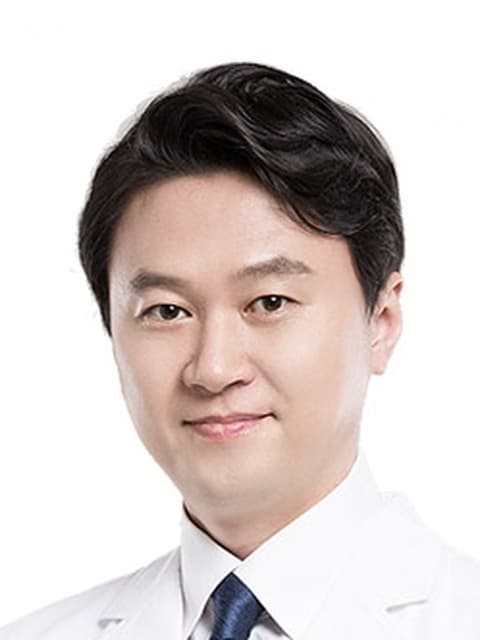
Im Young Min
Chief Director · Board-certified in Plastic Surgery
Hello, I'm Dr. Im Young Min, Chief Director and board-certified plastic surgeon at VERYGOOD Plastic Surgery in Gangnam, Seoul. I trained at Seoul St. Mary's Hospital, I'm a full member of the American Society for Aesthetic Plastic Surgery, and I operate across body, breast, face and eyes.
Two facts here bear directly on your question. Three board-certified anesthesiologists work at VERYGOOD full time, so one of them watches your blood pressure, pulse and breathing from the first injection until you're awake, and the surgeon does nothing but operate. And when the conversation turns to your heart medication or an old clot rather than your waistline, a medical interpreter for your language is provided at no extra charge.
If your doctor at home gave you a reason, that reason is the most useful thing you can send. Write it out on WhatsApp next to a daylight photo of the area and ask whether it still applies to you; that way the question you're asking is about your own body.
Send your photos and health question on WhatsApp
Why does the amount removed matter more than the method?
Because most of the serious risks grow with volume, treated area and time under anesthesia. The device or cannula style matters far less than how much is done in one session.
Before the fat comes out, the surgeon fills the area with a large volume of fluid: salt water with a local anesthetic and a drug that narrows small blood vessels. That fluid limits bleeding and numbs the tissue, but some of it is absorbed into your bloodstream. Treat one small area and the amount is minor.
Treat the abdomen, flanks, back and thighs in one sitting, and your body has far more fluid and anesthetic to process, a much larger raw surface under the skin that can bleed or collect fluid, and more hours lying still, which is how leg clots get started.
That's why plastic surgeons treat very large single-session volumes as a higher-risk category that calls for closer monitoring, and why many prefer to split a big plan into two operations. If you're hoping for five areas in one trip, I'd ask you which two bother you most. Doing those well and leaving the rest for a later trip is usually the safer plan.
Adding another operation under the same anesthetic stretches the time further. The pairing that drew the strongest warnings is liposuction combined with fat grafted into the buttocks. In 2018 five plastic surgery organizations issued a joint safety advisory after reports of deaths from fat entering the large veins beneath the buttock muscle, and the American Society of Plastic Surgeons now stresses keeping injected fat above the muscle. If a plan you've been quoted anywhere includes that step, ask about it specifically.
Who should wait, or skip liposuction altogether?
Anyone whose weight is still changing, whose health would make a long anesthetic risky, or whose fullness isn't fat. Broken down, as general medicine:
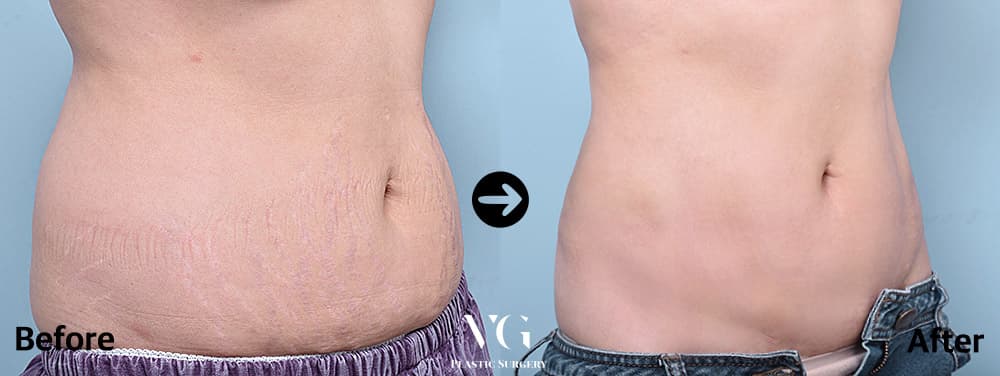
- Weight still moving. Liposuction reshapes areas; weight is a separate job. The American Society of Plastic Surgeons describes good candidates as healthy non-smokers close to their ideal weight with firm, elastic skin. If you're mid-diet or recently stopped a weight-loss medicine, wait until the scale has held still for a few months.
- Heart, lung or kidney disease, or diabetes that isn't well controlled. These make fluid shifts and long anesthesia harder on the body. Some people need clearance from their own specialist first, and some shouldn't have elective surgery abroad at all.
- A past blood clot, a clotting disorder, or blood thinners. Add the flight home and the clot risk stacks. Fish oil, vitamin E, ginkgo and some over-the-counter painkillers can also increase bleeding, so they belong on your medication list.
- Smoking or vaping nicotine. Nicotine narrows small vessels and slows healing at the incisions and in the treated layer.
- Pregnancy, breastfeeding or a recent birth. The abdomen and breasts are still changing; wait until they settle.
- Loose skin. It isn't dangerous, but removing fat from under skin that has lost its spring can leave it looser, which is the question at the heart of whether full upper arms are fat or loose skin.
- Fullness that isn't fat. A belly pushed out by fat inside the abdomen, or a full neck from muscle or glands, won't change with suction. Checking whether fat is really the problem under the chin follows the same logic for other areas.
A doctor at home said no. Does that change in Seoul?
Sometimes. It turns on which kind of no you got.
A medical no, such as a heart condition, a clotting history or a weight that hasn't settled, travels with you. Seoul doesn't change your bloodwork, and the flight home adds risk on top. A plan no is different. A surgeon who preferred fewer areas, a staged approach or a different operation is giving an opinion about your tissue, and that can be talked through with another surgeon.
Say you're 44 and live outside Leeds. You lost a lot of weight over two years and kept it off, and the surgeon you saw said suction on your lower belly would leave the skin hanging. That's a tissue answer. Ten hours on a plane won't change how elastic that skin is. What I'd want to know is how much of the fullness is fat you can pinch and how much is skin with little underneath it.
If it's mostly skin, I'd tell you the same thing your surgeon did: liposuction alone won't fix it.
So is liposuction safe after a no from home? It can be, when the reason was about the plan and not about your health, and when the new plan is smaller than the one that was turned down. Every surgeon's training and center is published under their own name on VERYGOOD's English site, so you can check who works in body contouring before you decide anything.
Contour irregularities, numbness, fluid and clots: what can go wrong
Most of what people feel after liposuction is temporary. The serious problems are rare and mostly tied to volume, health and lying still.
The usual reactions are bruising, swelling and soreness like a heavy workout, plus numb or oddly sensitive skin over the treated area. The tissue can feel firm and lumpy as it heals. Bruising typically fades within weeks, while numbness and firmness can take several months to settle.
Less often, you can get an uneven or rippled contour, one side differing from the other, a seroma (a pocket of fluid under the skin that may need draining), infection, darker skin over the area, or slow-healing incision points. Contour problems are the ones most likely to lead to a second operation, and they're more frequent when a lot of fat is taken close to the skin.
Rare but serious: a clot in the leg that travels to the lungs, fat entering the bloodstream, a dangerous fluid imbalance, a reaction to too much absorbed local anesthetic, and puncture of deeper structures. The American Society of Plastic Surgeons lists these in its liposuction safety guidance. They're the reason volume limits, a specialist watching the anesthesia and moving your legs early all matter.
How often any of them happens varies with the amount removed, your health and how the operation is planned, so no surgeon can promise it won't happen to you.
Once you're home, know the warning signs. A swollen, painful calf on one side, chest pain, sudden shortness of breath or coughing up blood means emergency care straight away; tell them you had surgery and a long flight. Fever, spreading redness, discharge from an incision or a swelling that grows quickly needs a doctor the same day.
Ask for your operative note, anesthesia record and medication list in English before you leave, and tell your GP or family doctor before the trip that you're having surgery abroad, so your first visit back doesn't start from zero.
If one of the conditions on the list above applies to you, type out every medicine and supplement you take straight from the labels, add the condition itself, and send both on WhatsApp with one question: does this rule me out, or only change the plan? A list read off the bottles catches the fish oil and the daily aspirin that people forget when they answer from memory.
Send your photos and health question on WhatsApp
The long flight is part of the safety plan
Sitting still for ten or more hours a few days after surgery, in a tight compression garment and slightly dehydrated, is close to a recipe for a leg clot. The guidance on medical tourism from the U.S. Centers for Disease Control and Prevention warns that flying after surgery raises the risk of blood clots, and liposuction adds its own clot risk on top.
A few things make a real difference. Book an aisle seat so you can stand and walk every hour or two, drink water and skip alcohol and sleeping pills on board, keep the compression garment on as instructed, and flex your ankles while seated. If you have any clot history, ask the surgeon before you book flights whether you need extra prevention.
The bigger lever comes earlier. Plan the number of areas around your flight, not the flight around the number of areas, and don't set the return date before you've been checked after surgery. The recovery stages and the days to plan in Seoul are covered in what liposuction changes and how long to stay.
What sets the cost of liposuction, and where safety shows up
The estimate is built from how many areas you treat and how large they are, how much fat sits in each, the type and length of anesthesia, whether anything else is added under the same anesthetic (fat grafting, for example), and the compression garments and follow-up visits around the operation. Your nights in Seoul are a separate cost on your side.
Several of those cost factors are also safety factors. A smaller plan done in one sitting keeps both the operating time and the estimate down, and a plan that needs to be staged shows up as two operations on paper, which is what it is.
Foreign patients pay the same surgery fee as Korean patients, and you receive a written estimate. There's more on how liposuction cost in Korea is set. The deposit and payment method are settled after the consultation, so ask about both on WhatsApp in the same message where you ask what your own combination of areas would cost.
Before you book a flight
On WhatsApp, send front and side photos of each area you're considering, taken in daylight, plus the dates you could travel, and ask one question: given my health history, would you operate on these areas, and how is follow-up handled once I'm back home?
At the consultation in Seoul, the thing I want to see in person is how your skin moves when it's pinched and lifted, because that decides whether removing fat leaves a smoother line or a looser one, and whether liposuction is the right operation for you at all.
Related pages:
Body Contouring before & after — more cases
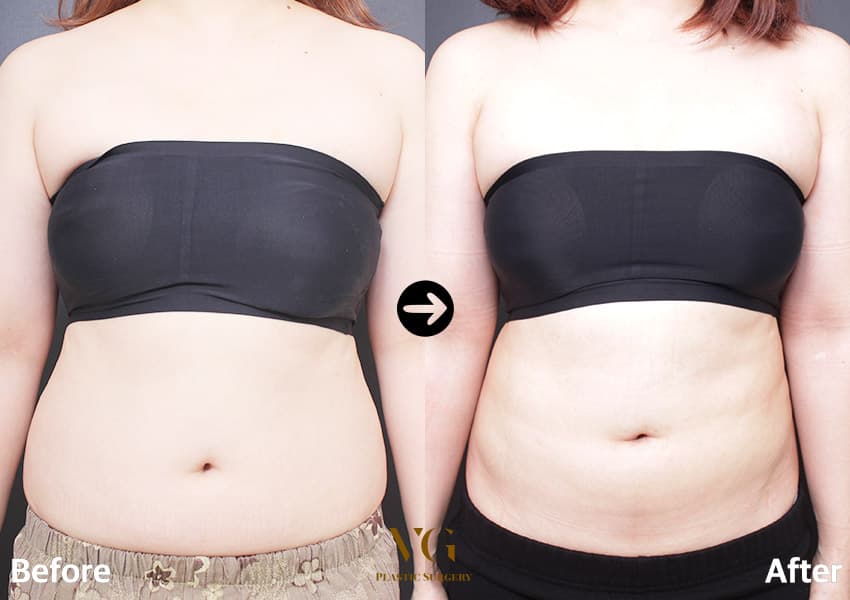
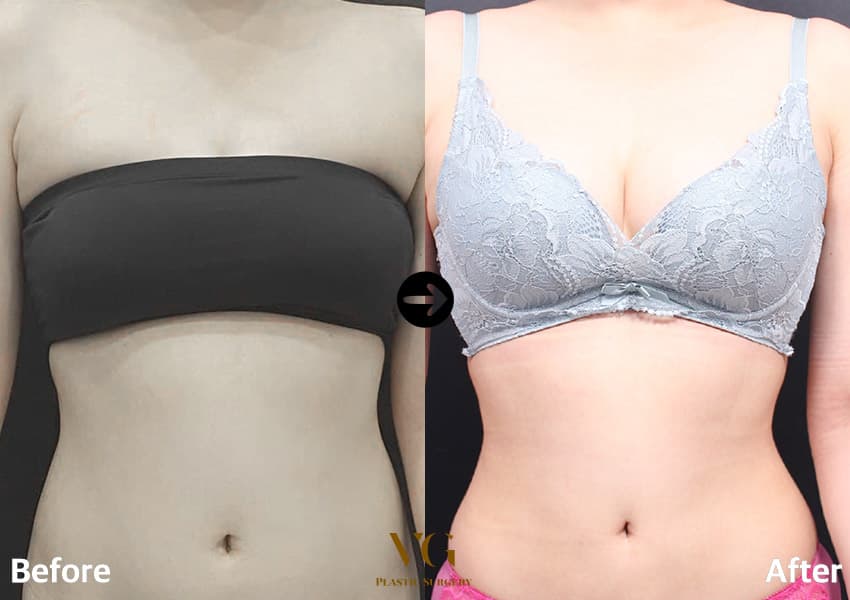
Real patients from our archive, all photographed 3 months after surgery. Tap a case to compare it full size.
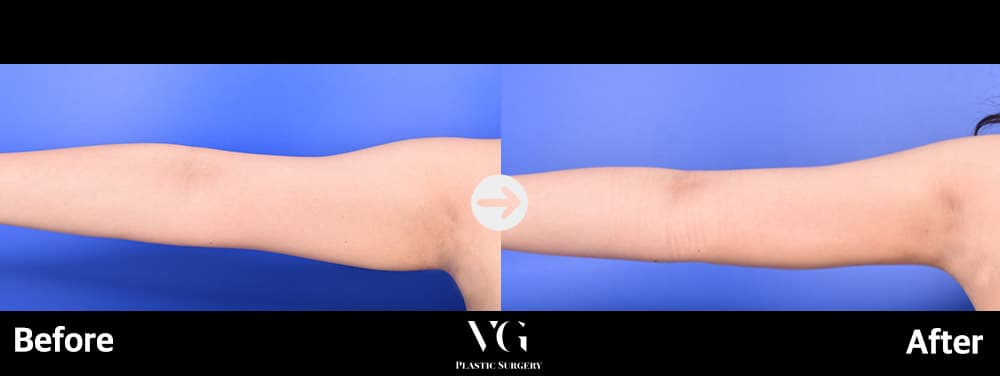
Arm Liposuction3 months after surgery
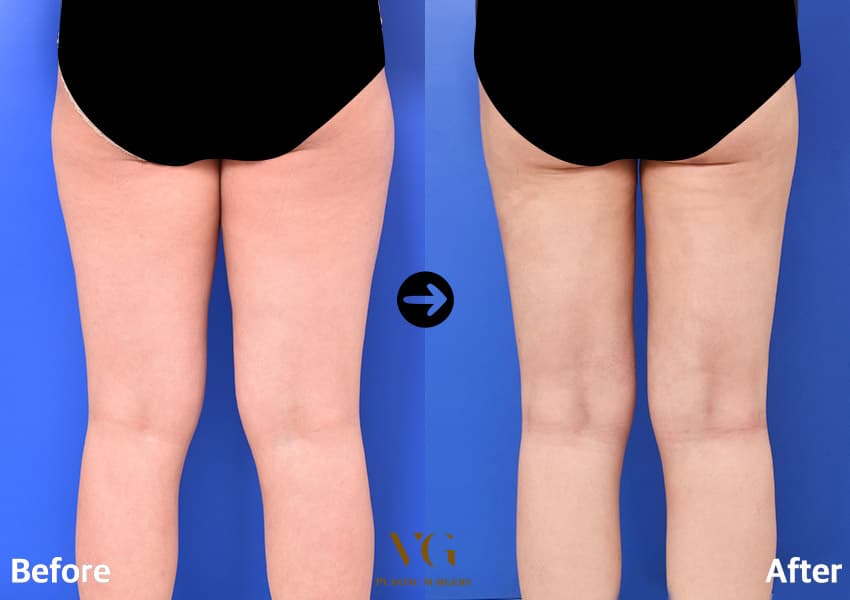
Thigh Liposuction3 months after surgery
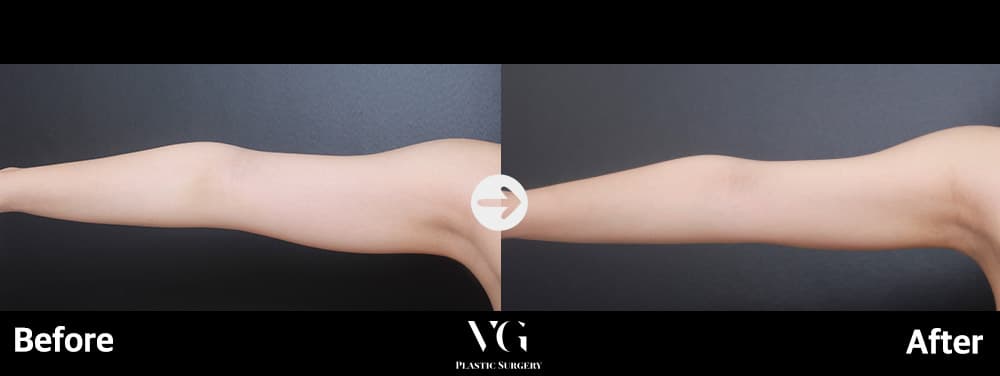
Arm Liposuction3 months after surgery
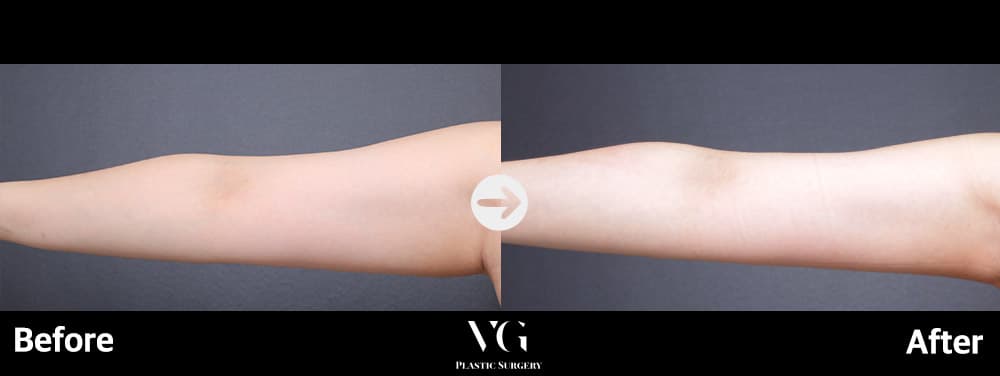
Arm Liposuction3 months after surgery
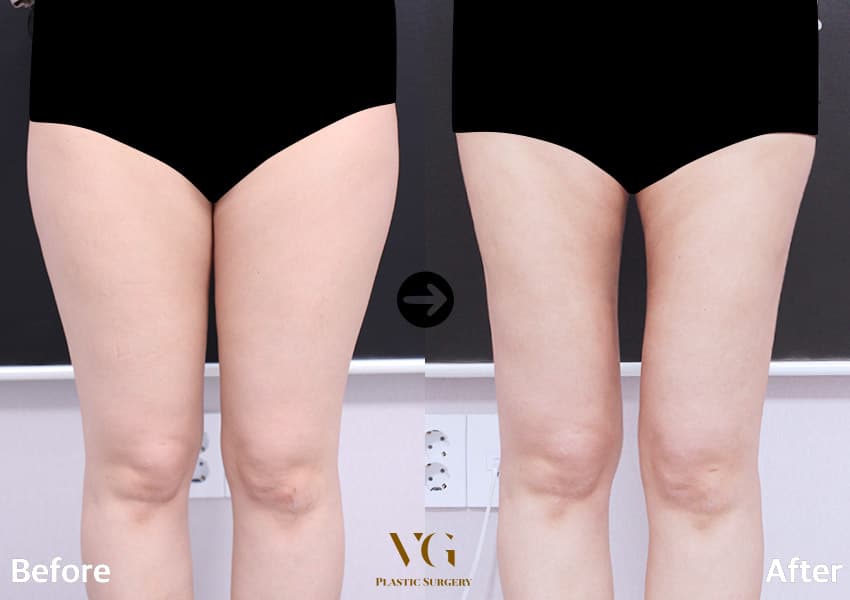
Thigh Liposuction3 months after surgery
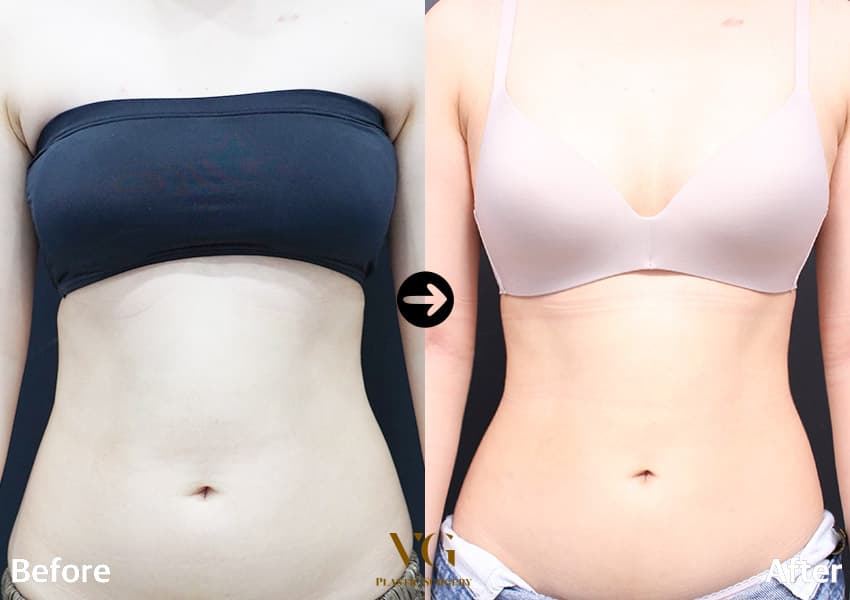
Abdominal Liposuction3 months after surgery
FAQ
Questions patients ask
Does liposuction need general anesthesia?
Not always. Small areas are often done with local anesthetic in the tissue alone or with light sedation, while larger or multiple areas are commonly done under deeper sedation or general anesthesia. At VERYGOOD a board-certified anesthesiologist on staff monitors you throughout, and if you've reacted badly to anesthesia before, bring that record to the consultation.
Can fat come back after liposuction?
The fat cells that are removed don't grow back, but the ones left in the area and elsewhere can still enlarge if you gain weight. A significant gain tends to show up in areas that weren't treated, which can make the result look uneven.
Is liposuction safe in an area that has been treated before?
It can be done, but scar tissue from the first operation makes the remaining fat harder to remove evenly, so dents and ridges are more likely. Bring the earlier operative record and any photos from before the first surgery to the consultation.
Is liposuction a way to lose weight?
No. It removes fat from chosen areas to change their shape, and the number on the scale usually moves very little. If weight loss is the goal, liposuction belongs after it, once your weight has held steady.
Can I combine liposuction with another surgery on the same trip?
It's sometimes done, but each addition lengthens the anesthetic and the recovery you carry onto the plane. A small area added to a short facial procedure is a very different case from large-volume liposuction plus breast surgery. If you're considering a combination, list both in your first message so the timing can be looked at as one plan.
Sources
This article explains general medical information. Whether surgery suits you, and which method, is decided only after a consultation with the surgeon.
Written by
Im Young Min
Chief Director · Plastic Surgery
- Ph.D. in Medicine
- Internship and residency, Seoul St. Mary's Hospital
- Board-certified plastic surgeon, Seoul St. Mary's Hospital
- Adjunct professor of plastic surgery, Seoul St. Mary's Hospital
- Former director, Topface Plastic Surgery
Next step
Send two photos. Get a surgeon’s answer.
Front and side, natural light, no filter. Dr. Im Young Min reviews them and tells you which method fits and how many days to stay in Seoul.
International patients pay the same surgical fee as Korean patients. Pricing policy
Keep reading
Body Contouring
Abdominal Liposuction Cost Korea: Will It Flatten Your Stomach?
Your figure for abdominal liposuction in Korea is set by the zones treated, the fat and skin you have, the method, the anesthesia, and your days in Seoul. First check that your belly is the kind of fat liposuction can reach.
Im Young Min ·
Body Contouring
Double Chin Liposuction Cost Korea: Is Fat Really Your Problem?
Double chin liposuction suits fullness that is mainly pinchable fat, with skin that still has some spring. Its cost is set by the area treated, any added lift or chin procedure, anesthesia and follow-up.
Im Young Min ·
Body Contouring
BBL in Korea Price: Is Your Fat Enough? What Decides It
A BBL moves your own fat to the buttocks by liposuction and grafting. Its cost follows the areas harvested, the fat placed, the anesthesia and your days in Seoul, so the figure belongs to your body and plan.
Im Young Min ·