Eyes
Double Eyelid Surgery in Korea: Incision or Not, Recovery and Stay
An eye surgeon in Seoul explains what double eyelid surgery does, how he decides between incisional and non-incisional methods, the recovery timeline, how many days to stay in Korea and how the fee is set.

· 7 min read · Last updated
In this article
The short answer
Double eyelid surgery creates a fold in the upper eyelid so the lid no longer sits flat on the lashes. There are two main routes: a non-incisional method that fixes the crease with sutures, and an incisional method that forms the crease while trimming skin and fat. Which one fits depends on eyelid thickness, fat and the strength of the muscle that opens the eye. Plan to stay in Korea at least 7 days.
- Eyelid thickness, fat under the skin and the strength of the lifting muscle decide the method, not the line you saw in a photo.
- The operation takes 30 minutes to 2 hours under sedation, and most people go back to the hotel the same day.
- Swelling peaks at 2–3 days for non-incisional and 3–5 days for incisional; the final shape takes 3 to 6 months.
- Every eye surgery needs a stay of at least 7 days in Korea, so stitches come out and the first follow-up happens before you fly.
- International patients pay the same surgical fee as Korean patients, confirmed in one itemised written quote.
I am Hong Dae Won, a board-certified plastic surgeon at VG Plastic Surgery in Seoul, working mainly in our eye and nose surgery centres. I trained at Asan Medical Center and I am a full member of the Eyelid Surgery Research Group of the Korean Society of Plastic and Reconstructive Surgeons. Double eyelid surgery is the question I answer most often from patients abroad, so here is how I explain it in consultation.
Profile
Hong Dae Won
Director · Board-certified in Plastic Surgery
What double eyelid surgery actually changes
Many eyelids have no crease, or a crease that hides under the skin above it. The lid then rests flat on the lashes, and the eye reads smaller or sleepier than it is. The operation fixes a fold at a chosen height, so the skin above folds back when the eye opens.
That sounds simple, and the fold itself is. What takes judgement is that the same line behaves differently on different lids. I measure three things first: how thick the eyelid is, how much fat sits under the skin, and how strongly the muscle that lifts the eye works. Those three decide whether an incision is needed at all.
People searching for Korean eyelid surgery or Asian eye surgery often picture one standard look. There is no standard look. There are four common line styles, and the height that suits you depends on your lid and your face. Our eye surgery centre page shows results sorted by concern, from no crease to sleepy eyes.
Who it suits, and when I say wait
These are the eyes I see most often in consultation where surgery is a reasonable answer.
- You raise your forehead and eyebrows to open your eyes, and it leaves lines on your forehead
- Your double eyelid line keeps fading, or the two sides no longer match
- People often tell you that you look sleepy, and you want the shape of the eye itself to change
- A previous eyelid surgery healed unnaturally and you are considering revision
I also tell people when not to go ahead yet. Saying so is part of an honest consultation.
- Untreated dry eye or blepharitis — I ask you to see an ophthalmologist first
- A travel schedule too short for stitch removal and the first follow-up in Korea
- You want the exact eyes from a celebrity photo — a different eyelid structure cannot produce the same shape
- Pregnancy, or an uncontrolled thyroid or bleeding disorder
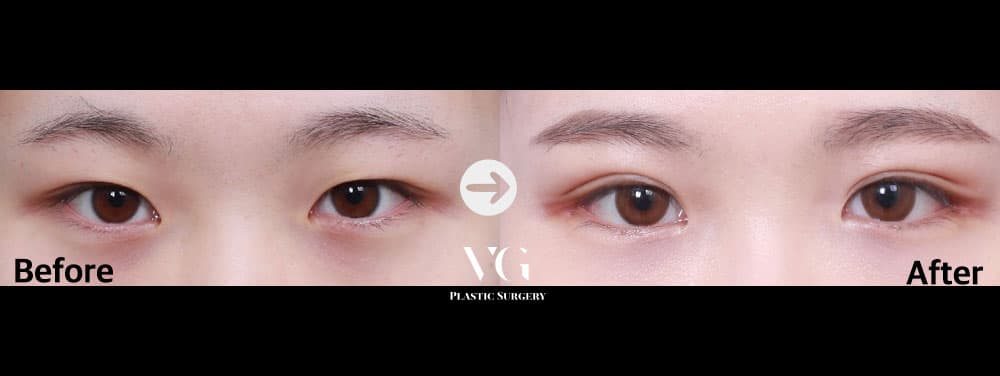
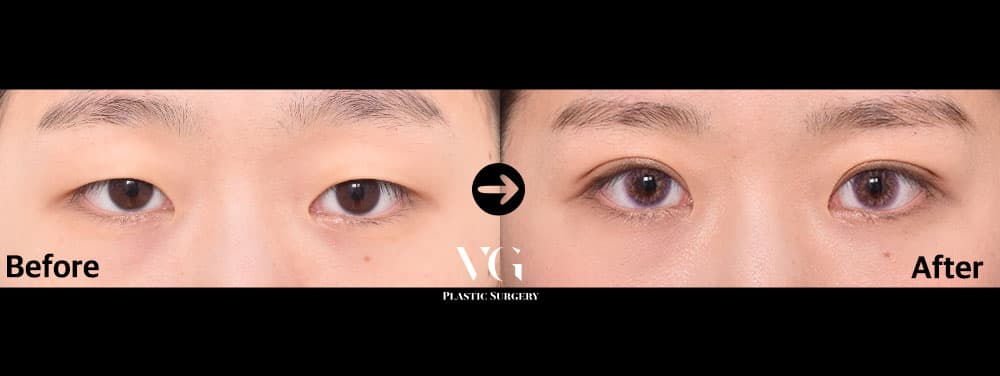
Both are from lids that were thin enough for sutures to hold a fold. You can see the first natural adhesion case in full, or browse every eye surgery before-and-after photo by concern.
Incisional vs non-incisional: how I decide
Incisional vs non incisional is the first real decision. Neither is better in general. The lid decides, and the table below is how our team sets them against each other.
| Non-incisional (natural adhesion) | Incisional | |
|---|---|---|
| How it works | The crease is fixed with sutures, without an incision | The crease is formed while trimming fat and skin |
| Suits | Thin eyelids with little fat | Thicker eyelids with more fat, or skin that has begun to droop |
| Not advised for | Heavy eyelid fat or clearly drooping skin | Short trips that cannot absorb the swelling period |
| Swelling | Mild; peaks at 2–3 days | Moderate to strong; peaks at 3–5 days |
| Scarring | No incision, so scarring is minimal | A fine trace may remain along the line, inside the fold |
| How long it lasts | May loosen over time, especially on a thicker lid | Tends to hold semi-permanently |
The honest trade-off is recovery against hold. Non-incisional recovers faster, but on a thicker lid the line can loosen, and I say so before you decide. Incisional holds, but the swelling takes longer to settle.
When the eye also looks sleepy
If the muscle that lifts the lid is weak, a crease alone will not open the eye. That is ptosis, and it is corrected by adjusting the muscle, with or without an incision. Missing it is one of the reasons people come back with eyes that still look sleepy after a first surgery.
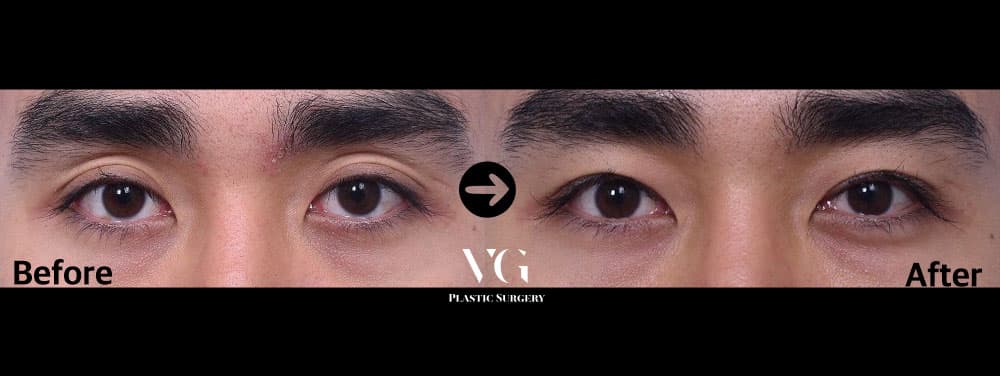
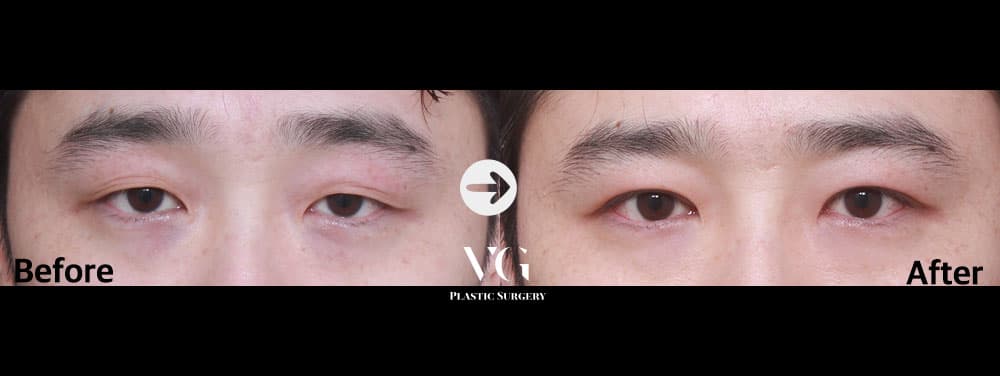
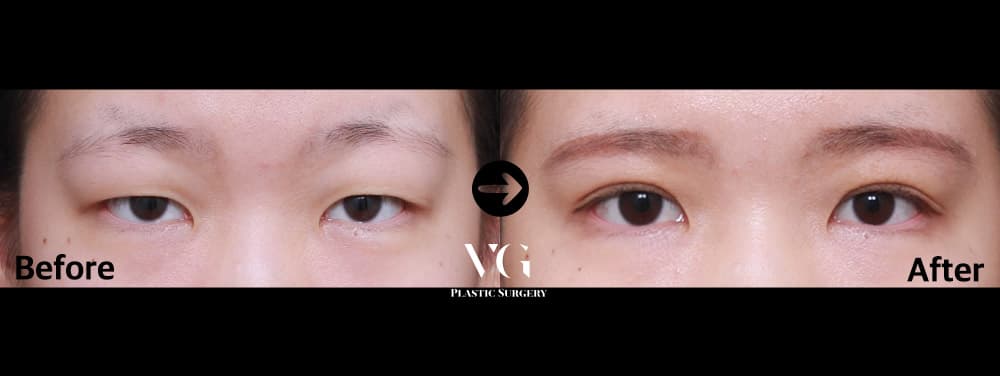
The first case is a crease alone; the second combined the crease with ptosis correction because the lids were covering the upper part of the iris. Our incisional and non-incisional comparison also sets ptosis correction and epicanthoplasty in the same table.
Surgery day and the recovery timeline
You arrive 90 minutes before your slot. I draw the line on your eyelids and go through it with you for 20–30 minutes, with an interpreter present, and nothing starts until you agree to it.
The operation takes 30 minutes to 2 hours under sedation, and an anaesthesiologist monitors you throughout. You rest in the recovery room for 1–2 hours, and admission is usually not required. The next day you come back for a short check, which is not optional.
| Milestone | Non-incisional | Incisional |
|---|---|---|
| Swelling peaks | 2–3 days | 3–5 days |
| Stitches out | 3–5 days (sometimes none to remove) | 5–7 days |
| Back to daily life | 5–7 days | 10–14 days |
| Looks natural | About 1 month | 2–3 months |
| Final result | 3 months | 6 months |
A few practical points matter more than people expect. Eye makeup can start 3–5 days after the stitches are out. Contact lenses and light exercise wait 2 weeks, and alcohol and smoking wait 4 weeks.
Send one photo of your eyes open and one with them gently closed, and I'll tell you whether your lids need an incision.
Having double eyelid surgery in Korea: stay, stitches and fee
For every eye surgery we ask you to stay at least 7 days. That covers stitch removal and the first follow-up before you fly. Do not book your return flight for the day of your last appointment, because appointments move.
Interpretation during consultation is free, and an interpreter is with you on the morning of surgery and at every follow-up. Our trip planning guide covers the order of those days, from arrival to the flight home.
After you fly, we keep watching. At week 1, month 1 and month 3 we review your photographs, and the surgeon who operated answers in writing; when photographs are not enough, we ask for more from set angles.
What sets the double eyelid surgery cost
We do not publish a price list, because one figure is only true for one plan. A crease alone, a crease with ptosis correction, and a revision take different time in theatre and a different technique. What we do publish is the rule: international patients pay the same surgical fee as Korean patients, with no foreigner surcharge and no agency commission built in.
After consultation you receive one itemised written quote before you decide anything. It covers anaesthesia, the operating theatre, dressings and medication, interpretation and three months of remote follow-up. Our pricing policy lists what is included and what can add to it.
What I check first in consultation
- Skin thickness and fat — whether sutures can hold a fold, or trimming is needed
- The lifting muscle — whether ptosis is present and needs correcting in the same operation
- Eye length, spacing and the height of the outer corner — they change which line reads natural
- Facial proportion and asymmetry — the two eyes are rarely identical to begin with
Then we choose the line together. An in line tucks inward at the front and looks calm; an in-out line opens outward toward the tail and is the most chosen. A semi-out line shows a little more at the front, and an out line shows along its whole length for a more defined look.
One more thing patients ask: the surgeon you consult is the surgeon who operates. One dedicated eye surgeon performs the whole operation to the end. You can read more about my training and the work I do.
Risks, side effects and revision
The most common problems are not dramatic, but they are real. A crease set too high reads as a swollen "sausage" line. Two sides can settle at different heights, and a non-incisional line can fade when the fixation was too weak for the lid.
Most of these are decided before surgery, by choosing a height your lid can carry and by checking for ptosis. A fine scar may remain along an incisional line, which is why it is placed inside the fold.
After you fly home, tell us right away about any of these signs. Send a photo through messenger and you will have an answer the same day.
- Bleeding that will not stop
- Pain that keeps getting worse
- Fever or chills
- Blurred or changed vision
- Sudden swelling on one side only
- Discharge or an odour
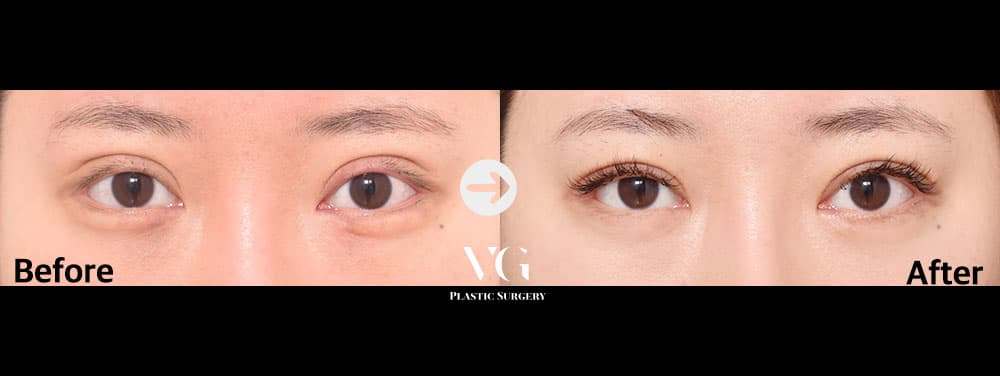
Revision is possible, but it should wait at least 6 months after the first surgery. What was done last time sets what can be done this time, so bring photos and, if you have them, records from the first operation. If you are also weighing a nose, I have written about how a Korean nose job is planned as well.
Eyes before & after — more cases
Real patients from our archive, all photographed 3 months after surgery. Tap a case to compare it full size.
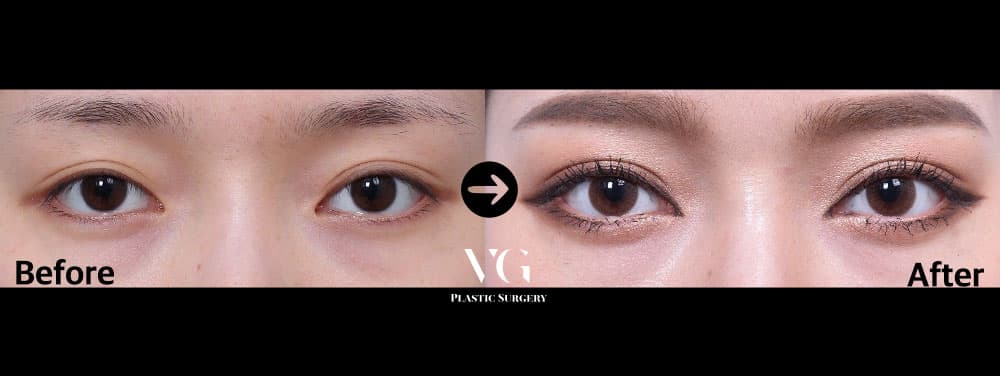
Natural-Adhesion Double Eyelid3 months after surgery
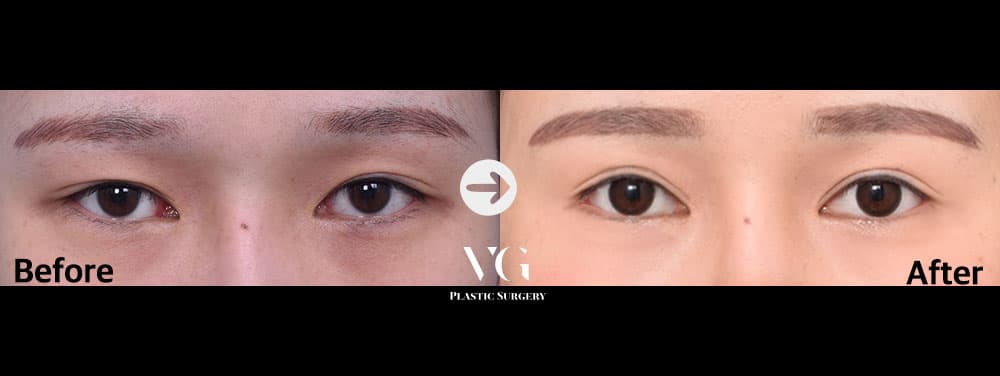
Incisional Double Eyelid3 months after surgery
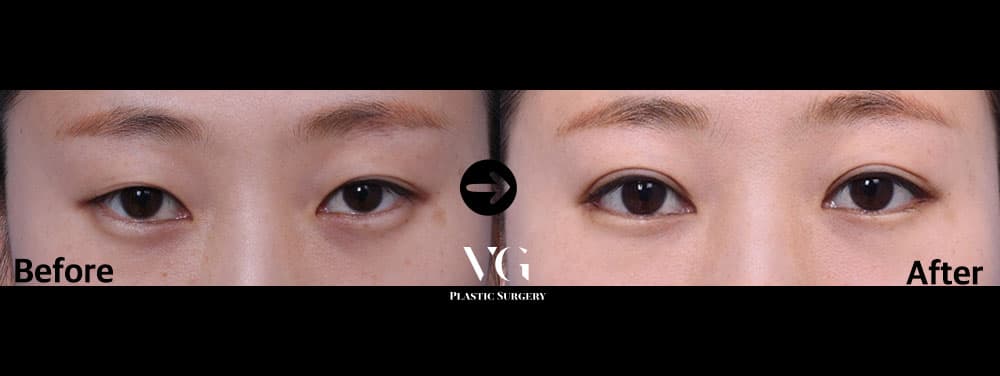
Incisional Double Eyelid3 months after surgery
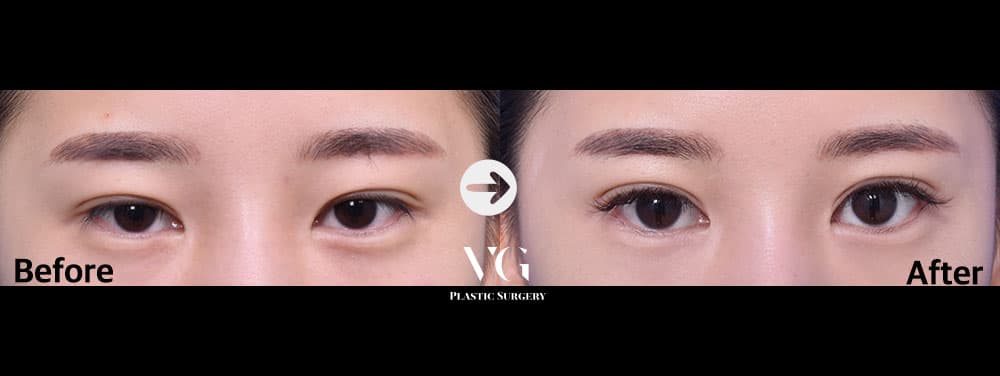
Natural-Adhesion Double Eyelid3 months after surgery
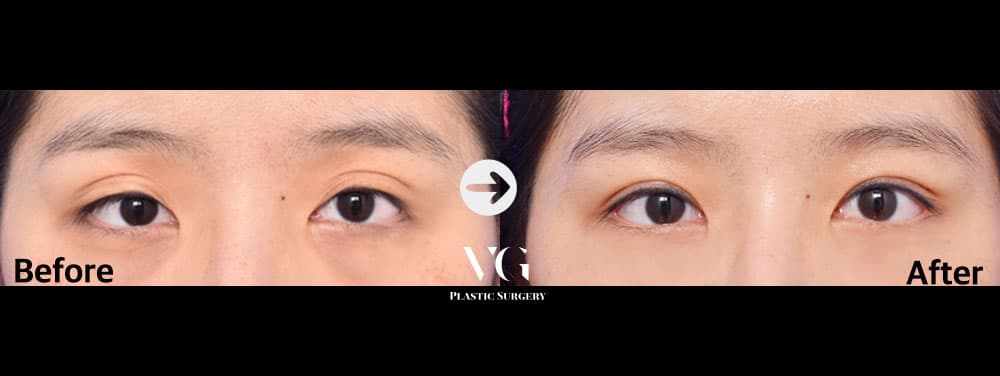
Incisional Double Eyelid3 months after surgery
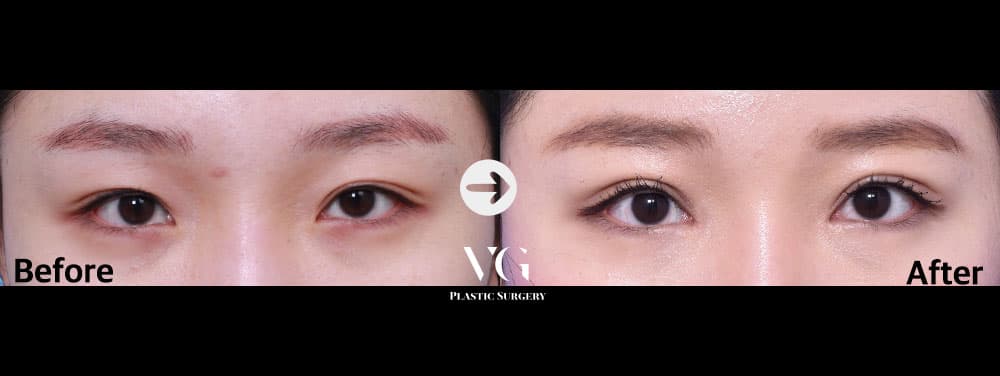
Natural-Adhesion Double Eyelid3 months after surgery
FAQ
Questions patients ask
What is double eyelid surgery?
It is an operation that creates a fold in the upper eyelid, so the lid folds back when the eye opens instead of resting flat on the lashes. The fold is either fixed with sutures (non-incisional) or formed through a small incision while trimming skin and fat (incisional).
Is incisional or non-incisional better for me?
Thin eyelids with little fat usually suit non-incisional, which recovers faster but can loosen over time. Thicker lids, more fat or skin that has begun to droop usually need an incision so the crease holds. Eyelid thickness and muscle strength are hard to judge from a photo, so we confirm it at the in-person consultation in Seoul.
How many days do I need to stay in Korea?
At least 7 days for every eye surgery. That covers stitch removal and the first follow-up before you fly. Getting back to daily life is a separate number: about 5–7 days for non-incisional and 10–14 days for incisional.
How long does swelling last after double eyelid surgery?
Swelling peaks at 2–3 days after non-incisional surgery and 3–5 days after incisional surgery, then settles. The eyes look natural at around 1 month for non-incisional and 2–3 months for incisional. The final shape takes 3 to 6 months.
How much does double eyelid surgery cost for foreigners?
We do not publish a price list, because the fee depends on the method and whether ptosis correction or other steps are added. International patients pay the same surgical fee as Korean patients, and you receive one itemised written quote after consultation.
Will I have a scar?
Non-incisional surgery has no incision, so scarring is minimal. With the incisional method a fine trace may remain along the line, and it sits inside the fold.
Can a crease that has faded be fixed?
Yes. If the skin is thin and there is little scar tissue, a non-incisional approach can be enough; where scarring is heavy or the skin is thick, an incisional revision is used. Revision should wait at least 6 months after the first surgery.
This article explains general medical information. Whether surgery suits you, and which method, is decided only after a consultation with the surgeon.
Written by
Hong Dae Won
Director · Plastic Surgery
- Board-certified plastic surgeon, Asan Medical Center, Seoul
- Plastic surgery fellowship, Florence University Hospital, Italy
- International Confederation for Plastic, Reconstructive and Aesthetic Surgery (IPRAS)
- American Society of Plastic and Reconstructive Surgeons (ASPRS)
- American Society for Aesthetic Plastic Surgery (ASAPS)
Next step
Send two photos. Get a surgeon’s answer.
Front and side, natural light, no filter. Dr. Hong Dae Won reviews them and tells you which method fits and how many days to stay in Seoul.
International patients pay the same surgical fee as Korean patients. Pricing policy
Keep reading
Eyes
How Much Does Double Eyelid Surgery Cost in Korea? Results, How Long It Lasts, Reviews and When to Spend Less
There's no single figure: the method your lids need, any ptosis or inner-corner work, the anesthesia and your days in Seoul set the quote, and foreigners pay the same surgical fee as Korean patients.
Im Young Min ·
Eyes
Lower Blepharoplasty Korea Cost: Fat, Skin or Lid Support? Reviews, Methods and Recovery
Your lower blepharoplasty cost in Korea follows what is causing the bags: bulging fat, a hollow beneath it, loose skin or a slack lower lid, plus the anesthesia and the days you plan in Seoul.
Im Young Min ·
Eyes
Double Eyelid Surgery Cost in Korea: What Changes Your Quote? Results, Reviews and Methods
Quotes for double eyelid surgery in Korea differ because they describe different operations: suture or incision, fat removal, ptosis correction, inner-corner work and revision.
Im Young Min ·