Eyes
Lower Blepharoplasty Korea Cost: Fat, Skin or Lid Support? Reviews, Methods and Recovery
Your lower blepharoplasty cost in Korea follows what is causing the bags: bulging fat, a hollow beneath it, loose skin or a slack lower lid, plus the anesthesia and the days you plan in Seoul.
In this article
- 01What are you actually paying to fix under your eyes?
- 02Lower blepharoplasty methods: inside the lid, below the lashes, or moving the fat
- 03What sets your lower blepharoplasty Korea cost?
- 04What do lower bleph reviews get right, and what do they miss?
- 05How long is lower blepharoplasty recovery, and how many days in Seoul?
- 06Risks, and who should wait
- 07Choosing who operates: what you can check before you fly
The short answer
Worried that your lower blepharoplasty Korea cost will grow once you're in Seoul, or that you'll pay for more surgery than your under-eyes need? The cost mostly follows what is causing the bags: fat that bulges forward, a hollow beneath it, loose skin, or a lower lid that has lost its tension. The anesthesia and the days you plan in Seoul make up the rest.
- The cost follows the cause of your bags: fat, a hollow, loose skin or a slack lower lid.
- Each added step, like fat repositioning or lid support, makes the operation longer and changes the quote.
- Anesthesia type and whether upper lids are done in the same session also move the cost.
- Plan your days in Seoul around the exam, the surgery and the check-ups, and ask how many days your method needs.
- A daylight photo, front-on and looking up, is the most useful first thing to send.
Before you compare quotes or book a flight, read this through.

Profile
Im Young Min
Chief Director · Board-certified in Plastic Surgery
By the end you'll know what each method on a quote means, what reviews get right and wrong, how recovery fits around your days in Seoul, and which factors move the cost, so you can tell which approach suits your eyes and your budget.
Hello, I'm Dr. Im Young Min, Chief Director and a board-certified plastic surgeon at VG Plastic Surgery in Gangnam, Seoul. I completed my internship and residency at Seoul St. Mary's Hospital, where I'm an adjunct professor of plastic surgery.
Three facts about our clinic matter for this decision. Three board-certified anesthesiologists work here full time and do not operate, so one of them watches your blood pressure, pulse and breathing from the first injection until you're awake. For eyes, we check lid thickness, fat and lifting strength before deciding whether to cut at all. And foreigners pay the same surgical fee as Korean patients, with the quote given in writing.
I'm writing this because many people price lower eyelid surgery as one fixed operation, when two people with similar-looking bags can need quite different surgery.
There is no single figure for lower blepharoplasty in Korea. The number on your quote follows your anatomy, so a clear photo tells you more than any price list.
If you want to know which group your under-eyes fall into, send one front-facing photo taken in daylight, no makeup, eyes looking straight ahead, on WhatsApp, with your age and the dates you're considering. A daylight photo shows the bulge and the skin texture far better than a written description does.
Send an under-eye photo on WhatsApp
What are you actually paying to fix under your eyes?
The lower lid has a few layers that age at different speeds. Behind a thin membrane called the septum sits a cushion of fat around the eyeball. In your forties and fifties that membrane often weakens, and the fat pushes forward as a bag. Just below the bag, the skin over the bony rim of the eye socket thins, and a groove forms, the tear trough. Meanwhile the skin itself loosens, and the tendon that holds the lower lid snug against the eye can slacken.
So “under-eye bags” is really four possible problems: bulging fat, a hollow groove, loose skin and a slack lid. Most people in their forties and fifties have two or three of them. Each one needs its own repair, and that is the main reason quotes differ.
You can get a rough sense of yours in a mirror. Tilt your head down and look up at the ceiling: if the bulge grows, it is mostly fat. If a dark line stays even when you look down, part of the problem is the groove, or pigment in the skin, and surgery doesn't change pigment.
Surgeons also often use a quick test. They gently pull the lower lid down and watch how fast it springs back. A slow return suggests the lid needs support during surgery, and that adds a step.
Lower blepharoplasty methods: inside the lid, below the lashes, or moving the fat
The terms on a quote can look like jargon. These are the ones you're most likely to see, and the eyes each one generally suits.
| Term | What it means | Who it usually suits |
|---|---|---|
| Transconjunctival approach | Incision on the inside of the lower lid; fat is trimmed with no skin cut | Bulging fat with firm skin |
| Transcutaneous (subciliary) approach | Incision just below the lashes; skin and muscle can be tightened | Loose or crinkled skin as well as bags |
| Fat repositioning | Fat is moved over the bone edge into the groove instead of being removed | Bags with a hollow underneath |
| Lid support (canthopexy) | The outer-corner tendon is tightened to hold the lid up | Lower lids that spring back slowly |
| Fat grafting | Your own fat is injected into the hollow | Hollows without much of a bag |
My reasoning on method starts from one point: removing too much fat is harder to correct than leaving a little. An over-hollowed lower lid looks tired in a different way, and putting volume back is a second operation. That's why repositioning fat into the groove is often considered when a bag sits above a hollow. I recommend only the operations you actually need and leave out the ones you don't, and with lower lids that often means a smaller plan than people arrive expecting.
If your upper lids are hooded as well, my post on blepharoplasty in Korea for hooded upper lids and under-eye bags covers what changes when both are planned together. Lid support at the outer corner is related to, but different from, the lower canthoplasty that changes the shape of the eye; one holds the lid in place, the other aims to open the eye downward.
What sets your lower blepharoplasty Korea cost?
The fee for the operation is built from a handful of decisions. Here they are in the order they usually matter.
The method and the number of steps. Fat trimming through the inside of the lid is one step. Removing skin, tightening muscle, repositioning fat and supporting the lid each add operating time, and that is what a quote mostly reflects.
What is combined in the same session. Upper blepharoplasty or fat grafting on the same day means one anesthetic and one recovery period, but a longer operation and a different quote.
The anesthesia. Lower lid surgery may be done under local anesthesia, sedation or general anesthesia, depending on the method and on your health. Because our anesthesiologists are on staff and do not operate, the one assigned to you is there for your whole operation.
First surgery or revision. If you have had lower lid surgery before, scar tissue and missing fat change the plan, and revision work generally takes more planning than a first operation.
Your days in Seoul. The surgical fee isn't the whole trip. Hotel nights, the check-ups after surgery and stitch removal, if your method uses skin stitches, all belong in your budget.
Say you're 54 and flying in from Melbourne. The bags have been there for ten years, the skin below your lashes crinkles when you smile, and there's a groove where the bag meets the cheek. That isn't a fat-removal-only case. I'd be thinking about an approach below the lashes with the fat repositioned into the groove, and I'd check how firmly your lower lid springs back before deciding on lid support. Each of those is a line on the quote.
Now say you're 34, your skin is firm, and the bulge runs in your family. Fat trimming from the inside of the lid may be all you need, which is a shorter operation and a shorter quote. Same complaint, very different surgery.
When you receive a written quote, check that it names the method, the anesthesia and the follow-up visits it covers. To get the figure for your own case, ask on WhatsApp what it would cost, with a photo attached.
Alongside your front-facing photo, add a second one taken while you look up toward the ceiling, and mention any previous eyelid surgery or LASIK. Those two details are what most often change the method, and with it the cost.
Send an under-eye photo on WhatsApp
What do lower bleph reviews get right, and what do they miss?
Forum threads about lower bleph in Korea repeat a few claims. Some hold up medically and some need a footnote.
“It was quick and done under local.” This can be true for fat trimming through the inside of the lid. Longer combined operations are more often done under sedation or general anesthesia, so one person's experience says little about yours.
“There's no scar.” The inside-the-lid approach leaves no skin scar. The below-the-lashes approach does leave one, which usually sits in the lash line and fades over months, but it is still a scar.
“My eyes looked hollow afterward.” This is real, and it usually means more fat was removed than the face could spare. It is one reason fat repositioning exists.
“My lower lid pulled down.” Also real, and more likely when skin is removed from a lid that was already slack. I've gone through this one in detail in what lower blepharoplasty threads get right about risk.
The figure someone posts in a thread reflects their method, their add-ons and their anesthesia. Treat it as their lower blepharoplasty Korea cost, not a preview of yours.
How long is lower blepharoplasty recovery, and how many days in Seoul?
For many people, swelling and bruising are most visible in the first several days and settle noticeably over the following couple of weeks, with subtle swelling taking longer to fade. General aftercare advice, including that of the American Society of Plastic Surgeons, covers cold compresses, keeping your head raised and avoiding strenuous activity for a while.
I won't give a fixed number of days here, because it depends on your method. Plan for the consultation and exam before surgery day rather than landing the night before, the operation itself, at least one check-up afterward, and stitch removal if your method uses skin stitches. Ask on WhatsApp how many days to plan for your case before you book flights.
On the flight home, cabin air is dry and your eyes may feel gritty, so keep lubricating drops in your carry-on and sunglasses for any bruising. You can see our eye surgery overview and the ways to reach us on our English home page.
Risks, and who should wait
Risks and side effects to know
The common reactions are temporary: swelling, bruising, a tight feeling, watery or dry eyes, briefly blurred vision, and sometimes swelling of the white of the eye. For most people these ease over the first few weeks.
Less common problems include asymmetry, too much or too little fat removed, a lower lid that pulls down and shows white below the iris, difficulty closing the eyes fully, infection and a visible scar. The American Society of Plastic Surgeons also lists bleeding and, rarely, loss of eyesight among eyelid surgery risks. Bleeding behind the eye is rare, but it is an emergency.
As general medicine, it's usually wise to wait or talk it through first if you have significant dry eye, active thyroid eye disease, recent eye surgery including LASIK, uncontrolled blood pressure, an infection around the eyes, or are pregnant or breastfeeding. If you take blood thinners or supplements that affect bleeding, mention them rather than stopping on your own. Smoking slows healing.
If, after you fly home, you get sudden severe pain, loss of vision or rapidly growing swelling on one side, go to a local emergency department straight away. For milder concerns, take dated photos and see a local eye doctor or plastic surgeon. The US CDC's medical tourism guidance suggests arranging follow-up care at home before you travel and bringing copies of your records. Results differ from person to person, and whether surgery suits you is decided at the in-person exam.
Choosing who operates: what you can check before you fly
Every plastic surgeon here is board-certified and operates under their own name, and where each one trained is published so you can check before you travel. Ask any clinic you're considering who will operate on you and who will run your anesthesia.
When you're ready, message us on WhatsApp with the one thing that bothers you most about your under-eyes, in your own words, and ask what it would cost for your case; you can ask before booking anything. When you come to Seoul, I'll examine your lids in person and recommend the approach that fits them.
Related pages:
Eyes before & after — more cases
Real patients from our archive, all photographed 3 months after surgery. Tap a case to compare it full size.
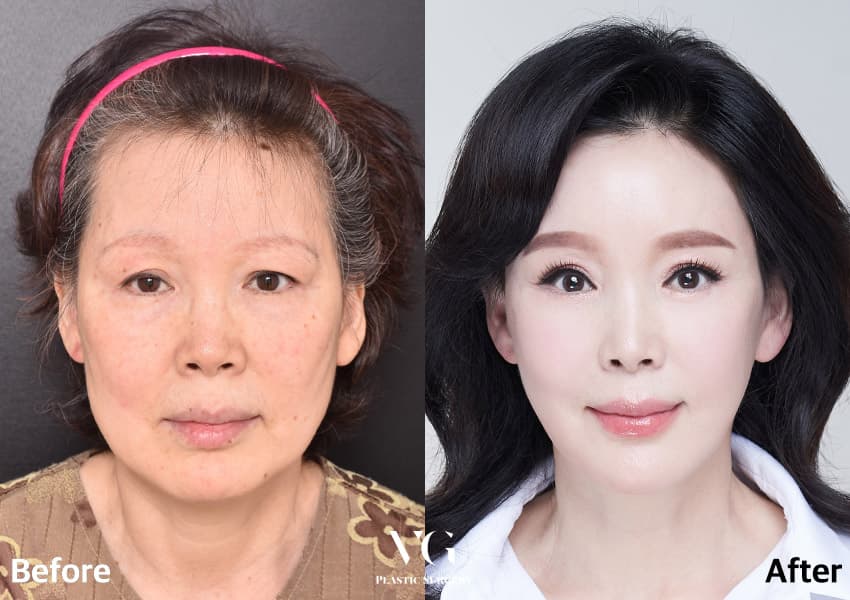
Face Lift3 months after surgery
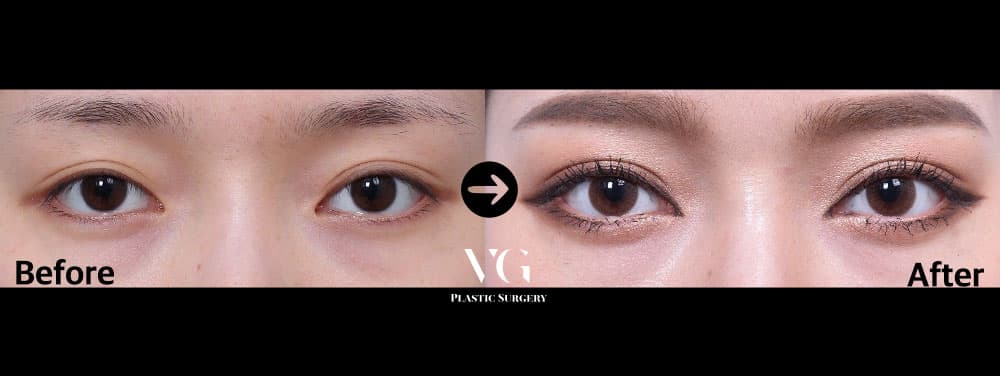
Natural-Adhesion Double Eyelid3 months after surgery
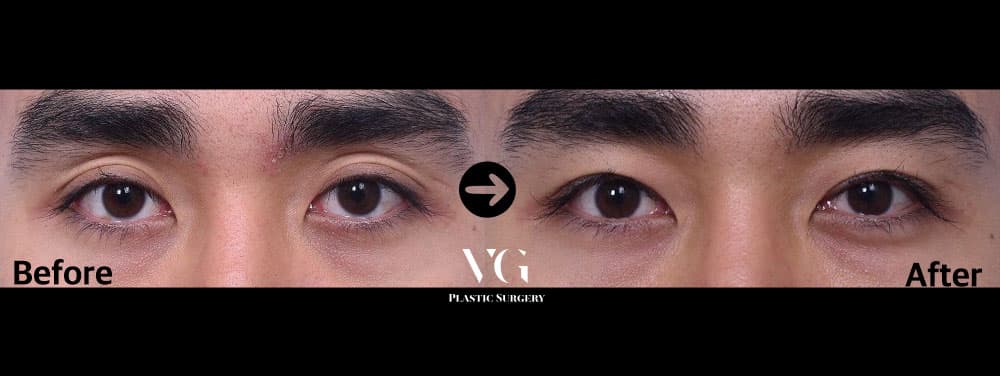
Incisional Double Eyelid3 months after surgery
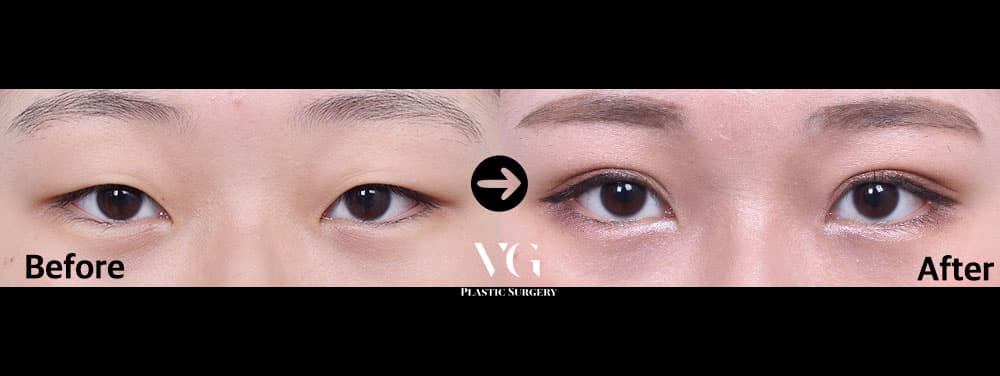
Incisional Ptosis Correction3 months after surgery
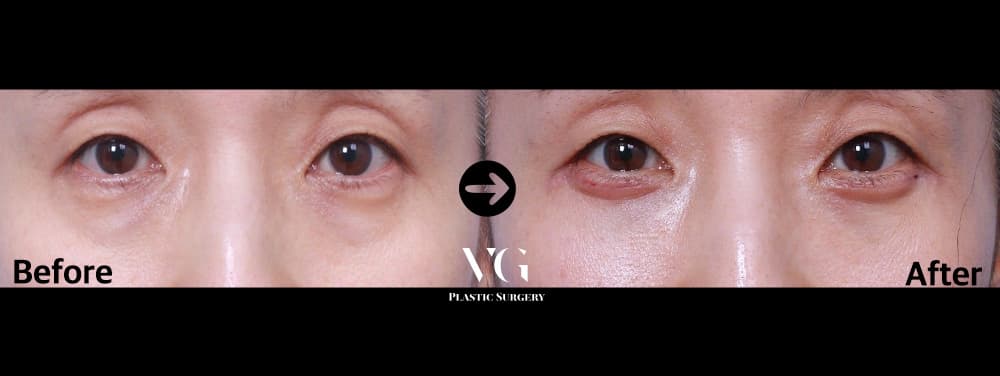
Lower Blepharoplasty3 months after surgery
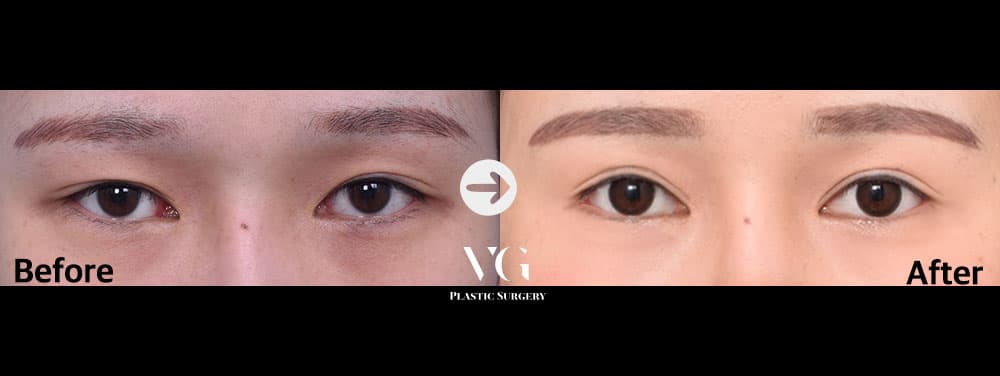
Incisional Double Eyelid3 months after surgery
FAQ
Questions patients ask
Is lower blepharoplasty done under general anesthesia?
It can be done under local anesthesia, sedation or general anesthesia, depending on the method and your health. At our clinic, three board-certified anesthesiologists work full time and do not operate, so one of them looks after you throughout surgery.
Can upper and lower blepharoplasty be done in the same trip?
They are often planned in one session, which means one anesthetic and one recovery period. It makes the operation longer and changes the quote, so mention your upper lids when you send your photo.
Will lower eyelid surgery get rid of dark circles?
It can soften the shadow cast by a bag or a groove. Darkness caused by pigment in the skin usually stays, because surgery doesn't change skin color.
How long do lower blepharoplasty results last?
Removed or repositioned fat generally doesn't return the way it was, but the face keeps aging, so skin and lid support continue to change over the years. Nobody can promise a lid will stay unchanged.
Why can't I get a figure without sending a photo?
Because the method sets the cost, and the method depends on whether your bags come from fat, a groove, loose skin or a slack lid. A front-facing photo and one looking up show most of that.
Sources
This article explains general medical information. Whether surgery suits you, and which method, is decided only after a consultation with the surgeon.
Written by
Im Young Min
Chief Director · Plastic Surgery
- Ph.D. in Medicine
- Internship and residency, Seoul St. Mary's Hospital
- Board-certified plastic surgeon, Seoul St. Mary's Hospital
- Adjunct professor of plastic surgery, Seoul St. Mary's Hospital
- Former director, Topface Plastic Surgery
Next step
Send two photos. Get a surgeon’s answer.
Front and side, natural light, no filter. Dr. Im Young Min reviews them and tells you which method fits and how many days to stay in Seoul.
International patients pay the same surgical fee as Korean patients. Pricing policy
Keep reading
Eyes
How Much Does Double Eyelid Surgery Cost in Korea? Results, How Long It Lasts, Reviews and When to Spend Less
There's no single figure: the method your lids need, any ptosis or inner-corner work, the anesthesia and your days in Seoul set the quote, and foreigners pay the same surgical fee as Korean patients.
Im Young Min ·
Eyes
Double Eyelid Surgery Cost in Korea: What Changes Your Quote? Results, Reviews and Methods
Quotes for double eyelid surgery in Korea differ because they describe different operations: suture or incision, fat removal, ptosis correction, inner-corner work and revision.
Im Young Min ·
Eyes
About Half of Asian Eyelids Have No Crease, and Other double eyelid surgery Korea percentage Numbers Worth Checking
No reliable published figure gives the double eyelid surgery Korea percentage. The number you can check is that about half of people of Asian descent have no upper eyelid crease (AAO EyeWiki).
Im Young Min ·