Eyes
Thinking About Korean Eye Bag Surgery? Methods, Cost and Recovery in Seoul
Korean eye bag surgery usually means planning about a week in Seoul: stitches, if used, come out 5 to 7 days after surgery, the first check falls in that week, and bruising can take 2 to 4 weeks to fade.
· 7 min read · Last updated
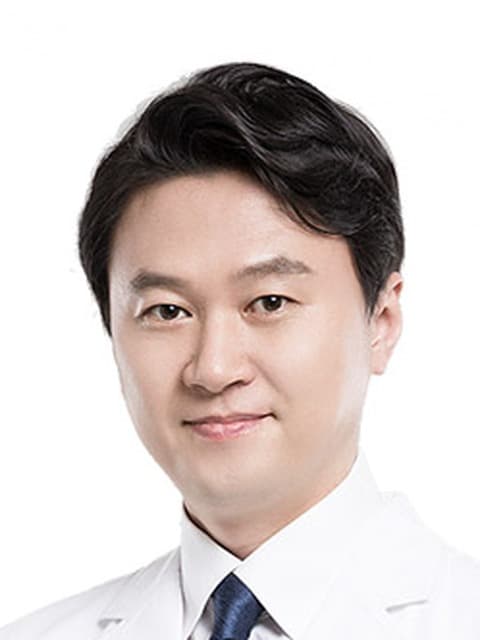
Edited by Im Young Min
In this article
- 01What Korean eye bag surgery changes under the lid
- 02Day by day: the first week after surgery
- 03How many nights should you book in Seoul?
- 04What can go wrong, including after you fly home
- 05Who may be asked to wait or change the plan
- 06Combining eye bag surgery with another operation on one trip
- 07What decides the cost of Korean eye bag surgery?
- 08Packing list for an eye bag surgery week in Seoul
The short answer
Are you weighing Korean eye bag surgery but worried about what happens once you're back home with the swelling still settling?
- Plan about seven to eight nights in Seoul so your return flight comes after the week-one stitch check.
- Vision is usually clear within 2 to 3 days, but bruising can last 2 to 4 weeks.
- Leave contact lenses out for at least two weeks and pack dark sunglasses.
- A lax lower lid, existing dry eye or recent under-eye filler can change the plan, so mention them early.
- Send lid photos and your travel dates on WhatsApp before booking flights.
Read on before you book flights or a hotel.
Profile
Im Young Min
Chief Director · Board-certified in Plastic Surgery
After this you will know what the surgery changes under the lid, how the methods differ, what decides the cost, and how many nights in Seoul your case may need.
Hello, I'm Dr. Im Young Min, Chief Director and a board-certified plastic surgeon.
At Verygood, three anesthesiologists are on staff and one is dedicated to every operation. They don't perform cosmetic surgery, so the surgeon working on your lower lids isn't also running your anesthesia.
I write this because many people assume recovery is over in three days and plan a short trip around that.
So, how long does Korean eye bag surgery keep you in Seoul? It depends on your lids and how you heal, so I would rather settle it with you directly than quote a number here.
Send your lid photos and travel dates on WhatsApp
What Korean eye bag surgery changes under the lid
Korean eye bag surgery is lower blepharoplasty: fat that has pushed forward under the eye is removed, or moved down into the hollow beneath it, through an incision inside the lid or just below the lashes. Which incision is used mostly comes down to whether you also have extra skin.
The American Academy of Ophthalmology's EyeWiki describes the inside-the-lid (transconjunctival) route as a good option for people whose fat bulges but who have no excess lower-lid skin. When there is loose skin, the incision sits just below the lashes and the skin is trimmed conservatively so the lid isn't shortened. Fat can also be repositioned into the groove below the bony rim instead of simply being taken out, which is what softens a tear-trough shadow. Our post on under-eye fat repositioning, bags and hollows goes deeper into that choice.
Upper and lower lids are separate operations with separate recoveries. If the tired look is coming from the upper lid, the plan looks more like double eyelid surgery in Korea, with or without an incision. The clinic's eye surgery page states its starting point plainly: lid thickness, fat and lifting strength are checked before deciding whether to cut at all.
Day by day: the first week after surgery
Most of what you'll notice in week one is swelling and bruising, and your vision usually recovers well before the bruises do. MedlinePlus, the U.S. National Library of Medicine's patient guide, says most people go home the same day as an eyelid operation, see well after 2 to 3 days, and may have bruising for 2 to 4 weeks.
| When | What published guidance describes | What it means for your trip |
|---|---|---|
| Day 0 | Same-day discharge is usual; ointment and a dressing go on before you leave | A hotel close to Gangnam, nothing planned that evening |
| Days 1–2 | Cold packs wrapped in a towel, head raised; EyeWiki notes cold compresses for 48 hours, then warm | Stay in; ask the hotel for an extra pillow |
| Days 3–5 | Activity limited for 3 to 5 days; vision usually clear by now | Short walks outside with sunglasses, still no gym |
| Weeks 2–4 | Bruising may last 2 to 4 weeks; no contact lenses for at least 2 weeks; no strenuous exertion for about 3 weeks | Glasses at the airport, tinted sunglasses on the flight and back at work |
The "back to normal in three days" line you'll find in forum threads is half right. Vision often is; the face usually isn't yet. MedlinePlus also lists more tearing, more sensitivity to light and wind, and occasional blurred or double vision during the first few weeks after eyelid surgery. Plan your first week back at work with sunglasses and glasses on hand.
How many nights should you book in Seoul?
In short, that figure comes from the 5-to-7-day stitch timeline in published guidance.
Laid out against a flight, the stay looks like this:
- Arrival night: land, sleep off the flight, keep the next day clear.
- Consultation: the in-person exam and the surgical plan, then surgery on the day you've booked.
- Days 1 to 4 after surgery: hotel, cold packs, head raised, short walks.
4. 5. Return flight: after that visit.
If you arrive with only five nights, the stitch check may simply not fit, and the trip has to be rebuilt around that visit rather than the other way round. People with fixed leave days often find it easier to choose the check date first and count backwards to the flight.
If you're working inside fixed leave, send your earliest arrival and latest departure on WhatsApp together with the lid photos.
Send your lid photos and travel dates on WhatsApp
Say you are flying in from abroad and have only one week off work. You notice the bags under your eyes most in photos, and you wear contact lenses every day. I would first look at whether the bulge is fat alone or also hollowing below it, because that changes the method. Then I would ask when you must be back at your desk and how you feel about going out with visible bruising. With those answers we can work out whether your nights in Seoul cover the stitch removal and a check of the swelling, or whether it is wiser to add a day or two.
What can go wrong, including after you fly home
Most problems after lower-lid surgery are temporary: dry or gritty eyes, extra tearing, light sensitivity and swelling of the white of the eye (chemosis). The rarer problems matter more for a traveler, because they can appear or persist once you're home.
Risks and side effects to know
EyeWiki lists lower-lid retraction (the lid sitting low and tethered by scar), ectropion (the lid turning outward, linked to lax lid support that wasn't corrected), double vision from injury to an eye muscle, thickened scars and suture cysts. MedlinePlus adds slow or uneven healing, lids that don't match, difficulty closing the eyes during sleep (rarely lasting) and, rarely, damage to the eye or loss of vision. Bleeding behind the eye, called retrobulbar hemorrhage, is rare but treated as an emergency.
What that means once you're back home:
- Sudden pain, swelling that keeps getting worse, a bulging eye or a drop in vision: go to an emergency department where you are, then tell your surgeon.
- Signs of bleeding or infection, the two warnings EyeWiki names: contact your surgeon.
- Dryness, tearing, light sensitivity: common in the first weeks; use lubricating drops if prescribed and wear sunglasses outdoors.
Keep a copy of your operation summary and your medication list with you, so a local doctor can see what was done. Healing speed and the final shape differ from person to person, and whether surgery suits you is decided at the in-person exam in Seoul.
Judging the result at week two is a common trap.
Who may be asked to wait or change the plan
Some lower lids need a different plan, and a few are better left alone for now. The usual reasons are a lax lid, extra skin, existing dry eye and recent under-eye injectables.
- A lax lower lid. When the lid is slow to snap back after a gentle pull, surgeons generally consider supporting the outer corner as well, because EyeWiki ties ectropion to uncorrected laxity and weak canthal support.
- Extra skin as well as fat. This moves the incision from inside the lid to below the lashes, with its own small scar to heal.
- Dry eye you already live with. Post-operative dryness lands on top of it, so tell the surgeon what drops you use now.
- Under-eye filler. Say what was injected and when; it changes what the surgeon expects to find.
- Hollows more than bags.
If a surgeon at home called your lids "difficult", bring what they said. It is often one of the points above, and knowing which one tells you early whether a single week in Seoul is realistic.
Combining eye bag surgery with another operation on one trip
In short, it can be planned, but every extra area brings its own recovery, and the longest one sets your flight home.
Bone work changes the arithmetic completely. V-line surgery on the jaw and chin or square-jaw and long-curve jaw reduction carries a far longer swelling period than lower lids, so the trip is planned around the bone, not the eyes.
What decides the cost of Korean eye bag surgery?
The cost depends on what your lower lids need. The method matters first: removing fat, repositioning it, or doing both are different operations with different time in the operating room. The amount of fat and the area treated also count, as does whether upper lids or other areas are included in the same visit. Anaesthesia, the number of days you stay in Seoul, and the follow-up checks before you fly home all add to the total. To get the figure for your case, send a photo of your lower lids on WhatsApp and ask for it there.
Packing list for an eye bag surgery week in Seoul
The American Society of Plastic Surgeons advises darkly tinted sunglasses and careful sun protection until eyelid healing is complete, which makes sunglasses the first thing in the bag.
- Dark sunglasses for the clinic visits, the walk outside and the flight.
- Your glasses, since contact lenses stay out for at least two weeks.
- Tops that open at the front, so nothing gets pulled over your face.
- A list of your current medications and any records of earlier eyelid surgery or under-eye filler.
- The clinic address for taxis and hotel searches: 635 Nonhyeon-ro, Gangnam-gu, Seoul.
When you have a rough window, send a photo of your lower lids and your travel dates on WhatsApp, and ask me one thing: how many nights in Seoul your case needs. One photo is enough, and you can ask before booking anything. When you come, I will examine you and recommend what fits your lids and your schedule.
Related pages:
Eyes before & after — more cases
Real patients from our archive, all photographed 3 months after surgery. Tap a case to compare it full size.
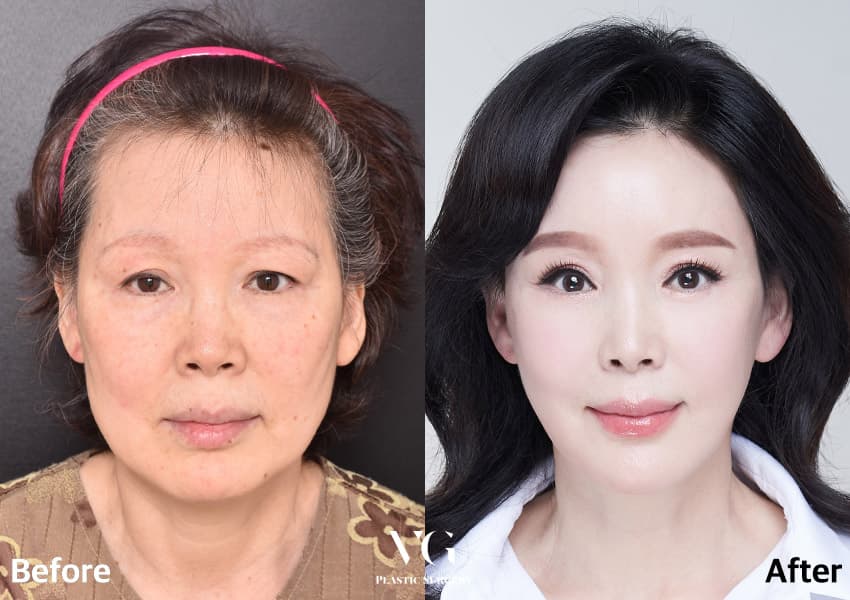
Face Lift3 months after surgery
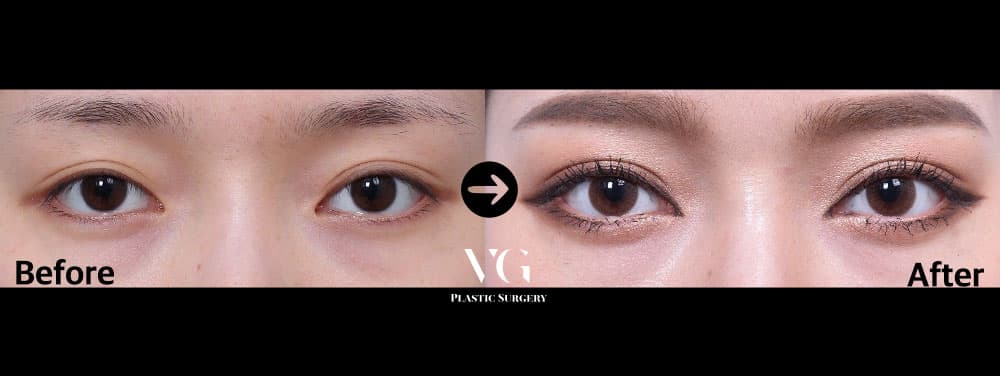
Natural-Adhesion Double Eyelid3 months after surgery
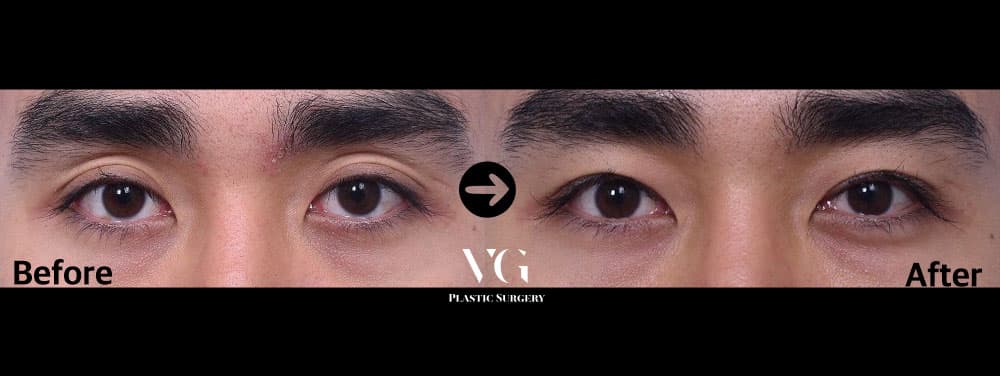
Incisional Double Eyelid3 months after surgery
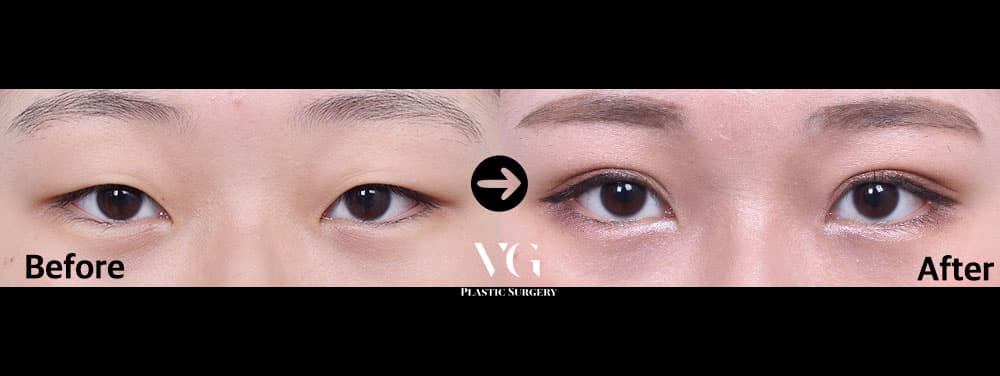
Incisional Ptosis Correction3 months after surgery
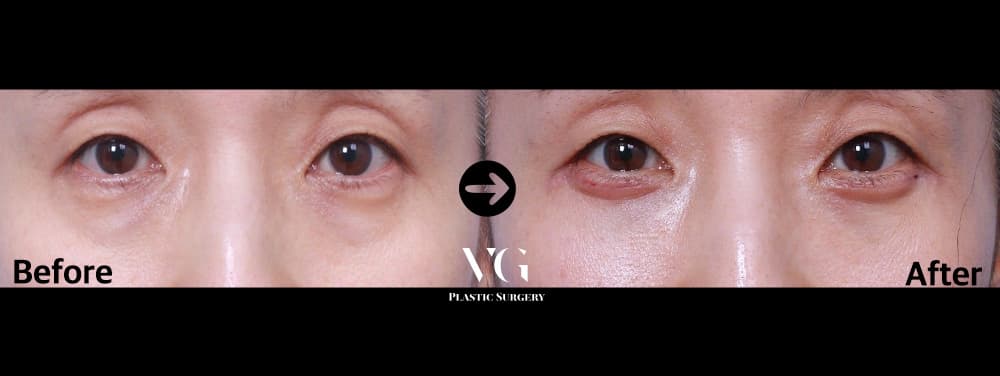
Lower Blepharoplasty3 months after surgery
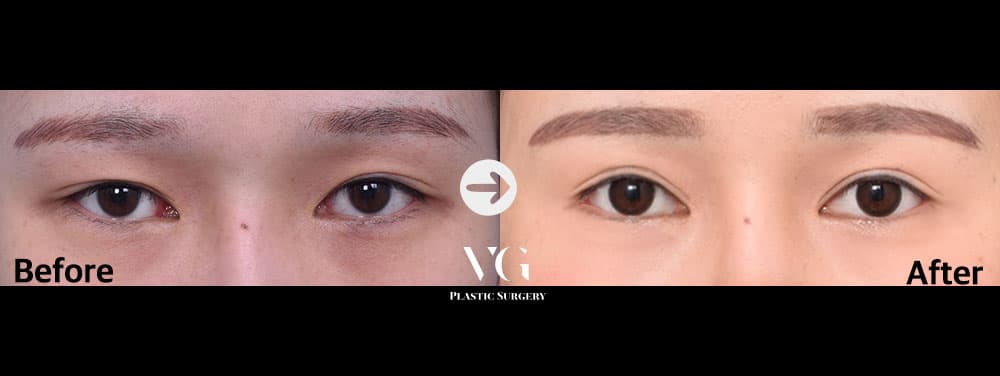
Incisional Double Eyelid3 months after surgery
FAQ
Questions patients ask
Is Korean eye bag surgery done asleep or awake?
The anesthetic approach is chosen for each patient by an anesthesiologist. VG Plastic Surgery has three anesthesiologists on staff, and one is dedicated to every operation; they don't operate, they assess underlying conditions beforehand and watch blood pressure, pulse and breathing throughout. Which approach fits you is settled at your consultation.
Will there be a visible scar under my eye?
With the inside-the-lid approach there is no skin incision. When extra skin has to be trimmed, the incision sits just below the lashes. MedlinePlus notes that eyelid scars can stay slightly pink for 6 months or more before fading to a thin line.
When can I wear contact lenses again after eyelid surgery?
MedlinePlus advises avoiding contact lenses for at least two weeks after an eyelid operation. Bring your glasses for the whole trip and for your first days back at work.
How long do the results of Korean eye bag surgery last?
According to MedlinePlus, the refreshed look after eyelid surgery usually lasts for years. The face keeps ageing, though, so skin and support around the eye continue to change over time.
Is eye bag removal the same as under-eye fat repositioning?
Both are forms of lower blepharoplasty. Removal takes out bulging fat, while repositioning moves it into the groove below the bony rim to soften a hollow. EyeWiki describes both, and which one suits you depends on whether you have bags, hollows or both.
Sources
This article explains general medical information. Whether surgery suits you, and which method, is decided only after a consultation with the surgeon.
Written by
Im Young Min
Chief Director · Plastic Surgery
- Ph.D. in Medicine
- Internship and residency, Seoul St. Mary's Hospital
- Board-certified plastic surgeon, Seoul St. Mary's Hospital
- Adjunct professor of plastic surgery, Seoul St. Mary's Hospital
- Former director, Topface Plastic Surgery
Next step
Send two photos. Get a surgeon’s answer.
Front and side, natural light, no filter. Dr. Im Young Min reviews them and tells you which method fits and how many days to stay in Seoul.
International patients pay the same surgical fee as Korean patients. Pricing policy
Keep reading
Eyes
How Much Does Double Eyelid Surgery Cost in Korea? Results, How Long It Lasts, Reviews and When to Spend Less
There's no single figure: the method your lids need, any ptosis or inner-corner work, the anesthesia and your days in Seoul set the quote, and foreigners pay the same surgical fee as Korean patients.
Im Young Min ·
Eyes
Lower Blepharoplasty Korea Cost: Fat, Skin or Lid Support? Reviews, Methods and Recovery
Your lower blepharoplasty cost in Korea follows what is causing the bags: bulging fat, a hollow beneath it, loose skin or a slack lower lid, plus the anesthesia and the days you plan in Seoul.
Im Young Min ·
Eyes
Double Eyelid Surgery Cost in Korea: What Changes Your Quote? Results, Reviews and Methods
Quotes for double eyelid surgery in Korea differ because they describe different operations: suture or incision, fat removal, ptosis correction, inner-corner work and revision.
Im Young Min ·