Eyes
Can I Get Korean Eyes With Thick, Puffy Lids?
Korean eyes usually means a low, natural double eyelid crease that follows your own eye shape. Whether it suits you, and whether a crease will hold, comes down to lid thickness, fat, lifting strength and the inner fold.

· 8 min read · Last updated
Edited by Im Young Min
In this article
- 01What people mean by Korean eyes
- 02Four traits in your lids that decide the result
- 03Thick skin and fat decide whether a crease holds
- 04Do your lids open fully, or droop a little?
- 05Where the inner fold sits, and whether to change it
- 06Which crease height will still look like you?
- 07What decides the cost of Korean eyes surgery?
- 08Risks, and who should wait
- 09Swelling, stitches and the flight home
- 10Who looks at your eyelids at VG Plastic Surgery
The short answer
Can you get Korean eyes if your lids are thick and puffy?
- Korean eyes usually means a low, soft double eyelid crease that follows your own eye shape.
- Four traits decide the plan: skin and fat thickness, lifting strength, the inner-corner fold and crease height.
- Thick, puffy lids are more likely to need an incision than sutures alone for the crease to hold.
- Asymmetry is the most common complication, and a fold set too high is harder to fix than one set low.
- Plan your flight after the stitch-removal visit, which published guidance places 5 to 7 days after surgery.
Read on before you book anything, because the answer depends on your own lids.
Profile
Im Young Min
Chief Director · Board-certified in Plastic Surgery
After this you will know what the look really means, which traits in your lids decide it, what the risks are, and how swelling fits around your flight home.
I'm Im Young Min, Chief Director, board-certified plastic surgeon at VG Plastic Surgery, certified at Seoul St. Mary's Hospital. I wrote this because many people assume thick lids rule out a crease, when skin, fat and lifting strength matter more.
Short answer: Korean eyes means a low, soft double eyelid crease, and thick lids can suit it when those three allow. Sometimes the crease needs more than stitches to hold.
Send two eyelid photos and your dates on WhatsApp
What people mean by Korean eyes
A crease, mostly. In a 2015 anatomy review in Seminars in Plastic Surgery, Kiranantawat and colleagues describe the Asian upper lid as puffier, with a less visible crease, frequent epicanthal folds and, quite often, a mild droop of the lid margin.
The same review explains why eyelid surgery moved away from copying a Western lid. High Caucasian-style folds often looked unnatural on Asian faces, and the goal shifted to what the authors call a “beautiful normal” Asian eyelid, a range of acceptable shapes agreed between surgeon and patient. That range is what most people mean by Korean eyes. The anatomy underneath is shared by many people who search for “Chinese eyes” or “Japanese eyes”, so the label describes a style rather than a nationality.
Mechanically, a crease forms where fibres from the lid-lifting muscle (the levator) reach the skin and the thin muscle just under it. When you open your eye, the levator pulls, and the skin above that attachment folds over it. In a single lid, the review explains, this skin–muscle–tarsus connection is weak or narrow, so the skin rolls down without a clean line. Double eyelid surgery creates that attachment on purpose, either with buried sutures or through a small incision.
Four traits in your lids that decide the result
Every route to Korean eyes comes back to four traits you can partly see in a mirror. The table puts them side by side.
| Trait | What you notice in the mirror | What it tends to change |
|---|---|---|
| Skin and fat thickness | Puffy lids; a taped crease fades by evening | Sutures alone, or an incision with fat trimming |
| Lifting strength | A tired look; the lid covers part of the iris | Whether ptosis correction joins the plan |
| Inner-corner fold | A small web of skin over the inner corner | Infold or on-fold crease; whether epicanthoplasty is discussed |
| Face and brow | Which crease height still looks like you | How low the new line is set |
None of these is a pass or fail. They are the measurements that turn “I want Korean eyes” into a specific operation, and two people with the same goal can end up with different plans.
Thick skin and fat decide whether a crease holds
If your lids are full, a crease made with stitches alone is more likely to fade. The 2015 review notes that Asian upper lid skin is thicker, that fat in front of and under the muscle is more prominent, and that the deeper fat pad often sits as low as the upper edge of the tarsal plate. All of that cushions the line a surgeon is trying to create.
The American Academy of Ophthalmology's EyeWiki entry on Asian blepharoplasty sets out the trade-off clearly. The non-incisional method leaves no external scar, takes less time and is easier to revise, and suits people who only need a crease, with no fat, skin or muscle to remove. Its main drawback is a high failure rate, because a few sutures have to hold several tissue layers.
The incisional method fixes the levator to the overlying tissue directly and lets the surgeon remove fat or excess tissue, at the cost of a longer operation and a longer recovery.
One simple check shows the difference. With a thin probe pressed gently along the planned line while you look up, a thin lid folds crisply and keeps the fold; a thick lid tends to bury the line or roll a soft bulge over it. That second picture is where the incisional route usually comes up. The full comparison of both methods, with recovery for each, is in our guide to double eyelid surgery in Korea.
Say your lids are thick, you have a faint crease on one side only, and you want a low, soft fold that still looks like you. I would first look at how much fat sits behind the skin and whether the lid lifts fully when you look straight ahead. If the skin is heavy and the fat is full, a few stitches may loosen as the swelling goes down, so I would talk with you about an incision and some fat removal instead.
If the lid is lighter, stitches might be enough. Either way, I would pick the crease height by how it sits against your brow and the inner corner of your eye, not from a photo of someone else's lids.
Do your lids open fully, or droop a little?
Look straight into a mirror at eye level with your brows relaxed. If the upper lid covers a noticeable part of the coloured iris, or you find yourself lifting your brows to see better, lifting strength may be part of the picture. The anatomy review lists mild ptosis among the common features of the Asian eyelid.
This matters because a crease added to a weak lid can make the eye look heavier. The new line sits on a lid that still doesn't open fully, so the tired look many people want to fix stays put. When lifting strength is low, ptosis correction tightens the levator so the lid opens further, and the crease is set within the same operation. It is also why a photo with your eyes open and brows down tells a surgeon more than a smiling selfie.
Where the inner fold sits, and whether to change it
The epicanthal fold is the small web of skin that covers the inner corner of many East Asian eyes, and it shapes the crease more than people expect.
Creases are grouped by where they start relative to that fold. An infold crease begins inside the fold and fans outward; an on-fold crease starts at the fold; an outfold crease runs above it along the whole length of the lid.
Epicanthoplasty, which opens the inner corner, is one of the eye procedures VG lists alongside double eyelid surgery and ptosis correction. It changes the distance between the eyes and is hard to undo. A softer infold crease that leaves the corner alone is often closer to what people picture when they say Korean eyes. A wide, parallel crease with an opened corner is a different look, and some people want exactly that.
Which crease height will still look like you?
Lower than most people first ask for. The review's figure of roughly 2 mm lower for Asian creases, and lower again in men, is a useful anchor: a line set high on a thick lid tends to look surgical.
EyeWiki reports an excessively high fold in about 7% of patients, often from adhesions or aggressive fat removal. A fold that is too high is also harder to bring down than a low fold is to raise.
If you want to judge results yourself, our page on reading Korean eyelid surgery pre- and post-treatment photos explains which angles and timings make a photo trustworthy.
What decides the cost of Korean eyes surgery?
The main factor is the method. A stitched crease and an incision with fat removal are different operations with different time in the operating room. The thickness of your skin and fat decides which one your lids need, and whether the upper lid muscle also needs work. Anaesthesia type and the number of days you can stay in Seoul for stitch removal and check-ups also shape the plan. If you have had eyelid surgery before, revision work adds another layer.
To get the figure for your case, ask on WhatsApp and attach a photo of your eyes open and gently closed.
Risks, and who should wait
Double eyelid surgery carries real risks, and the most common one is cosmetic. The EyeWiki entry lists:
- An excessively high fold, in about 7% of patients
- Loss or loosening of the crease, in less than 3% of cases, more often after suture methods with absorbable stitches
- A droop of the lid (ptosis) from injury to the levator
- Bleeding, from prolonged bruising to a hematoma
- New or worsened dry eye symptoms
Most faces have some asymmetry before surgery, so small differences once swelling settles are expected. A revision is generally considered only when a difference is clear and stable.
Some people should wait: anyone with active dry eye or an eye infection, anyone whose lid opening hasn't been checked for ptosis, and anyone still unsure which height they want. If your lids have grown heavy with age, the fold may be coming from the brow, and a brow lift may fit better than a new crease. If you've had eyelid surgery before, revision follows its own plan. Whether you are a candidate is decided at the in-person exam in Seoul, once the lid has been examined directly.
Swelling, stitches and the flight home
Plan the trip around the stitch-removal visit, because that date doesn't move. EyeWiki puts suture-removal follow-up at 5 to 7 days after surgery and a first look at the result at around two weeks. The American Society of Plastic Surgeons describes early healing as swelling, bruising, irritation, dry eyes and discomfort, managed with cold compresses, ointment and medication, and advises sun protection and dark sunglasses until healing is complete.
For a traveller, that means three things. Book the return flight after the stitch-removal visit, not on the same morning. Expect to look swollen in photos for the first week, and pack large sunglasses. Skip swimming and hard exercise during the trip, which the EyeWiki entry also advises. The exact number of days depends on whether you have sutures alone, an incision, or ptosis correction added, so your dates belong in your first message.
Send your planned arrival and departure dates on WhatsApp with one photo of your eyes open.
Send two eyelid photos and your dates on WhatsApp
Who looks at your eyelids at VG Plastic Surgery
Three surgeons share the eye centre: Hong Dae Won, Yang Jong Phil and me. Hong Dae Won and Yang Jong Phil are both full members of the Eyelid Surgery Research Group of the Korean Society of Plastic and Reconstructive Surgeons. My own background includes a Ph.D. in Medicine, internship and residency at Seoul St. Mary's Hospital, an adjunct professorship of plastic surgery there, and full membership of the American Society for Aesthetic Plastic Surgery (ASAPS).
The clinic is at 635 Nonhyeon-ro, Gangnam-gu, Seoul. Each surgeon's training is published under their own name on the site, so you can check who would operate before you fly. If under-eye bags are part of what makes your eyes look tired, that is a separate operation, covered in under-eye fat repositioning in Korea.
The smallest useful step is two photos on WhatsApp: eyes open looking straight ahead with your brows relaxed, and eyes gently closed, both in daylight without makeup. Add one question with them: "Would stitches hold a crease on my lids, or do I need an incision?" One photo is enough to start, and you can ask before booking anything.
You can also browse each centre from the clinic's English homepage.
Related pages:
Eyes before & after — more cases
Real patients from our archive, all photographed 3 months after surgery. Tap a case to compare it full size.
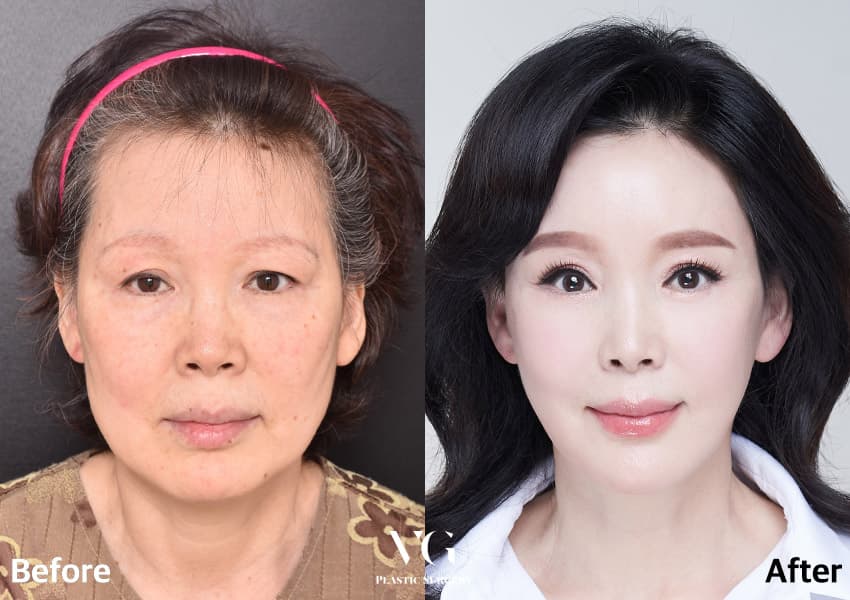
Face Lift3 months after surgery
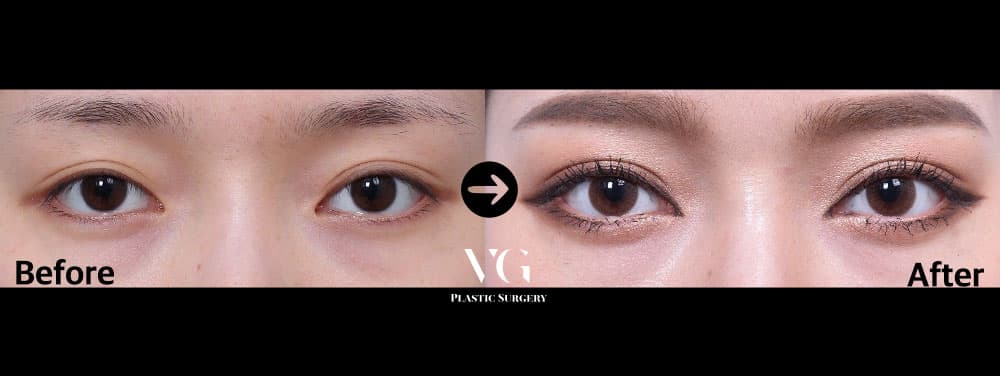
Natural-Adhesion Double Eyelid3 months after surgery
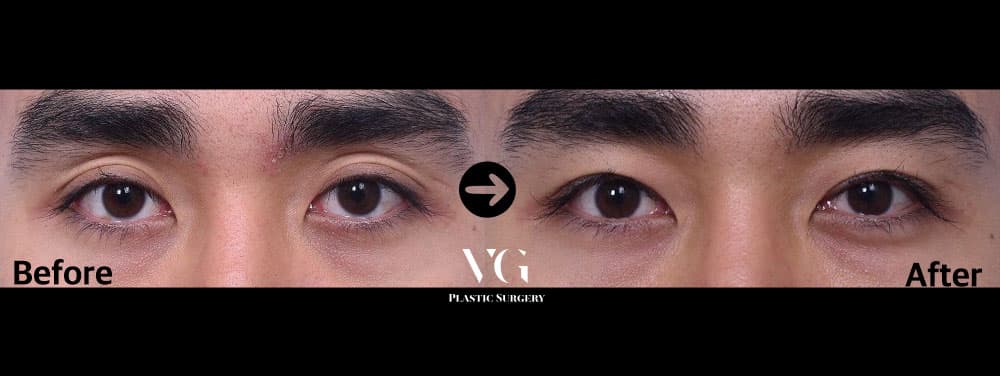
Incisional Double Eyelid3 months after surgery
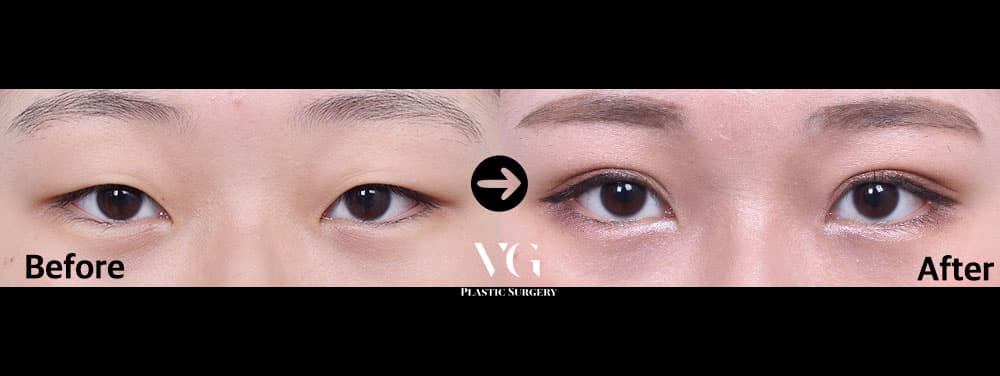
Incisional Ptosis Correction3 months after surgery
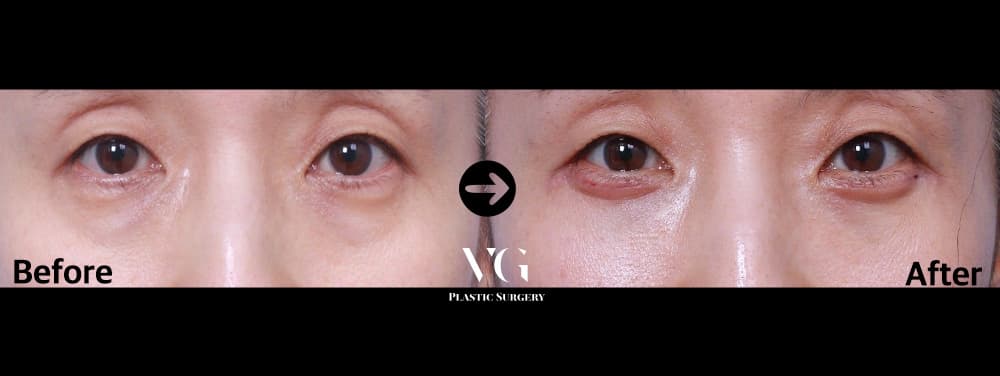
Lower Blepharoplasty3 months after surgery
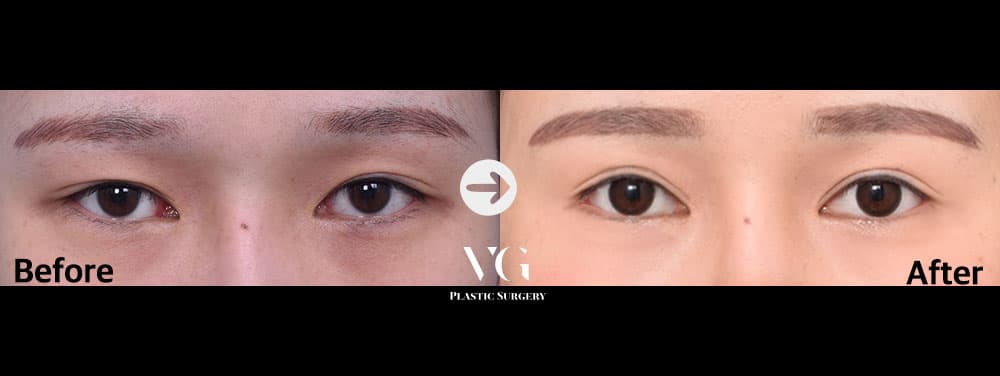
Incisional Double Eyelid3 months after surgery
FAQ
Questions patients ask
Is getting Korean eyes the same as double eyelid surgery?
Mostly, yes. The core of the look is a low, natural crease made with sutures or through an incision. Depending on the lid, ptosis correction or epicanthoplasty may be added, and the four traits described above decide which.
Can men get Korean eyes without looking feminine?
Yes. Male creases are usually set lower, and a 2015 review in Seminars in Plastic Surgery notes that its authors generally favour an infold or on-fold crease for men. A low line on a lid that opens well tends to read as rested.
Will a stitched crease last if my lids are puffy?
It is less likely to. The American Academy of Ophthalmology's EyeWiki notes a high failure rate for the non-incisional method because a few sutures must hold several tissue layers. Thick lids with prominent fat are often better suited to the incisional method, where fat can be trimmed.
Will people see a scar after incisional double eyelid surgery?
The incision is placed along the new crease, so it usually sits inside the fold when your eyes are open. It is more noticeable when the eyes are closed in the first weeks and tends to soften as healing continues.
Do I need to speak Korean for the consultation?
Starting with photos on WhatsApp is also fine.
Sources
This article explains general medical information. Whether surgery suits you, and which method, is decided only after a consultation with the surgeon.
Written by
Im Young Min
Chief Director · Plastic Surgery
- Ph.D. in Medicine
- Internship and residency, Seoul St. Mary's Hospital
- Board-certified plastic surgeon, Seoul St. Mary's Hospital
- Adjunct professor of plastic surgery, Seoul St. Mary's Hospital
- Former director, Topface Plastic Surgery
Next step
Send two photos. Get a surgeon’s answer.
Front and side, natural light, no filter. Dr. Im Young Min reviews them and tells you which method fits and how many days to stay in Seoul.
International patients pay the same surgical fee as Korean patients. Pricing policy
Keep reading
Eyes
How Much Does Double Eyelid Surgery Cost in Korea? Results, How Long It Lasts, Reviews and When to Spend Less
There's no single figure: the method your lids need, any ptosis or inner-corner work, the anesthesia and your days in Seoul set the quote, and foreigners pay the same surgical fee as Korean patients.
Im Young Min ·
Eyes
Lower Blepharoplasty Korea Cost: Fat, Skin or Lid Support? Reviews, Methods and Recovery
Your lower blepharoplasty cost in Korea follows what is causing the bags: bulging fat, a hollow beneath it, loose skin or a slack lower lid, plus the anesthesia and the days you plan in Seoul.
Im Young Min ·
Eyes
Double Eyelid Surgery Cost in Korea: What Changes Your Quote? Results, Reviews and Methods
Quotes for double eyelid surgery in Korea differ because they describe different operations: suture or incision, fat removal, ptosis correction, inner-corner work and revision.
Im Young Min ·