Facial Contouring
What Korean Jaw Shaving Removes, and Why Your Age Changes the Plan
Korean jaw shaving removes part of the lower jaw's angle and outer bone through incisions inside the mouth. It suits width that comes from bone, and past 35 it also needs skin that can follow a smaller jaw.
· 8 min read · Last updated
Edited by Im Young Min
In this article
- 01What jaw shaving takes off, and what it leaves
- 02Is your jaw wide because of bone or because of muscle?
- 03Why age changes the plan after 35
- 04How the operation is done
- 05What decides the cost of Korean jaw shaving?
- 06Risks, and who shouldn't have it
- 07Swelling and the flight home
- 08What to bring to the consultation
The short answer
Wondering whether Korean jaw shaving would narrow your square lower face, and what it asks of you in swelling and risk?
- Korean jaw shaving removes the flared jaw angle and thins the outer bone through incisions inside the mouth.
- It helps width that comes from bone; a thick chewing muscle changes less with bone surgery.
- After 35, skin elasticity sets how much bone can come off without a loose jawline.
- Jaw shaving does not change your bite; a misaligned jaw needs double jaw surgery, which this clinic does not perform.
- Plan your flight around the post-operative checks, because swelling lasts longer than any trip.
Read on before you book or decide. After this post you will know what bone comes off, how to tell bone width from muscle width, how age changes the plan, and what the cost depends on.
Profile
Im Young Min
Chief Director · Board-certified in Plastic Surgery
I'm Im Young Min, Chief Director, board-certified plastic surgeon, trained at Seoul St. Mary's Hospital. I wrote this because many people assume a wide jaw always means bone, when a thick chewing muscle is often part of it, and that changes what surgery can do. Short answer: Korean jaw shaving removes bone at the back corner of the lower jaw through incisions inside the mouth, and it suits width that comes from bone more than from muscle.
Send your front and profile photos on WhatsApp
What jaw shaving takes off, and what it leaves
The name covers two moves, and most operations combine them. Angle resection cuts away the flared back corner of the jaw along a curve, which mainly changes your profile. Outer-cortex reduction thins the outer layer of bone along the side of the jaw, and that changes the width you see in a mirror from the front.
People often arrive asking for the angle cut when the thing that bothers them in photos is front-view width. Those are different operations on the same bone. A plan that only removes the corner can leave a face that looks smaller from the side and almost unchanged from the front.
When the reduction continues forward along the lower border toward the chin, it becomes a long-curve reduction. There's a fuller comparison of a square jaw angle against long-curve reduction on this site. If the chin's length or width is part of what you want changed, that's a separate step, which is why V-line surgery treats the jaw and chin as one line. For how the jaw fits with cheekbones and chin overall, see which contouring surgery a face actually needs.
What jaw shaving leaves alone matters just as much. The joint, the teeth and the way they meet are untouched, and the jaw is not moved forward or back.
Is your jaw wide because of bone or because of muscle?
Clench your teeth with your fingertips on the corners of your jaw. If a firm bulge pushes out under your fingers, part of your width is the masseter, the chewing muscle. If the corner feels just as wide when you relax, it's mostly bone.
Most square faces are a mix, and the ratio decides what Korean jaw shaving can do for you. Removing bone does little to a thick masseter. When most of the width is muscle, the operation can change less than you expect, and that's worth knowing before you book a flight. The CT shows both layers: how thick the bone is, how far it flares, and how much muscle sits on top of it.
Two related searches point somewhere else entirely. A recessed jaw, where the lower jaw sits back, isn't helped by removing bone. Jaw angle implants do the opposite of shaving: they add width for people who feel their jaw is too soft.
Why age changes the plan after 35
At twenty-five, the main question is how much bone to remove. At forty-five, a second question joins it: will the skin and fat that drape over the jaw settle onto a smaller frame, or hang from it?
Bone is the scaffold of the lower face. Over the years skin loses elasticity, and the fat along the jawline tends to descend. Take bone out from under tissue that has already started to soften, and the new, narrower line can show some looseness or an early jowl that the old wide angle was holding up. That's one reason surgeons generally remove a more conservative amount of bone in older patients, and why a lift sometimes enters the conversation.
| Your situation | What the exam looks at | How the plan may shift |
|---|---|---|
| 20s to early 30s, firm skin | Bone versus muscle, symmetry | Angle and cortex amount are the main decisions |
| Late 30s to 40s, slight softness at the jawline | Skin elasticity, jowl fat, bone thickness | Less bone; a lift may be discussed |
| 50s and beyond, visible jowls | Whether width is still the main problem | A facelift may change more than bone removal |
Age also changes the medical side: blood pressure, medicines that thin the blood, and how quickly swelling settles. These go into the anesthesia assessment before surgery is scheduled.
The clinic's facelift options include Crystal, SMAS and mini lifts. Lost volume in the cheeks is a different problem again, often addressed with fat grafting to the face. Whether any of these belong in your plan is decided at the in-person exam.
Say you are 41, and from the front your lower face looks wide and square. You assume it is all bone. When I look at photos like yours, I first check whether the width sits at the corner of the jaw or higher, over the chewing muscle, and whether the skin along the jaw line has started to loosen with age.
If the corner is clearly the widest part, shaving that bone can make sense, and I would keep the amount as small as the shape allows, because bone does not grow back. If the width sits higher, over the muscle, taking more bone would not match what you see in the mirror, and the plan would have to change. Your age decides how much the skin will settle after the bone is reduced, so it shapes the plan from the start.
How the operation is done
Korean jaw shaving is done under general anesthesia through an incision inside the mouth, behind the lower back teeth, so there is no cut on the skin of the face. The surgeon shapes the angle with a saw along a planned curve, then reduces the outer cortex.
The main structure to protect is the inferior alveolar nerve, which runs through a canal inside the jaw and carries feeling to the lower lip and chin.
The nerve's course varies from person to person, which is why it is traced on your own CT before the line is drawn.
The second thing to read is the bone itself. Its thickness varies along the jaw, and cortex that is thin in one spot can't be reduced as much as the rest. Seeing that on CT is how the amount removed is matched to what your bone can spare.
During the operation, the anesthesiologist's only job is you. The surgeon watches the bone and the nerve; the anesthesiologist watches your breathing, pulse and blood pressure until you're awake in recovery.
What decides the cost of Korean jaw shaving?
The cost depends on how much of the jaw needs work. Taking only the corner is a smaller operation than reshaping a longer stretch of the jaw line, and the plan changes with the method. How much bone is removed, and whether the muscle is also a reason for the width, changes the plan too. Anaesthesia time follows the length of the operation. The days you stay in Korea matter as well, because swelling and a check of your jaw before you fly home need to fit your schedule.
Follow-up after you return is part of the plan too. To get the figure for your own case, send a front photo and a profile photo on WhatsApp and ask for it there.
Risks, and who shouldn't have it
Temporary numbness of the lower lip is the risk people most often meet.
- lower-lip numbness, or injury to the mental nerve near the chin
- hematoma (a collection of blood under the tissue) and severe swelling
- infection
- scarring at the corner of the mouth
- a secondary angle, a new step in the jawline where the cut ends
- asymmetry between the two sides
- lasting facial nerve injury
- subcondylar fracture and massive bleeding, both rare and serious
The same paper notes that jaw reduction is among the most frequently performed procedures in Korea. Common doesn't mean minor. This is bone surgery under general anesthesia, and you should hear your own risks, explained from your own CT, before you agree to anything.
Some people shouldn't have jaw shaving, or shouldn't have it yet:
- If your teeth don't meet properly, or your jaw is crooked or set back, the problem is the jaw's position. That calls for orthognathic surgery (double jaw surgery) by an oral and maxillofacial team. We don't perform double jaw surgery, and shaving can't correct a bite.
- If most of your width turns out to be muscle.
- If your skin has loosened to the point where removing bone would leave the lower face looking emptier.
- If you're hoping for a different face and a narrower jaw is only part of it.
Uncontrolled blood pressure, blood-thinning medication you can't pause, and smoking all affect timing and are discussed before a date is set.
Swelling and the flight home
Plan your flight around the surgeon's post-operative checks, since swelling outlasts any reasonable trip. In general, the lower face is most swollen in the first several days, visible fullness eases over the following weeks, and the final line of the jaw keeps refining for a few months.
What that means for a traveler:
- Expect soft food for a while, because the incision is inside the mouth; the surgeon tells you when normal eating can resume.
- A compression garment around the jaw is commonly used after jaw reduction.
Once you're home, gradual easing of swelling and slowly returning feeling in the lip are expected. Swelling on one side that grows, fever, a bad taste or discharge in the mouth, or numbness that gets worse should be seen by a doctor promptly, and those notes you carried home will help them.
If trip length is what's holding you back, send your travel dates on WhatsApp along with the two photos.
Send your front and profile photos on WhatsApp
What to bring to the consultation
A few documents make the consultation at 635 Nonhyeon-ro in Gangnam more useful, especially if you've only got a short window in Seoul:
- any panoramic dental X-ray or facial CT you already have, with its date
- a list of medicines and supplements, including anything that thins the blood
- records of earlier facial or dental surgery
- if you're over 35, a photo of yourself from ten or fifteen years ago
That older photo is surprisingly useful. It shows how much of today's jawline is bone you were born with and how much is time, and those two need different plans.
When you're ready, send a front photo and a profile photo on WhatsApp, with your age and the month you're thinking of traveling. Then ask one question: is my width mostly bone or muscle, and is jaw shaving a fit for it? One photo is enough to start, and you can ask before booking anything.
Related pages:
Facial Contouring before & after — more cases
Real patients from our archive, all photographed 3 months after surgery. Tap a case to compare it full size.
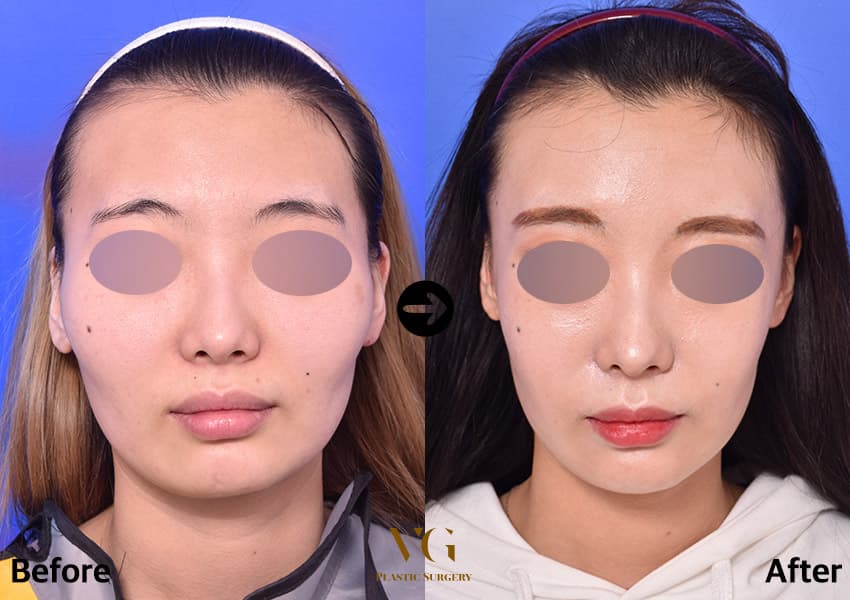
Cheekbone (Zygoma) Reduction3 months after surgery
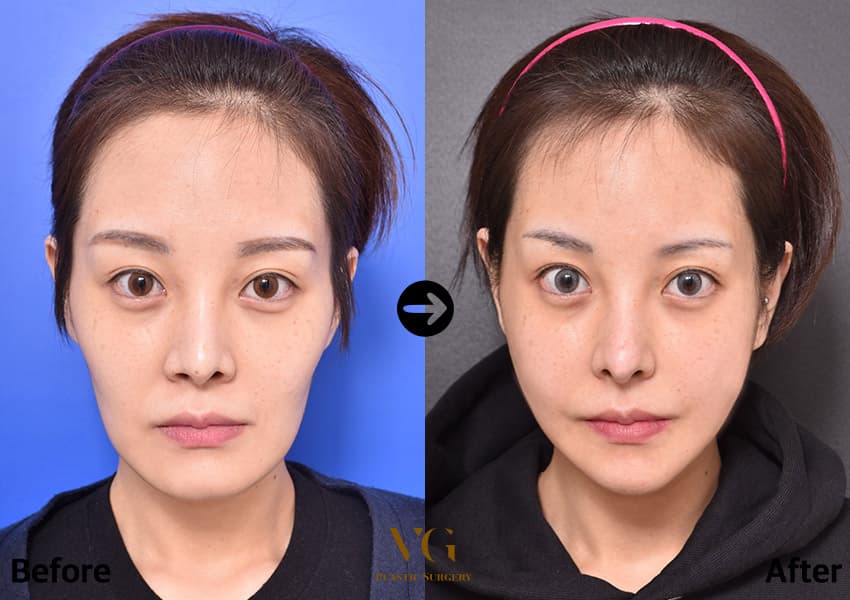
Cheekbone (Zygoma) Reduction3 months after surgery
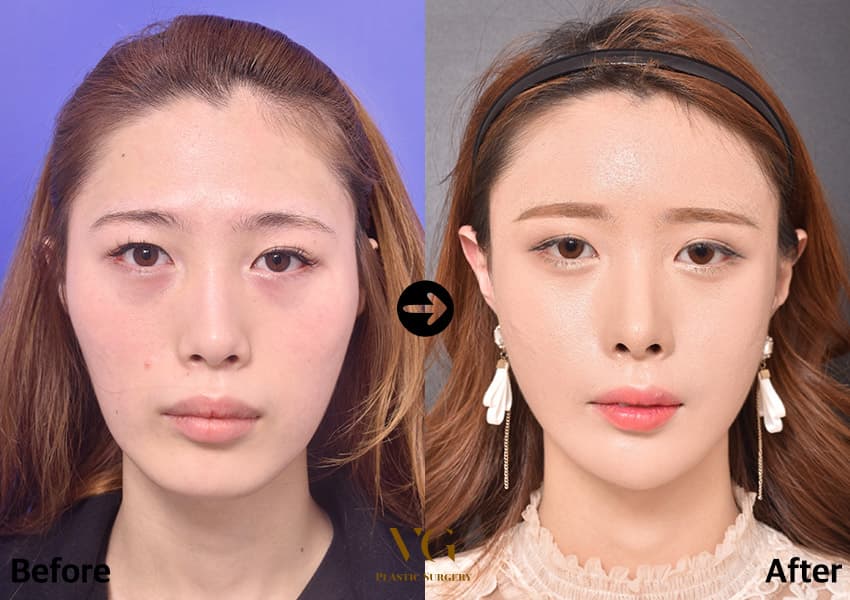
Cheekbone (Zygoma) Reduction3 months after surgery
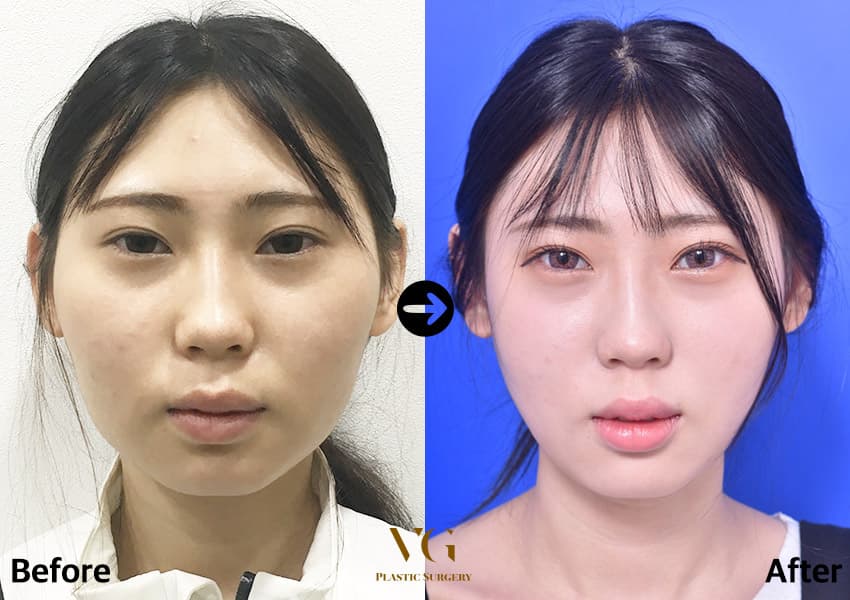
Cheekbone (Zygoma) Reduction3 months after surgery
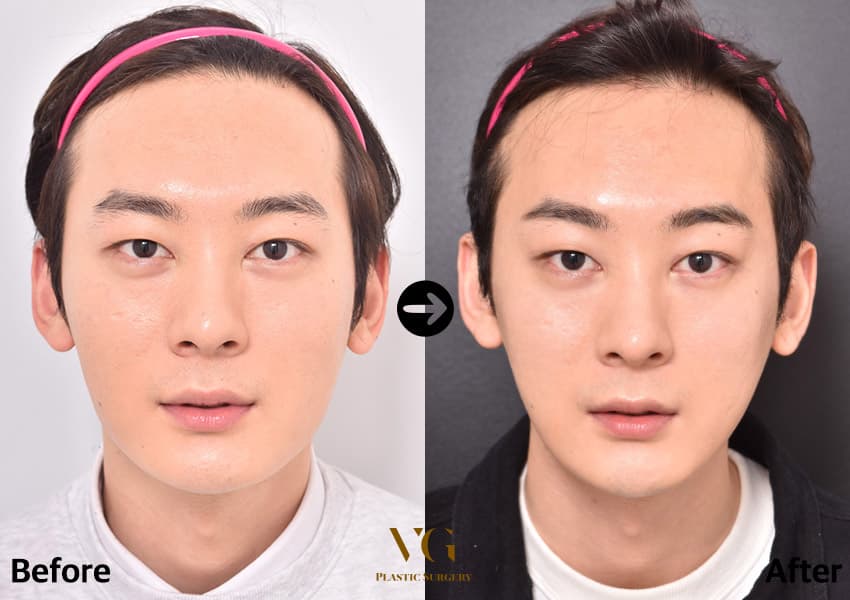
Square Jaw Reduction3 months after surgery
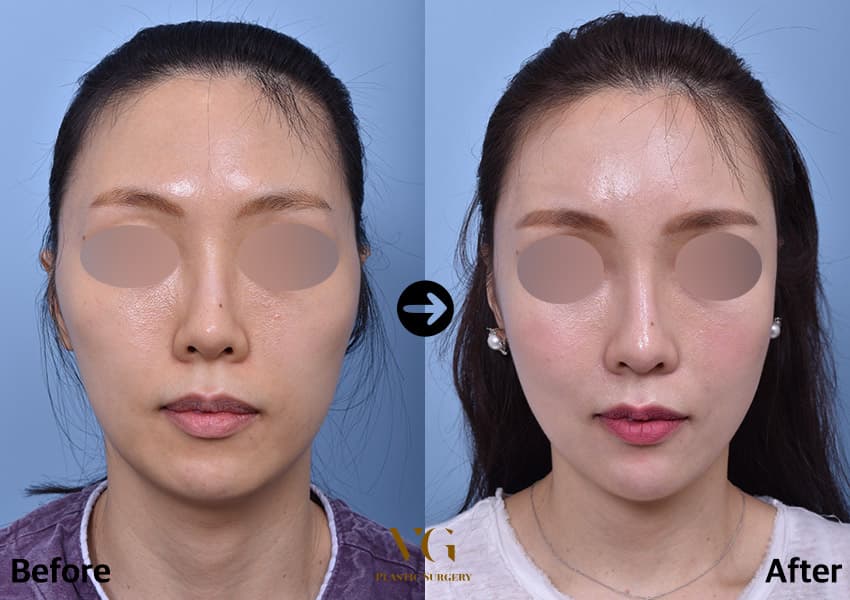
Cheekbone (Zygoma) Reduction3 months after surgery
FAQ
Questions patients ask
Will Korean jaw shaving change how my teeth bite together?
If your bite is off or your jaw is set back or crooked, that is treated with orthognathic (double jaw) surgery by an oral and maxillofacial team, which VG Plastic Surgery does not perform.
Is jaw shaving the same thing as V-line surgery?
They overlap but are not the same. Jaw shaving works on the angle and the side of the lower jaw. V-line surgery usually adds chin reshaping so the jaw and chin read as one tapered line from the front.
Can the jaw bone grow back after shaving?
Removed bone does not grow back, which is why the amount is planned on CT before surgery. The cut edges heal and remodel over the following months, but the overall width you lose stays lost, so taking too much cannot simply be reversed.
Will jaw shaving leave a scar on my face?
With the approach through the mouth, the incision sits inside the cheek behind the lower back teeth, so there is no cut on the facial skin. Scarring at the corner of the mouth is listed in the medical literature as a possible complication, and your surgeon explains how the incision is protected.
How long does lip numbness last after jaw reduction surgery?
Some numbness of the lower lip or chin is common in the early period after jaw reduction because the nerve sits close to the operating area. It usually improves as healing continues, but how long it lasts varies. Numbness that worsens rather than improves should be checked by a doctor.
Am I too old for Korean jaw shaving in my 40s or 50s?
Age alone doesn't rule it out. What matters more after 35 is skin elasticity and whether jowls are forming, because a smaller jaw under loose skin can look older. In those cases a more conservative reduction or a facelift may be discussed instead of, or along with, bone removal.
Sources
This article explains general medical information. Whether surgery suits you, and which method, is decided only after a consultation with the surgeon.
Written by
Im Young Min
Chief Director · Plastic Surgery
- Ph.D. in Medicine
- Internship and residency, Seoul St. Mary's Hospital
- Board-certified plastic surgeon, Seoul St. Mary's Hospital
- Adjunct professor of plastic surgery, Seoul St. Mary's Hospital
- Former director, Topface Plastic Surgery
Next step
Send two photos. Get a surgeon’s answer.
Front and side, natural light, no filter. Dr. Im Young Min reviews them and tells you which method fits and how many days to stay in Seoul.
International patients pay the same surgical fee as Korean patients. Pricing policy
Keep reading
Facial Contouring
South Korea Genioplasty Cost Range: What Moves the Number? Methods, Reviews and Recovery
A South Korea genioplasty cost range is wide because moving bone, shortening a chin and placing an implant are different operations; the method, anesthesia and days in Seoul set your figure.
Im Young Min ·
Facial Contouring
Three Dates That Shape a Zygoma Reduction Korea Trip, From CT to Flight Home
Zygoma reduction in Korea is bone surgery you fly home from, so plan around three dates: the consultation and CT before surgery, the check-up that clears you to fly, and your first appointment at home.
Im Young Min ·
Facial Contouring
Is chin lipo Korea Right for Your Full Chin? Cost, Reviews and What It Can't Fix
What chin lipo Korea does is remove fat under the chin and along the jaw. It won't shorten a long chin or narrow a square one, and it suits people at a stable weight whose skin still has some spring.
Im Young Min ·