Facial Contouring
Korean Plastic Surgery Before and After: How to Read the Photos
A Seoul plastic surgeon shows how to read before-and-after photos — time since surgery, angle, lighting, fixed landmarks and edits — using real cases from the clinic's archive.

· 7 min read · Last updated
In this article
- 01Why most before-and-after photos tell you less than they seem
- 02Check the date first: when was the after photo taken?
- 03Same angle, same distance: checking the geometry
- 04Lighting, makeup and edits: what to discount
- 05Where can I see Korean plastic surgery before and after photos?
- 06Reading a result for your own face
- 07Who facial contouring suits — and who it doesn't
- 08If the photos convince you: coming to Seoul for facial contouring
- 09What I look at in the photos you send
The short answer
Korean plastic surgery before and after photos are only useful if you check four things: how long after surgery the after photo was taken, whether both shots share the same angle and distance, whether the lighting matches, and whether fixed landmarks such as the ears and moles line up. A photo at three months shows a shape that is still settling — for facial contouring, the final result is assessed at about 12 months.
- Check the time since surgery first: a 3-month photo is close to final for some operations and still swollen for others.
- Compare the ears, eye level and camera distance; if they differ, the change may be the angle rather than the surgery.
- Discount brighter light, makeup and new hair, and judge the outline of the face instead.
- Look for cases whose before resembles your face, from more than one angle, each with a date.
- Facial contouring results are assessed at about 12 months, and the stay in Korea is at least 14 days.
I am Im Young Min, chief director and board-certified plastic surgeon at VG Plastic Surgery in Seoul, and I am part of our facial contouring team. I trained at Seoul St. Mary's Hospital, where I am an adjunct professor of plastic surgery. Almost every patient who writes to me from abroad has already spent hours on Korean plastic surgery before and after photos, so this is how I suggest reading them.
Profile
Im Young Min
Chief Director · Board-certified in Plastic Surgery
Why most before-and-after photos tell you less than they seem
Whether you type korea plastic surgery before after or search for south korea plastic surgery before and after, you get thousands of images in minutes. Most of them answer one question: does the after look better? They skip the question that matters to you — would that change happen to a face like mine, and how long would it take?
A Korean plastic surgery before and after pair is evidence only when the two pictures differ in one thing: the surgery. Everything else, from the camera distance to the light in the room, should stay the same. When it does not, you are comparing photographs, not results.
Check the date first: when was the after photo taken?
Every case in our archive carries the time since surgery, and almost all of them were photographed at three months. Three months is a useful checkpoint, but it is not the end. How close a three-month photo is to the final result depends on the operation.
| Surgery | Swelling at its peak | Looks natural to others | Final result assessed |
|---|---|---|---|
| Double eyelid, non-incisional | Days 2–3 | About 1 month | About 3 months |
| Double eyelid, incisional | Days 3–5 | 2–3 months | 6 months |
| Rhinoplasty without bone work | Days 3–5 | 1–2 months | 6 months |
| Rhinoplasty with osteotomy | Days 5–7 | About 3 months | 6–12 months |
| Facial contouring (bone) | Days 7–14 | 3–6 months | 12 months |
| Liposuction | Days 7–14 | About 3 months | 6 months |
| Facelift | Days 5–7 | 3–6 months | 12 months |
So a three-month photo of a non-incisional double eyelid is close to the end result, while a three-month photo of cheekbone and jaw reduction still has swelling left in it. If a contouring result is shown at one or two weeks, treat it as a swelling photo. The shape you would live with is not visible yet.
The opposite happens too. An after photo taken years later can show weight change or ageing rather than surgery. A date on the photo is the minimum; without one, you cannot interpret it.
Same angle, same distance: checking the geometry
Look at the ears first. In an honest front view, the same amount of each ear shows in the before and the after. If one photo shows more ear, the head is turned, and the jaw will look wider or narrower for that reason alone.
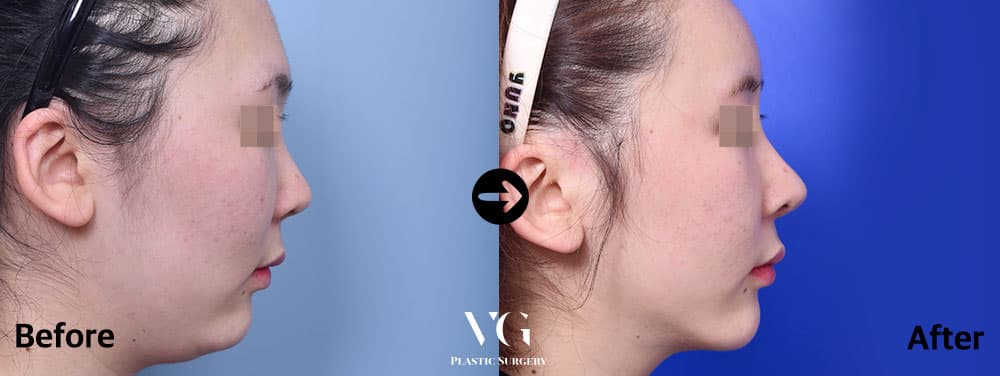
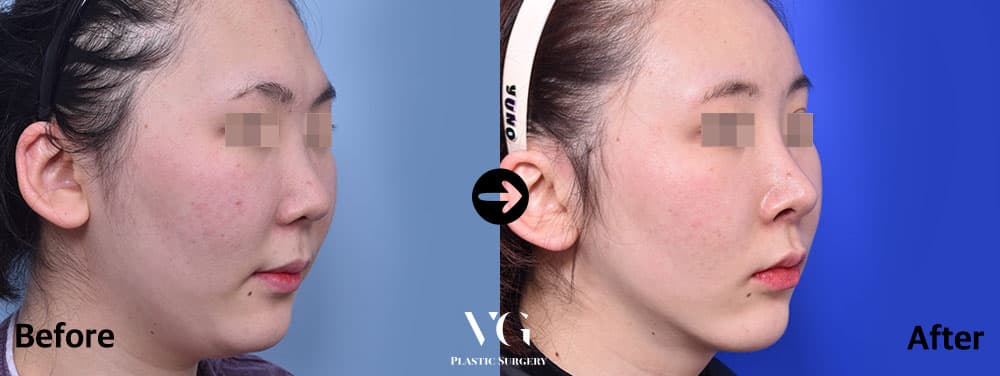
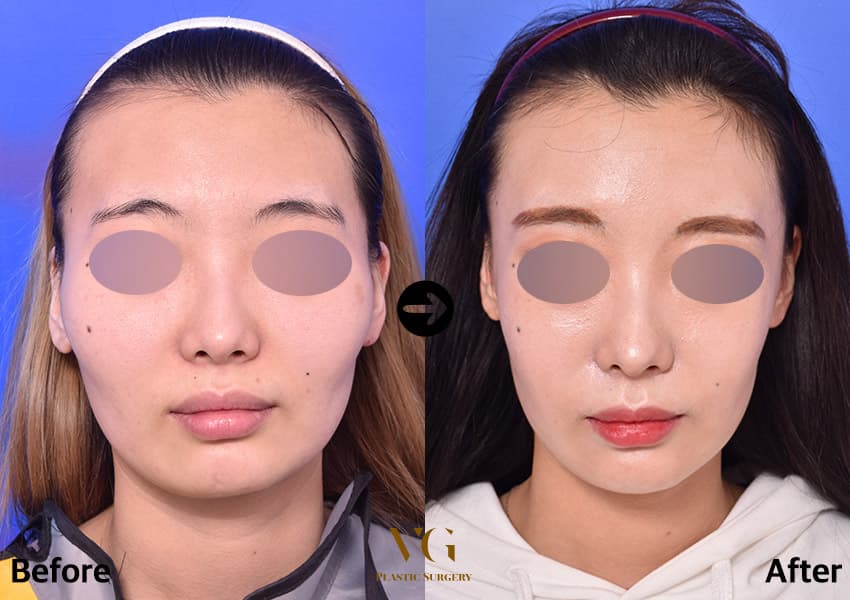
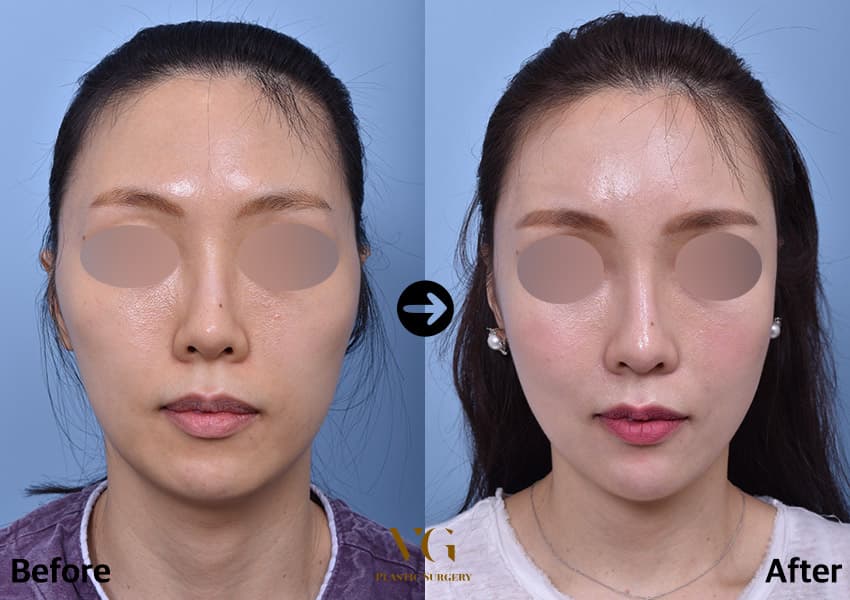
In this case the ear, the tip of the nose and the corner of the mouth sit in nearly the same places in both halves. So the change under the jaw is the surgery: the soft fullness below the chin is gone and the neck line is cleaner. You can see this case at every angle.
Now look at the background. It is a paler blue before and a deeper blue after. That does not move the jawline, but it changes how bright the skin reads, and your eye should subtract it.
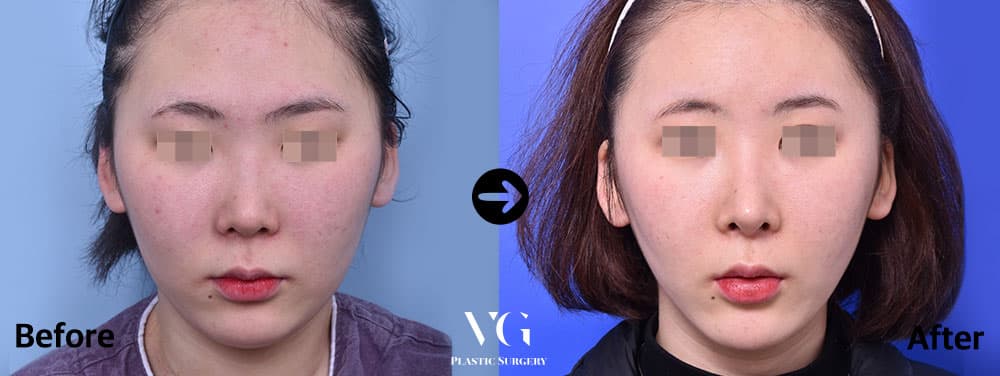
Fixed landmarks help most. In the front view of this case, the photo at the top of this page, a small mole beside the chin sits in the same spot before and after. When a mole, a scar or the hairline shifts between shots, something other than surgery has changed.
A 20-second geometry check
- Ears: the same amount visible on each side, in both photos
- Eye level: both eyes on one horizontal line — a tilted head changes how the jaw angle looks
- Distance: the face fills a similar share of the frame; a closer camera makes the nose and midface look wider
- Profile: the nose tip and the ear both in view, so you can tell whether the chin moved or the head did
Lighting, makeup and edits: what to discount
Brighter, flatter light softens the shadows under the cheekbones and along the jaw, which makes a face look slimmer before any bone has moved. Makeup, a new haircut or a hair band that pulls hair off the face does the same. None of these is dishonest on its own; they are simply things you subtract before judging the surgery.
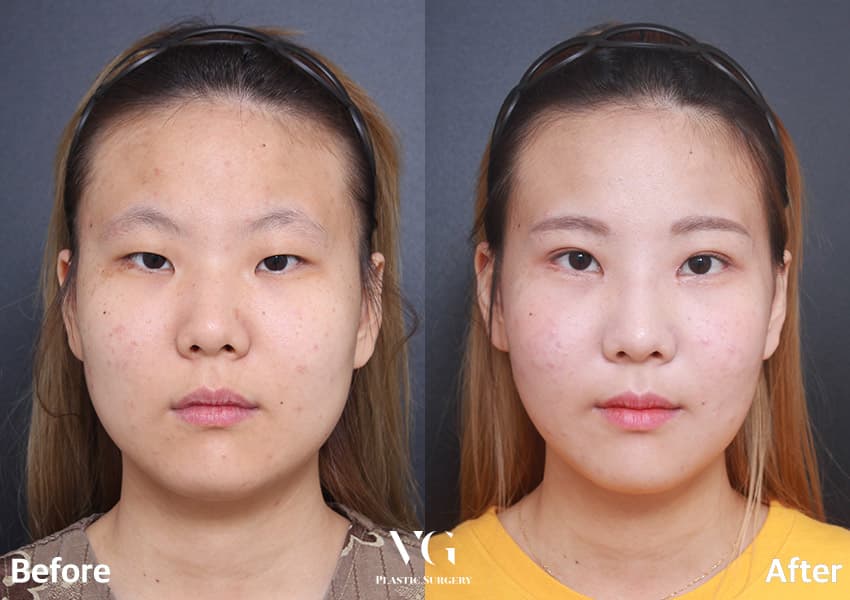
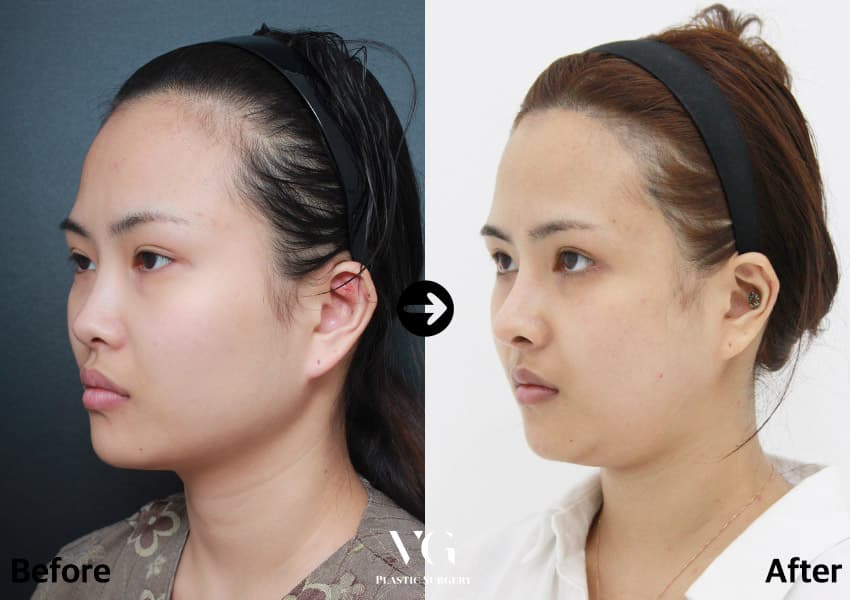
In the first case the after photo is brighter and the skin looks clearer. That comes from light and skin care, not from bone surgery. What surgery changed is the outline: the lower face now tapers towards the chin instead of squaring off below the ears.
The second case was photographed against a dark background before and a white one after, with different hair. The comparison that still holds is the line from the cheekbone down to the chin, which is shorter and narrower in the after. This case combined cheekbone, jaw angle and chin reduction.
Composite, filtered and generated images
Some images online are edited, merged from two people, or generated outright. Warning signs are skin texture that is identical in both halves, pores that vanish only in the after, a razor-sharp jawline next to a blurred neck, and hair edges that bend oddly where they meet the face.
The simplest test is to ask for the same case from more than one angle. A composite rarely holds up across a front, a three-quarter and a side view of the same person, each with a date.
Send a front and a side photo on WhatsApp — I'll tell you which of our cases starts closest to where your face starts.
Where can I see Korean plastic surgery before and after photos?
Our own cases are in the before-and-after gallery, grouped by procedure, and each case carries the time since surgery. Open a case to move between the angles of the same patient instead of judging from a single picture.
Elsewhere, a Korean before and after plastic surgery photo is worth trusting only as far as it passes the checks above: a date, matching geometry and light, and more than one view. Social media posts and ads often fail on the first of these.
Do Korean plastic surgery before and after photos show what I will get?
They show what happened to one face, not what will happen to yours. Use them to find cases that started where you do and to see which part changed — bone, fat or skin — then ask your surgeon what is realistic for your own photos.
Reading a result for your own face
When you scroll through Korean before and after plastic surgery galleries, the useful question is not whether the after looks good. It is whether the before looks like you. Find cases with the same width at the cheekbones, a similar jaw angle and a similar chin length, then compare what changed.
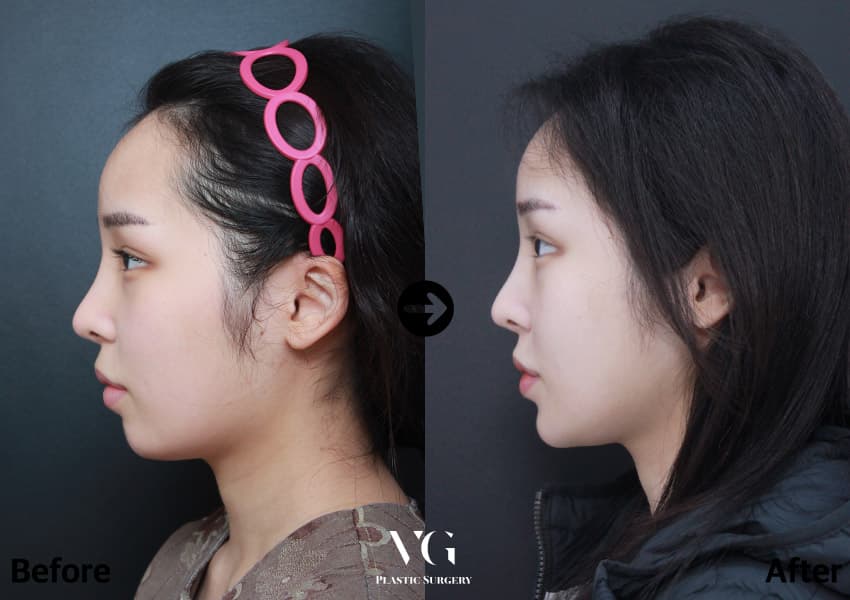
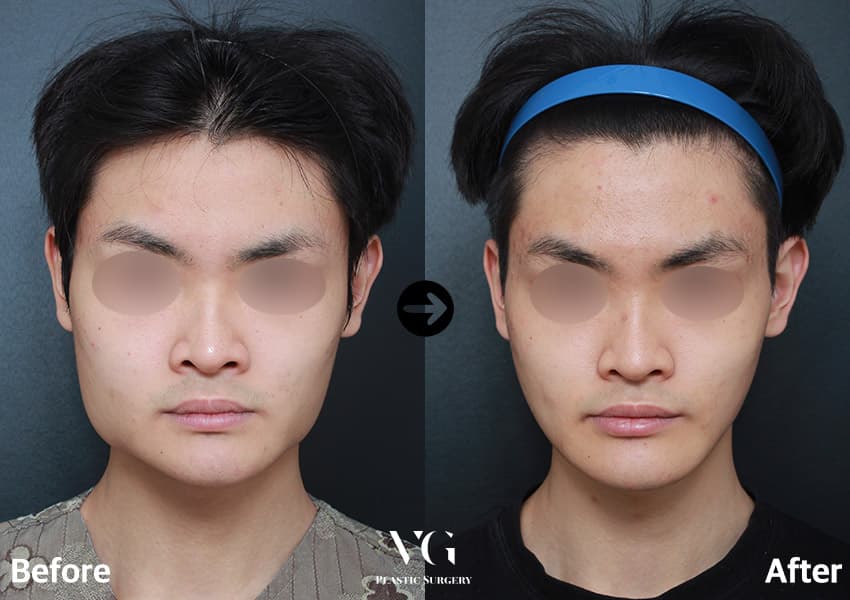
A side view shows what a front view hides. In the first case the chin was brought forward along with cheekbone and jaw reduction, and the profile from lips to chin changes more than the front view would suggest. The second is a man's jaw angle reduction: narrower below the ears, but still recognisably his face.
Sometimes the photo that matches you is not bone surgery at all. If the fullness is fat rather than bone, double chin liposuction is the fairer comparison. The same reading method works for eye surgery results and for a Korean nose job: date, angle, light, landmarks.
Who facial contouring suits — and who it doesn't
Photos can make any result look easy. These are the starting points where bone surgery is a reasonable answer.
- Cheekbones that project sideways and make the face read as wide from the front
- A square jaw angle that gives the face a harder impression
- A short or asymmetric chin that breaks the profile line
- You can stay in Korea two weeks or more for follow-up
And these are the cases where I suggest waiting, or something else first.
- The cause is soft tissue rather than bone — liposuction or a lift comes first
- Facial bone growth is not yet complete
- A schedule too short to stay through the swelling and the follow-up visits
- An uncontrolled systemic or bleeding disorder
If the photos convince you: coming to Seoul for facial contouring
Facial contouring surgery takes 1.5–4 hours under general anesthesia, and I advise one night in the clinic. Stitches come out 10–14 days after surgery, swelling peaks in days 7–14, and most people return to everyday activity in 3–4 weeks. Plan to stay in Korea for at least 14 days.
The trip planner for international patients lays those days out. International patients pay the same surgical fee as Korean patients, set out in one itemised written quote after consultation; our pricing policy explains why there is no price list.
After you fly home, follow-up continues for three months by photograph review. That is one more reason to learn to take your own photos the way this article describes.
What I look at in the photos you send
You can read about my training and the centres I work in before we talk. At consultation I will also tell you which parts of a photo you like are realistic for your face, and which are not.
Facial Contouring before & after — more cases
Real patients from our archive, all photographed 3 months after surgery. Tap a case to compare it full size.
Cheekbone (Zygoma) Reduction3 months after surgery
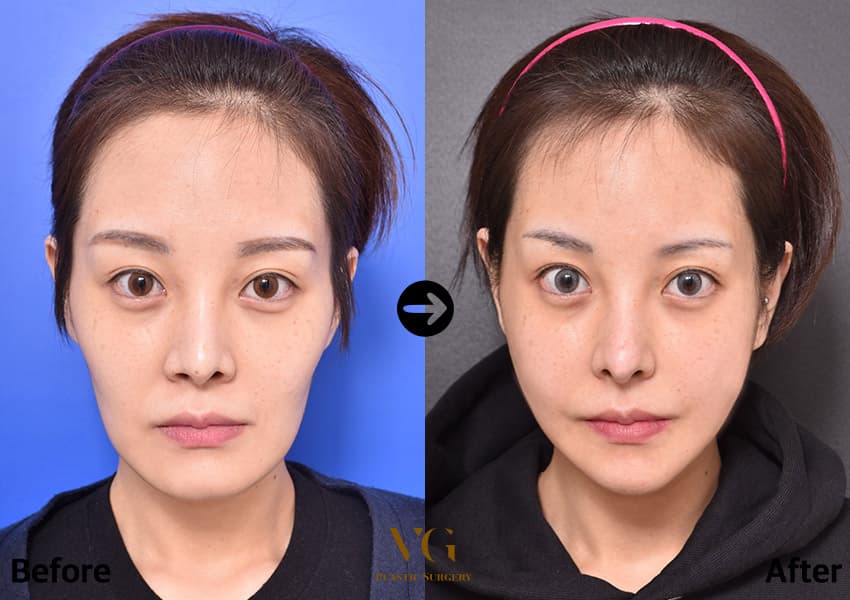
Cheekbone (Zygoma) Reduction3 months after surgery
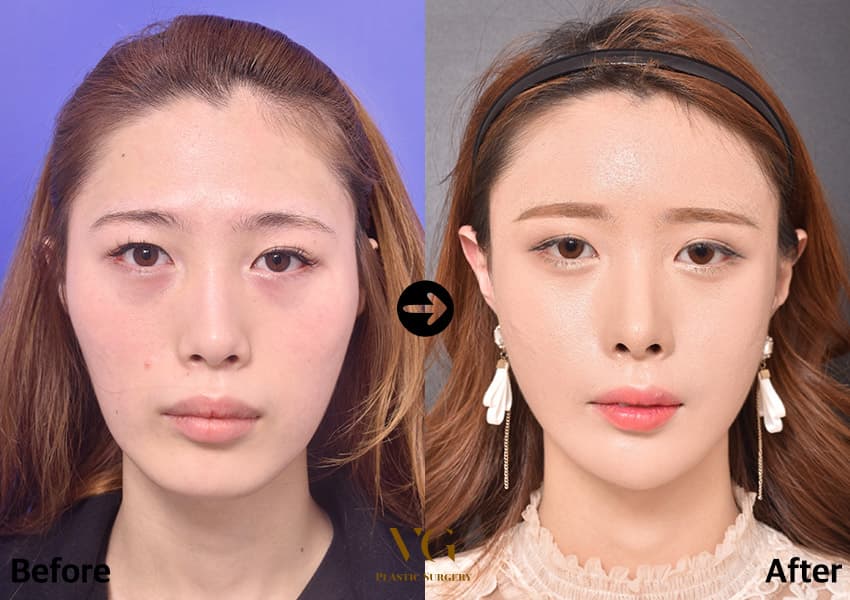
Cheekbone (Zygoma) Reduction3 months after surgery
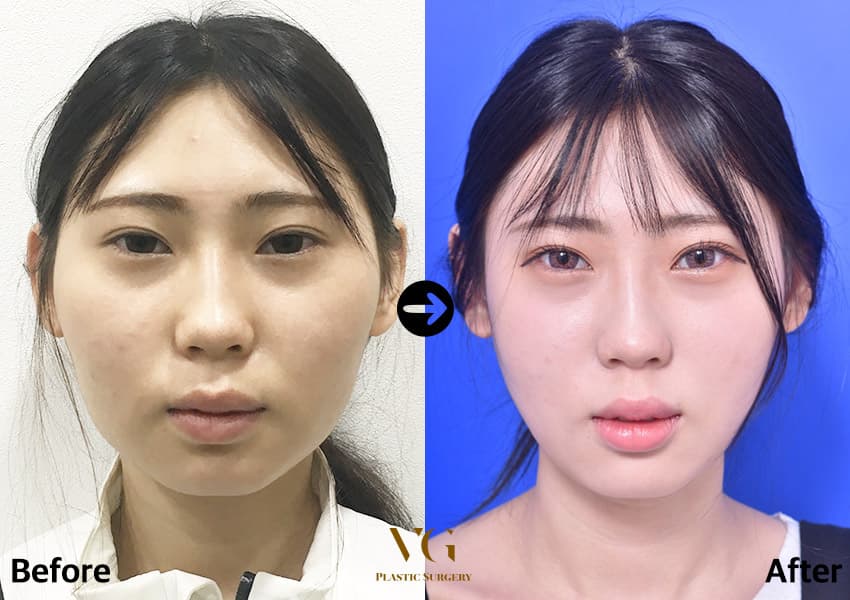
Cheekbone (Zygoma) Reduction3 months after surgery
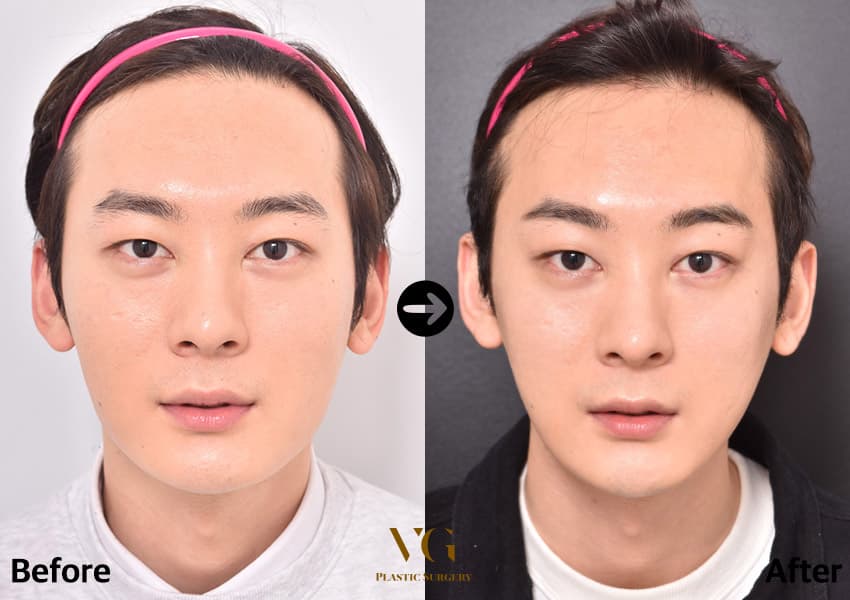
Square Jaw Reduction3 months after surgery
Cheekbone (Zygoma) Reduction3 months after surgery
FAQ
Questions patients ask
Are Korean plastic surgery before and after photos real?
Many are, but a photo alone cannot prove it. Check that it is dated, that the angle, distance and lighting match, and that fixed features such as the ears, moles and hairline line up. Ask for the same case from more than one angle — edited or composite images rarely hold up across three views.
How long after surgery should an after photo be taken?
Long enough for that operation's swelling to settle. Our archive cases are photographed at three months, which is close to final for non-incisional double eyelid surgery. Facial contouring and facelift results are assessed at about 12 months, and rhinoplasty at 6–12 months.
Why do after photos often look brighter?
Lighting, background, makeup and skin care change between visits, and brighter light softens shadows along the jaw. Judge the outline of the face — cheekbone width, jaw angle, chin position — against fixed landmarks rather than the skin tone.
Can I see the same patient from different angles?
Yes. Many cases in our archive include three photographs of the same patient from different angles, and each case page lets you move between them. A side view is where chin and jaw changes are easiest to judge.
Will my result look like someone else's photo?
No two faces start from the same bone and soft tissue, so treat a photo as a direction rather than a promise. Compare cases whose before resembles your face. At consultation I will say which parts of that result are realistic for you.
Where can I find Korean plastic surgery before and after photos?
Our own cases are in the before-and-after gallery on this site, grouped by procedure, with the time since surgery on each case. For photos found elsewhere, check the date, angle, lighting and fixed landmarks before trusting them.
Do Korean plastic surgery before and after photos show what my result will be?
They show what happened to one face, not a promise for yours. Use them to find cases whose before resembles your face, then ask your surgeon which parts of that result are realistic for you.
How long do I need to stay in Korea for facial contouring?
At least 14 days. Stitches come out 10–14 days after surgery and swelling peaks in days 7–14, so the stay covers both and a check before you fly home.
This article explains general medical information. Whether surgery suits you, and which method, is decided only after a consultation with the surgeon.
Written by
Im Young Min
Chief Director · Plastic Surgery
- Ph.D. in Medicine
- Internship and residency, Seoul St. Mary's Hospital
- Board-certified plastic surgeon, Seoul St. Mary's Hospital
- Adjunct professor of plastic surgery, Seoul St. Mary's Hospital
- Former director, Topface Plastic Surgery
Next step
Send two photos. Get a surgeon’s answer.
Front and side, natural light, no filter. Dr. Im Young Min reviews them and tells you which method fits and how many days to stay in Seoul.
International patients pay the same surgical fee as Korean patients. Pricing policy
Keep reading
Facial Contouring
South Korea Genioplasty Cost Range: What Moves the Number? Methods, Reviews and Recovery
A South Korea genioplasty cost range is wide because moving bone, shortening a chin and placing an implant are different operations; the method, anesthesia and days in Seoul set your figure.
Im Young Min ·
Facial Contouring
Three Dates That Shape a Zygoma Reduction Korea Trip, From CT to Flight Home
Zygoma reduction in Korea is bone surgery you fly home from, so plan around three dates: the consultation and CT before surgery, the check-up that clears you to fly, and your first appointment at home.
Im Young Min ·
Facial Contouring
Is chin lipo Korea Right for Your Full Chin? Cost, Reviews and What It Can't Fix
What chin lipo Korea does is remove fat under the chin and along the jaw. It won't shorten a long chin or narrow a square one, and it suits people at a stable weight whose skin still has some spring.
Im Young Min ·