Eyes
About Half of Asian Eyelids Have No Crease, and Other double eyelid surgery Korea percentage Numbers Worth Checking
No reliable published figure gives the double eyelid surgery Korea percentage. The number you can check is that about half of people of Asian descent have no upper eyelid crease (AAO EyeWiki).

· 7 min read · Last updated
Edited by Im Young Min
In this article
- 01Where the headline percentages come from
- 02Are double eyelids rare in East Asian faces?
- 03Fold height is a number you can measure
- 04Does a non-incisional fold last as long as an incisional one?
- 05Some monolids are actually droopy lids
- 06What decides the cost of double eyelid surgery?
- 07What the complication percentages mean for a trip
- 08Who checks the fold once you're home?
The short answer
Wondering what the double eyelid surgery Korea percentage figures really tell you, and whether your own fold could come out uneven? Read on before you book or decide anything. After this you'll know how common a natural crease is, what fold height and complication percentages mean, what shapes the cost, and how a stitched fold compares with an incisional one.
- No reliable published figure gives the share of people in Korea who have had double eyelid surgery.
- About half of people of Asian descent are born without an upper eyelid crease, according to AAO EyeWiki.
- A crease 6 to 8 mm above the lash line is the generally accepted standard, and 3 to 10 mm can also look natural.
- Uneven folds are the complication reported most often, so plan your follow-up before you fly home.
Hello, I'm Dr. Im Young Min, Chief Director and board-certified plastic surgeon.
Profile
Im Young Min
Chief Director · Board-certified in Plastic Surgery
At VG Plastic Surgery, I did my internship, residency and board certification in plastic surgery at Seoul St. Mary's Hospital, and I hold a Ph.D. in Medicine. I'm also a full member of the Korean plastic surgery societies and of the American Society for Aesthetic Plastic Surgery (ASAPS).
People often write to me assuming a national percentage predicts their own result, when it says very little about one particular lid. No reliable published source says what share of people in Korea have had the operation; the number you can check is that about half of people of Asian descent are born without an upper eyelid crease.
Send two eyelid photos on WhatsApp
Where the headline percentages come from
Most Korea-wide figures that circulate in forum threads and listicles have no survey, year or sample attached, so treat them as unverified. Published medical sources say something narrower. The American Academy of Ophthalmology's EyeWiki describes the double eyelid procedure as the cosmetic surgery requested more often than any other in Asia, and a 2009 review in Seminars in Plastic Surgery makes the same point.
That tells you the operation is common across the region. It doesn't give a double eyelid surgery Korea percentage, and it says nothing about whether a crease suits your lid. When a post quotes a precise share of Koreans, look for the study name and year before you let it shape your decision.
If your own lids are the real question, two photos are enough to start: eyes open and looking straight ahead, then gently closed, in daylight and without makeup.
Send two eyelid photos on WhatsApp
Are double eyelids rare in East Asian faces?
No. About half of people of Asian descent have no upper eyelid crease, according to EyeWiki, which leaves roughly the other half born with one. Many natural creases are low or partly tucked under a fold of skin, so they're easy to miss in a photo.
“Monolid vs double eyelid” is closer to a spectrum than a split. A crease forms where fibres from the muscle that lifts the lid connect to the skin. Where those connections are sparse, or where the skin is thicker and more fat sits in front of them, the lid folds lower, faintly, or not at all. That's why two people who both call themselves monolid can need different operations, and why one of them may need none.
Fold height is a number you can measure
The generally accepted crease height is 6 to 8 mm above the lash line, and EyeWiki notes that anything from 3 to 10 mm can also look natural.
These are the figures worth having in your notes before any consultation:
| Figure | What it describes | Source |
|---|---|---|
| About 50% | People of Asian descent without an upper eyelid crease | AAO EyeWiki |
| 6–8 mm | Generally accepted crease height above the lid margin | AAO EyeWiki |
| 3–10 mm | Wider range also considered pleasing | AAO EyeWiki |
| 5–8 mm | Usual tarsal plate height in Asian patients | Seminars in Plastic Surgery, 2009 |
A common belief is that a higher fold looks more Korean. The sources point the other way: a fold placed too high is listed as a complication, and a crease set far above the plate can make the lid look heavier. Ask what height is being planned for you in millimetres, and why that number fits your plate and your skin.
Does a non-incisional fold last as long as an incisional one?
Usually not quite. EyeWiki puts fading of the fold at under 3% of cases and notes that it happens more often with the suture technique than with incisions. That's a small number, and on a thin lid it can be a reasonable trade for less downtime; on a thick, full lid the odds shift.
Thin skin, little fat and a lid that lifts well are the conditions where a stitched, non-incisional fold tends to hold. Thick skin, more fat or extra skin hanging over the lashes push toward an incision, where tissue can be removed. The trade-offs, recovery and stay for each method are set out in our overview of double eyelid surgery in Korea, and if you're leaning toward stitches, fitting non-incisional surgery into a week of leave walks through the calendar.
Some monolids are actually droopy lids
A lid that looks hooded or tired may have a crease hidden under extra skin, or a lifting muscle that doesn't raise the lid far enough. The American Academy of Ophthalmology describes ptosis as an upper eyelid that droops, and stretching of the lifting muscle with age is one of its causes.
This matters for the percentage question because a search for double eyelids often starts with “my eyes look tired”. On our site, that complaint is the one that decides between ptosis correction and an upper lid lift. If the heaviness is skin that has dropped over the years, upper blepharoplasty for hooded lids is the closer match. If it's the area under the eye, the day-by-day recovery after eye bag surgery covers a different operation altogether.
Say you are 29, you have a flat monolid with a little puffiness, and you're flying in from Sydney for ten days. Looking at your photos, the first thing I'd ask is not which method is popular but how thick your lid is, how much fat sits behind it, and how well the lid lifts when you look up. If the lid is thin and lifts well, a stitched fold may be worth discussing.
If it is thick or heavy, a stitch may loosen sooner, and an incisional approach could make more sense. Either way, I'd also think about your travel dates, because the swelling settles in stages and I would want you to understand what your eyes will look like on the flight home.
What decides the cost of double eyelid surgery?
The cost depends on the method first: a stitched, non-incisional fold and an incisional fold are different operations with different amounts of work. It also depends on your lid itself. Thick skin or extra fat that needs removing adds steps, and a droopy lid that needs lifting is a larger procedure than creating a crease alone. The type of anaesthesia, the number of days you spend in Korea, and the follow-up visits after surgery all play a part.
The cost therefore differs from one person to the next and cannot honestly be read from a general list. To get the figure for your case, ask on WhatsApp and attach a photo of your eyes.
What the complication percentages mean for a trip
Bleeding, a lid that droops after surgery, and new or worse dry-eye symptoms are also listed, and the American Society of Plastic Surgeons' patient information on eyelid surgery covers bleeding, infection and dry eyes among its risks.
Of all the numbers behind a double eyelid surgery Korea percentage search, the 35% is the one to plan around. Early swelling makes many lids look uneven for a while, so a fold is usually judged after it settles, often weeks after you've flown home. That gap is the real risk of doing this abroad.
Before booking, ask how a fold that stays uneven would be assessed once you're home and when a correction could be considered; revision double eyelid surgery and its seven common problems shows what a correction involves.
On the operating side, three board-certified anesthesiologists work full time at VG Plastic Surgery, and one is dedicated to every operation, watching blood pressure, pulse and breathing so the surgeon does nothing but operate.
If the uneven-fold figure is the one on your mind, send a close photo of each eye on its own, open and then closed, plus the date your leave ends.
Send two eyelid photos on WhatsApp
Who checks the fold once you're home?
You and a doctor near you, working from records you bring back from Seoul. The CDC's medical-tourism guidance advises getting copies of your medical records and arranging follow-up care at home before you travel.
Ask for the name of the operation, the crease height that was planned, and whether sutures or incisions were used, so a local doctor isn't guessing. An interpreter is provided at VG Plastic Surgery's consultations, which makes it easier to get those details clear in English before you leave. The seven questions to put to any clinic about your own lids include the follow-up ones, and how to read eyelid surgery photos, dates included helps when you compare your own healing pictures with the ones you saw online.
The percentage that belongs in your decision is about your own lid. For a first message, send one photo of your eyes looking straight ahead and one looking down at the floor, with the month you're thinking of travelling, on WhatsApp, and ask one question: which fold method suits my lid? You can ask before booking anything, and one clear photo is enough to start. When you come to the clinic, I examine your eyes and recommend what fits you.
Related pages:
Eyes before & after — more cases
Real patients from our archive, all photographed 3 months after surgery. Tap a case to compare it full size.
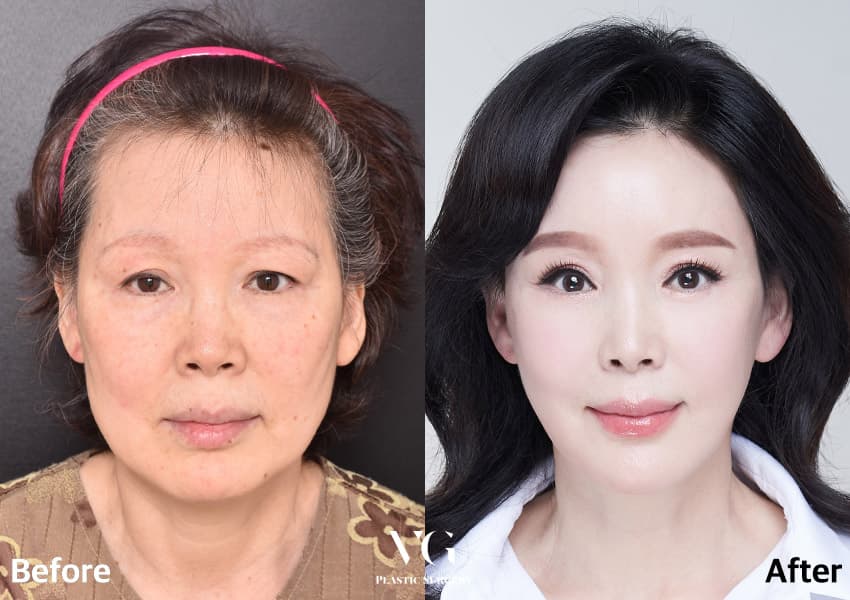
Face Lift3 months after surgery
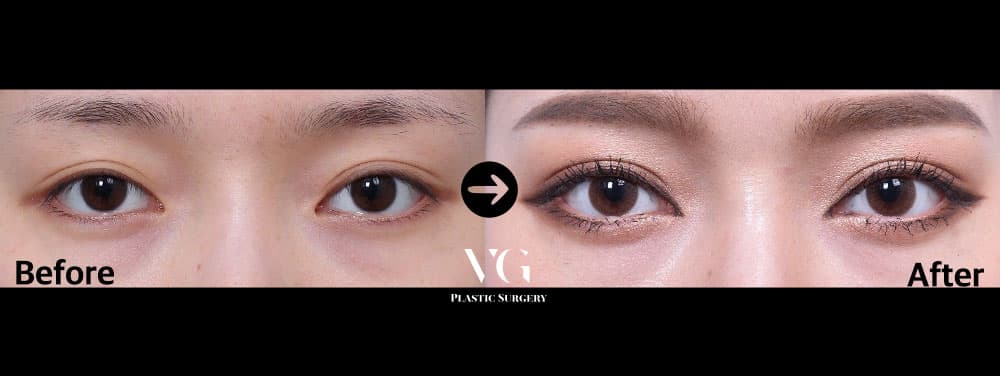
Natural-Adhesion Double Eyelid3 months after surgery
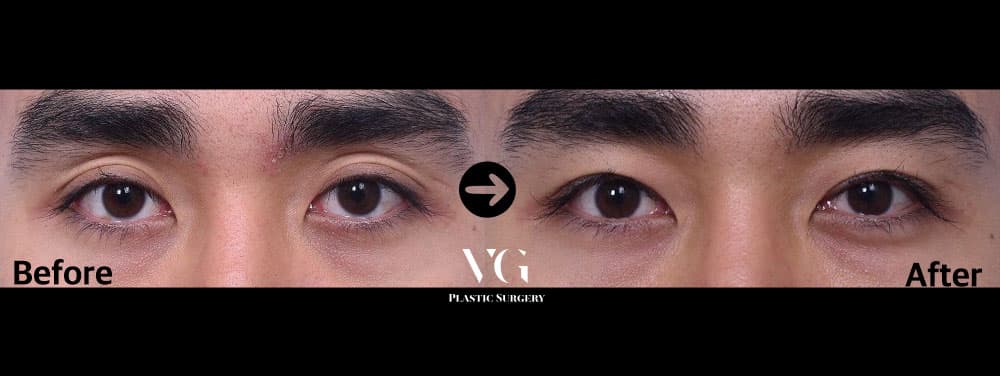
Incisional Double Eyelid3 months after surgery
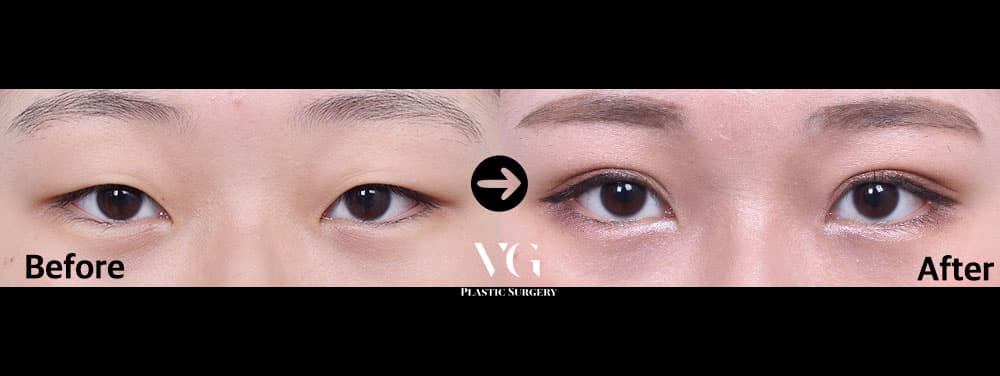
Incisional Ptosis Correction3 months after surgery
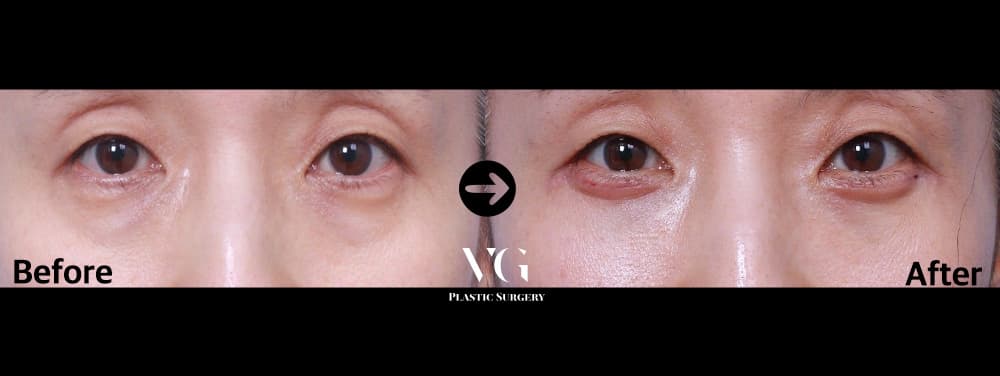
Lower Blepharoplasty3 months after surgery
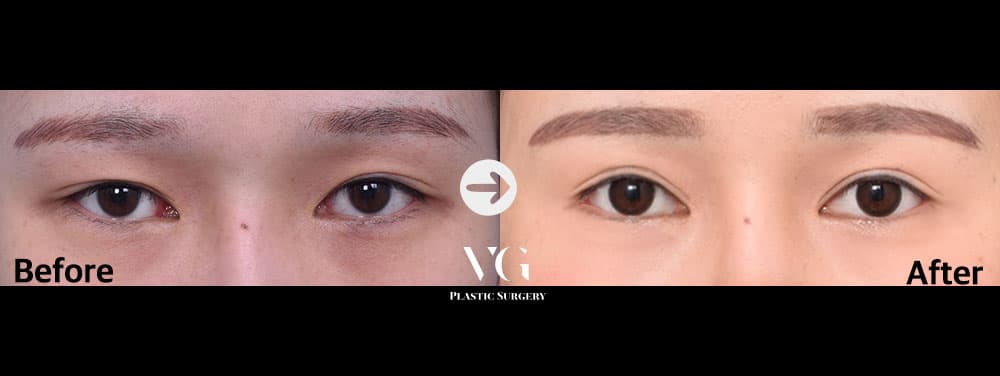
Incisional Double Eyelid3 months after surgery
FAQ
Questions patients ask
What percentage of people in Korea are born with double eyelids?
The medical sources cited here don't give a Korea-only figure. AAO EyeWiki reports that about half of people of Asian descent have no upper eyelid crease, so a natural crease is common, though it's often low or partly hidden. Any precise Korean share you see online should come with a named study and year.
Can a monolid get a double eyelid that looks natural?
Often, when the planned crease height suits the tarsal plate and the skin. EyeWiki gives 6 to 8 mm above the lid margin as the generally accepted height and notes that 3 to 10 mm can also look pleasing. Thicker lids with more fat usually need a lower, incision-based plan.
How long does a stitched double eyelid usually hold?
EyeWiki reports fading or loss of the fold in under 3% of cases, more often after the suture technique than after incisions. Thin lids that lift well are where stitches tend to hold. The sources don't give a fixed number of years.
Will my eyes look swollen right after double eyelid surgery?
Yes, for a while. Swelling usually makes a new fold look higher and fuller at first, and it settles over weeks. That's why symmetry is judged later, often after you're back home.
Do I need to speak Korean for a consultation in Seoul?
No. VG Plastic Surgery provides an interpreter at consultations. Writing down your questions about crease height, method and follow-up beforehand helps you get through them in one visit.
Sources
This article explains general medical information. Whether surgery suits you, and which method, is decided only after a consultation with the surgeon.
Written by
Im Young Min
Chief Director · Plastic Surgery
- Ph.D. in Medicine
- Internship and residency, Seoul St. Mary's Hospital
- Board-certified plastic surgeon, Seoul St. Mary's Hospital
- Adjunct professor of plastic surgery, Seoul St. Mary's Hospital
- Former director, Topface Plastic Surgery
Next step
Send two photos. Get a surgeon’s answer.
Front and side, natural light, no filter. Dr. Im Young Min reviews them and tells you which method fits and how many days to stay in Seoul.
International patients pay the same surgical fee as Korean patients. Pricing policy
Keep reading
Eyes
How Much Does Double Eyelid Surgery Cost in Korea? Results, How Long It Lasts, Reviews and When to Spend Less
There's no single figure: the method your lids need, any ptosis or inner-corner work, the anesthesia and your days in Seoul set the quote, and foreigners pay the same surgical fee as Korean patients.
Im Young Min ·
Eyes
Lower Blepharoplasty Korea Cost: Fat, Skin or Lid Support? Reviews, Methods and Recovery
Your lower blepharoplasty cost in Korea follows what is causing the bags: bulging fat, a hollow beneath it, loose skin or a slack lower lid, plus the anesthesia and the days you plan in Seoul.
Im Young Min ·
Eyes
Double Eyelid Surgery Cost in Korea: What Changes Your Quote? Results, Reviews and Methods
Quotes for double eyelid surgery in Korea differ because they describe different operations: suture or incision, fat removal, ptosis correction, inner-corner work and revision.
Im Young Min ·