Eyes
“My Lid Pulled Down”: What Lower Blepharoplasty Korea Threads Get Right About Risk
Lower blepharoplasty in Korea suits under-eye bags from forward-pushing fat when the lower lid is firm and the eyes aren't chronically dry; the risk to weigh most is the lid pulling down.
In this article
- 01Will my lower lid pull down after surgery?
- 02Inside the lid or under the lashes: does the route change the risk?
- 03The rest of the risk list, by how it usually shows up
- 04Who should wait, or skip lower blepharoplasty for now
- 05How long should you stay in Seoul, and what if something changes at home?
- 06Lower canthoplasty threads and how the two lid operations interact
- 07Upper and lower together, or one at a time?
The short answer
Lower blepharoplasty in Korea makes sense for under-eye bags caused by fat pushing forward, provided your lower lid is firm, your eyes aren't chronically dry and you can stay in Seoul until the stitches are out and the early swelling has settled. The worry behind most "lower blepharoplasty korea" searches is narrower than the threads suggest: what happens if the lower lid starts pulling down, or one eye keeps watering, after you're home and your surgeon is a long flight away?
- Lower blepharoplasty in Korea fits under-eye bags from forward-pushing fat when the lower lid is firm and the eyes aren't chronically dry.
- Lower lid pull-down (lid lag or ectropion) is the risk to weigh most, and lid laxity and cheek position help predict it.
- The inside-the-lid route leaves no skin incision but cannot remove loose skin; the under-the-lash route can, with more care over lid support.
- Rising pain, a bulging eye or worsening vision in the first days means going to an emergency department straight away.
- Every operation at the clinic has a dedicated anesthesiologist from a full-time team of three who do not operate.
At this clinic every operation has its own anesthesiologist, one of three board-certified anesthesiologists who work here full time and do not operate, so the surgeon's attention stays on your eyelid while someone else watches your blood pressure, pulse and breathing.

Profile
Im Young Min
Chief Director · Board-certified in Plastic Surgery
I'm Im Young Min, chief director and a board-certified plastic surgeon trained at Seoul St. Mary's Hospital, and a full member of the American Society for Aesthetic Plastic Surgery. The eye centre here is shared between me, Hong Dae Won and Yang Jong Phil, who are both members of the International Confederation for Plastic, Reconstructive and Aesthetic Surgery and the American Society of Plastic and Reconstructive Surgeons. Reddit threads on lower blepharoplasty Korea trips tend to circle the same few questions. Most get the risk half right and skip the measurement that actually decides it.
If you have a clear daylight photo of your under-eyes, taken straight on with your gaze slightly upward, send it on WhatsApp with the dates you're considering.
Send your under-eye photo on WhatsApp
Will my lower lid pull down after surgery?
A lower lid can pull down after surgery, and that single risk is what most lower-lid threads are really arguing about.
Picture the lower lid as a hammock strung between the inner and outer corners of the eye. It holds its position because the tendons at both corners are firm and the layers in front and behind are the right length. Lower blepharoplasty removes or moves fat, and sometimes trims skin. Then swelling and early scar tissue add a gentle downward pull for several weeks. A tight hammock absorbs that. A slack one sags.
What the threads tend to blur is timing. A lid that looks slightly low or rounded at the outer corner in the first couple of weeks, while the cheek is still swollen, is a different situation from a lid that is still low at two or three months. The first often settles. The second is when a surgeon talks about support for the outer corner or, as the ASPS list puts it plainly, the possible need for revision surgery.
The exam is where this risk gets measured before anything is booked. A second check is how far the lid can be drawn off the eyeball at all.
Then comes the side view: if the front of the cheek sits behind the front of the eye, the lid has less to rest on. A slow snap-back, a lid that travels far, or a cheek set back behind the eye each argue for removing less skin, adding support at the outer corner, or choosing a different operation.
Inside the lid or under the lashes: does the route change the risk?
The route matters, though less than lid support does. A transconjunctival approach goes through the inside of the lower lid and leaves no skin incision; a transcutaneous approach uses a cut just below the lash line so that loose skin can be trimmed as well.
The inside route is generally considered gentler on lid position because the skin and the muscle in front are left alone. Its limit is just as clear: it cannot remove excess skin, so it suits people whose problem is mainly fat with fairly smooth skin. The under-the-lash route can deal with crepey or redundant skin, and the trimmed skin is exactly where the downward-pull risk comes from, so the amount removed is the number to be conservative with.
A thread that says "always get the inside approach" is answering for a twenty-eight-year-old with firm skin. Someone in their fifties with folds of loose skin may be poorly served by it. Matching the route to the anatomy in front of the surgeon is the safer default.
The rest of the risk list, by how it usually shows up
Most of what happens after lower eyelid surgery is common and temporary; a few things are rare and need action that day. The two tables below sort the risks the ASPS lists for eyelid surgery into those groups, the common ones first.
| Risk | How it usually shows up | What it generally means |
|---|---|---|
| Swelling and bruising | Puffy, discolored lower lids and cheeks | Expected; heaviest in the first days, fading over weeks |
| Dryness, light sensitivity | Gritty or stinging eyes, squinting outdoors | Common early; lubricating drops and sunglasses are the usual measures |
| Difficulty closing the eyes | A small gap when you blink or sleep | Worth reporting; often tied to swelling, sometimes to lid position |
| Numb skin or lashes | Reduced feeling along the lid | Usually improves as the nerves recover |
The second group is rarer, and it is where you act sooner.
| Risk | How it usually shows up | What it generally means |
|---|---|---|
| Unfavorable scarring | A raised or pulling line below the lashes | Applies to the skin approach; may need treatment |
| Infection, bleeding at the incision | Redness, warmth, discharge, oozing | Needs a doctor's look |
| Change in vision | Blurring that gets worse, not better | Very rarely blindness; treat as an emergency |
| Need for revision | A lid that stays low or uneven after healing | Discussed once the swelling has settled |
The second table deserves one plain instruction. If, in the first day or two, pain keeps rising instead of easing, the eye feels tight and pushed forward, or your vision is getting worse, go to an emergency department straight away.
Anesthesia risks sit on the ASPS list too. Here three board-certified anesthesiologists work on staff full time, and one of them chooses the anesthetic approach for each patient, assesses underlying conditions in advance, and watches your blood pressure, pulse and breathing from the first injection until you are awake again, so the surgeon does nothing but operate. That is why your medical history matters as much as your photos at the first step.
If you have a dry-eye diagnosis, have had LASIK, or take blood thinners or fish-oil supplements, put that in your WhatsApp message along with an under-eye photo. Those details change whether the plan is surgery on this trip, surgery after treatment at home, or a different approach, and the doctor reviews them before you commit to flights.
Clinic address: 635 Nonhyeon-ro, Gangnam-gu, Seoul, Republic of Korea
Send your under-eye photo on WhatsApp
Who should wait, or skip lower blepharoplasty for now
Some lower lids are better left alone for now, and hearing that before you fly is part of a responsible plan. These situations usually mean "not yet" or "a different operation":
- Dry eye that isn't under control. Surgery can make dryness worse for a while, and a dry eye surface tolerates any change in lid position badly.
- A lax lower lid. A slow snap-back does not rule you out, but it means outer-corner support belongs in the plan, or the surgery is reconsidered.
- Prominent eyes with a cheek set back. The lid has less support underneath, so the pull-down risk rises.
- Active thyroid eye disease. Lid and eye position are still changing; surgery is generally postponed until the condition has been stable.
- Puffiness that comes and goes. Bags that are worse in the morning, after salty food or in allergy season are often fluid, and removing fat does not fix fluid.
- Hollows more than bulges. Taking fat out of a lid that is already hollow deepens the shadow; moving fat into the groove, covered in the overview of blepharoplasty in Korea, may fit better.
- Blood thinners you can't safely pause. That decision belongs to the doctor who prescribed them, before any booking.
How long should you stay in Seoul, and what if something changes at home?
Plan the stay around two events: the stitch removal or first check, and enough settled swelling that you can judge the lid in a mirror.
Most lower blepharoplasty Korea itineraries are built from that point backwards. The clinic is at 635 Nonhyeon-ro, Gangnam-gu, so a hotel in Gangnam keeps the follow-up visits short. If you'd like a surgeon's view before deciding, the clinic's site offers a free photo quote: you send photos and get a written plan back by messenger or email.
Home is where the threads get anxious, and a little structure helps. Pack a short record of what was done: which approach, whether the outer corner was supported, and which drops you were given. Show it to a local ophthalmologist or oculoplastic surgeon if you need a check. Then sort what you notice:
- Normal for the first weeks: swelling that is worse in the morning, tightness, watering, bruises turning yellow, slight unevenness between sides.
- Send a message with a photo: a lid that looks lower on one side after the swelling has gone down, an eye you can't fully close at night, or dryness that drops don't touch.
- Emergency department now: rising pain, a bulging or tense eye, or vision that is getting worse.
Lower canthoplasty threads and how the two lid operations interact
Threads that search "lower canthoplasty korea reddit" usually discuss pulling the outer lower corner down for a softer, rounder look. That operation and lower blepharoplasty both act on the support of the same lower lid, so doing them together adds up the downward forces.
A cosmetic downward shift of the corner and the outer-corner support used to prevent pull-down after blepharoplasty work in opposite directions. When someone asks for both, the surgeon has to weigh how much lowering the lid can take without showing white beneath the iris or rolling outward. The guide to inner, outer and lower canthoplasty covers how far the corners can open; for the lower lid, the snap-back check described above decides much of it.
Canthoplasty Korea: Inner, Outer or Lower Corner, and How Far to Open go further into what usually comes next.
Upper and lower together, or one at a time?
Both lids can be done in one session, and many people traveling plan it that way to keep to one recovery. The trade-off is a longer operation and two sources of dryness at once, since the upper lid affects how fully you close your eyes while the lower lid affects how the tear film spreads.
Whether to combine usually comes down to the eye surface and the time under anesthesia. Someone with healthy tears and firm lids is a reasonable candidate for both; someone with borderline dryness may be better served by the upper lid first and the lower one on a later trip. A combined plan is also where an anesthesiologist dedicated to the operation counts most, because the session runs longer. For how other operations fit around a Seoul stay, see which operation and how long you stay.
Before you book anything, send two photos on WhatsApp: one straight on in daylight and one from the side at eye level, plus a line about any dry eye, LASIK or thyroid history. The doctor reviews them, and you'll hear whether lower blepharoplasty Korea plans make sense for your lids, whether outer-corner support is likely to be part of the conversation, and how many days to set aside.
Related pages:
Eyes before & after — more cases
Real patients from our archive, all photographed 3 months after surgery. Tap a case to compare it full size.
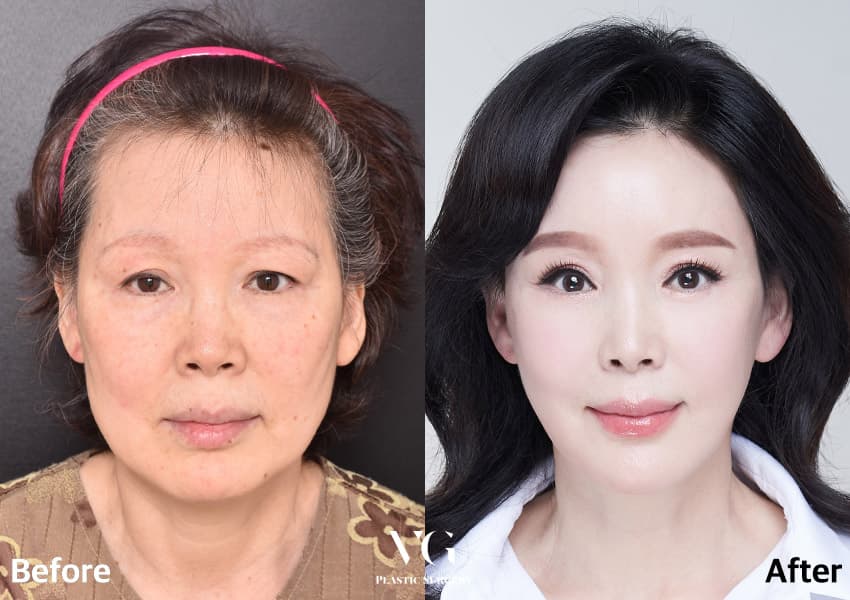
Face Lift3 months after surgery
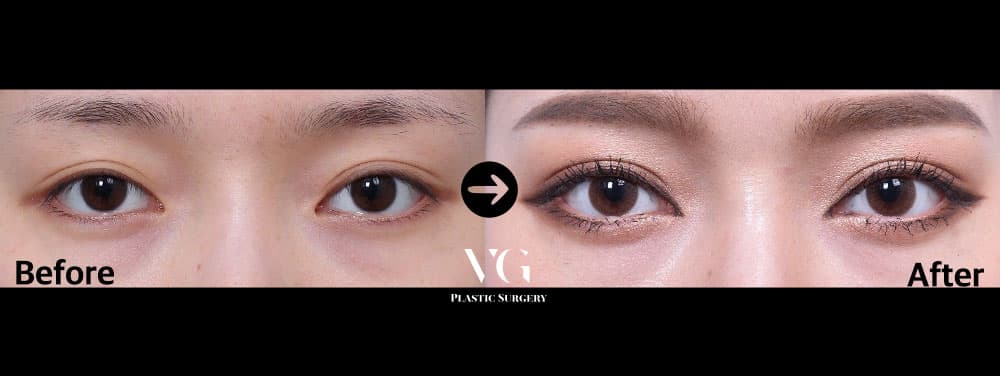
Natural-Adhesion Double Eyelid3 months after surgery
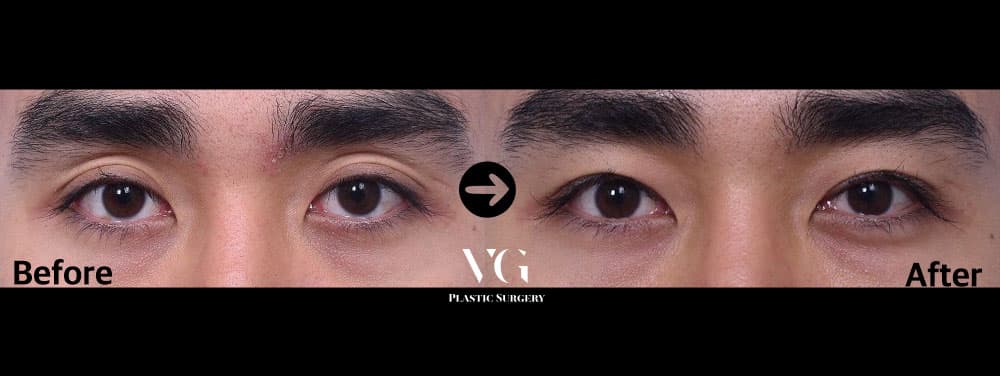
Incisional Double Eyelid3 months after surgery
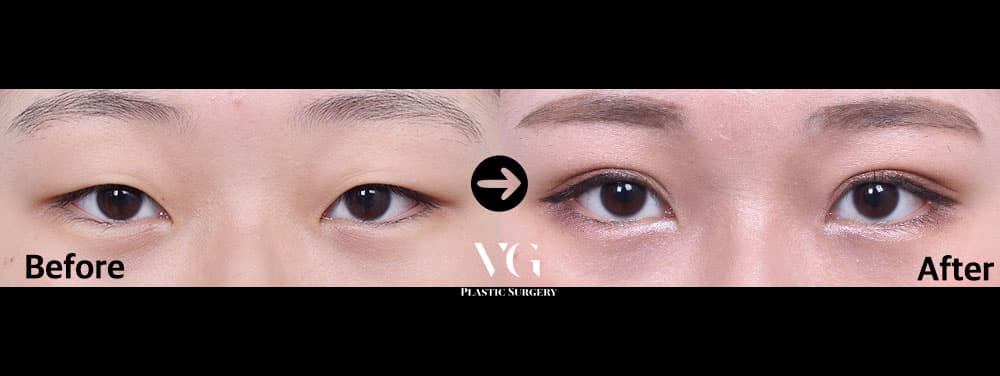
Incisional Ptosis Correction3 months after surgery
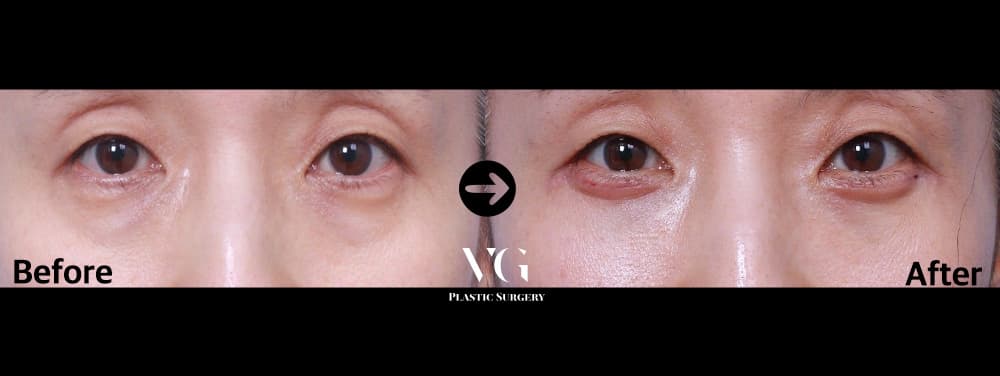
Lower Blepharoplasty3 months after surgery
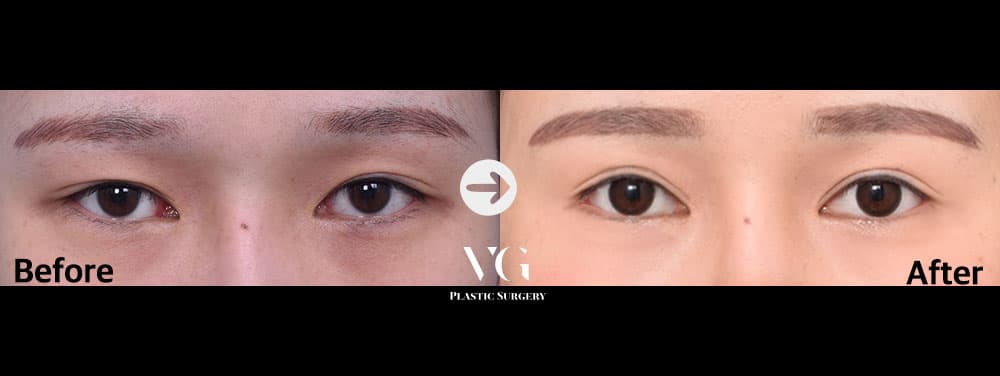
Incisional Double Eyelid3 months after surgery
FAQ
Questions patients ask
Is lower blepharoplasty the same as under-eye fat repositioning?
They overlap. Classic lower blepharoplasty removes some of the fat that bulges below the eye, while fat repositioning moves that fat down into the groove between lid and cheek instead of discarding it. Repositioning tends to suit people who have a bulge and a hollow together, and which one fits is judged from how your lid and cheek meet.
Does lower eyelid surgery leave a visible scar?
The transconjunctival approach works from inside the lid, so there is no skin incision.
When can I wear contact lenses after lower bleph?
Surgeons generally ask you to stay in glasses until the swelling and any dryness have settled and the eye surface has been checked. Pack glasses for the trip and for the first days back home.
Can under-eye bags come back after lower blepharoplasty?
Fat that has been removed does not usually return, but the tissues around the eye keep ageing, so the lid and cheek can change shape again over the years. Bags that were partly fluid, from allergy or salty food, can still appear on puffy mornings.
Is lower blepharoplasty done under general anesthesia?
It can be done under different types of anesthesia. At this clinic an anesthesiologist chooses the approach for each patient after assessing underlying conditions, and stays with you from the first injection until you are awake.
Sources
This article explains general medical information. Whether surgery suits you, and which method, is decided only after a consultation with the surgeon.
Written by
Im Young Min
Chief Director · Plastic Surgery
- Ph.D. in Medicine
- Internship and residency, Seoul St. Mary's Hospital
- Board-certified plastic surgeon, Seoul St. Mary's Hospital
- Adjunct professor of plastic surgery, Seoul St. Mary's Hospital
- Former director, Topface Plastic Surgery
Next step
Send two photos. Get a surgeon’s answer.
Front and side, natural light, no filter. Dr. Im Young Min reviews them and tells you which method fits and how many days to stay in Seoul.
International patients pay the same surgical fee as Korean patients. Pricing policy
Keep reading
Eyes
How Much Does Double Eyelid Surgery Cost in Korea? Results, How Long It Lasts, Reviews and When to Spend Less
There's no single figure: the method your lids need, any ptosis or inner-corner work, the anesthesia and your days in Seoul set the quote, and foreigners pay the same surgical fee as Korean patients.
Im Young Min ·
Eyes
Lower Blepharoplasty Korea Cost: Fat, Skin or Lid Support? Reviews, Methods and Recovery
Your lower blepharoplasty cost in Korea follows what is causing the bags: bulging fat, a hollow beneath it, loose skin or a slack lower lid, plus the anesthesia and the days you plan in Seoul.
Im Young Min ·
Eyes
Double Eyelid Surgery Cost in Korea: What Changes Your Quote? Results, Reviews and Methods
Quotes for double eyelid surgery in Korea differ because they describe different operations: suture or incision, fat removal, ptosis correction, inner-corner work and revision.
Im Young Min ·