Facelift
Ponytail Facelift Korea: Will It Lift Your Jowls? Who It Suits, Scars and What Sets the Cost
A ponytail facelift is mostly a name for a lift of the brow, outer eye corner and cheek through incisions hidden in the hairline. It suits early upper-face sagging and does little for jowls or neck skin.
Send your concern and a front and side photo. Replies in English, no obligation.
In this article
- 01What the ponytail lift actually is
- 02Does a ponytail lift fix jowls and neck skin?
- 03Does a hidden incision mean no visible scar?
- 04Is it a lunchtime lift with no downtime?
- 05Which of our lifts matches what you're after?
- 06Risks: hair loss at the incision, numbness and nerve injury
- 07Ponytail facelift Korea: what decides the cost
The short answer
Is the ponytail facelift Korea clinics advertise a separate operation, and will the scars show when you board the flight home? Mostly it's a name. The lift behind it raises the brow, outer eye corner and cheek through short incisions hidden in the hairline, and it does little for jowls or loose skin on the neck.
- A ponytail lift is a marketing name for a hairline-incision lift of the brow, temple and cheek.
- It does little for jowls or loose neck skin; those need a lift that pulls from around the ear.
- The incisions are hidden in hair, but a high or thin temple hairline makes them harder to hide.
- Any incision lift brings swelling and scalp numbness, so plan your return flight around the post-op check.
- Cost follows which lift your face needs, any add-ons, anesthesia and your days in Seoul.
Whether it suits you comes down to where your face has dropped. Sagging that starts at the brow and cheek can be lifted from the hairline. Sagging along the jaw and neck needs a lift that pulls from in front of and behind the ear.
Profile
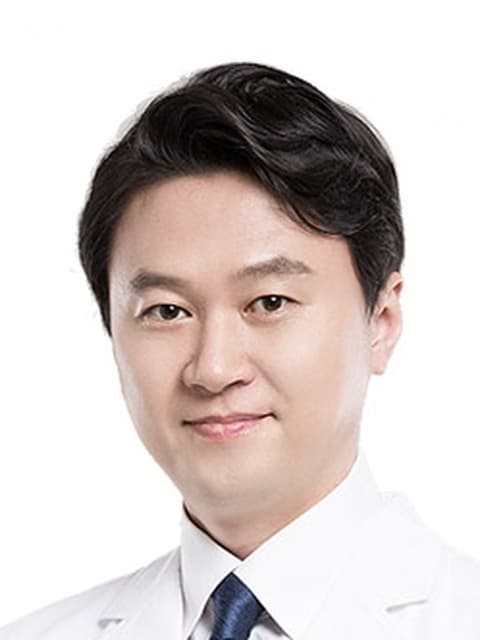
Im Young Min
Chief Director · Board-certified in Plastic Surgery
Hello, I'm Dr. Im Young Min, chief director and board-certified plastic surgeon at VG Plastic Surgery in Gangnam, Seoul, and a full member of the American Society for Aesthetic Plastic Surgery.
Our facelift menu covers mini, SMAS and Crystal lifts, with brow lift and upper eyelid surgery in the same center, so I'm not tied to one branded technique when I look at your face. Three board-certified anesthesiologists work here full time: during a lift, one of them watches your blood pressure, pulse and breathing while the surgeon only operates. If English isn't your first language, a medical interpreter for your language is provided at no extra charge.
If you'd like to know which kind of lift your face is asking for, send one photo from the front and one from the side on WhatsApp, with your hair pulled back so the temples show, and ask whether your sagging starts above or below the cheekbone.
Send a front and side photo with your hair pulled back on WhatsApp
What the ponytail lift actually is
"Ponytail lift" is a name that caught on in the US for a short-scar lift of the upper and middle face. It borrows the look many people get when they pull their hair up tight: brows a little higher, outer eye corners drawn up, cheeks sitting higher. What's sold under the name differs from surgeon to surgeon. Most versions combine a brow and temple lift, often done with an endoscope, with some lifting of the midface, all through incisions behind the hairline.
Patient guides from plastic surgery societies describe facelifts by where the incisions go and which tissue layer is lifted, and that is the more useful way to read any offer. Our menu doesn't use the ponytail name. What matters is whether the lift you're offered reaches the part of your face that has actually dropped.
Does a ponytail lift fix jowls and neck skin?
Usually not, and this is the belief I'd most like to correct before you book flights. Pulling from the hairline moves tissue upward and slightly outward. Jowls and neck bands come from tissue that has slid down along the jaw, and the pull that repositions it has to start near the ear, at the SMAS layer or deeper. A lift anchored at the temple doesn't have the leverage to reach that far.
You can test this at home. Stand at a mirror, place your fingertips at your temples and lift gently upward. If that improves what bothers you, an upper-face lift is worth discussing. If your jawline still looks soft, the trouble sits lower, and it helps to understand why the layer matters more than the name in a deep plane lift before you compare offers.
Does a hidden incision mean no visible scar?
The incisions are hidden, not absent. A lift through the hairline leaves scars inside hair-bearing scalp, and once the hair grows over them most people find them hard to spot. Three things change that picture:
- A high or thin temple hairline. Lifting from behind the hairline draws it back slightly. If your forehead is already tall or the hair at your temples is fine, that shift shows more, and the incision may need to sit along the hairline instead of behind it.
- Hair loss along the incision. The American Society of Plastic Surgeons lists hair loss at the incision sites among facelift risks. It is often temporary, but it does happen.
- How you wear your hair. If you really do wear a tight ponytail most days, the temples are exactly where other people's eyes land.
This is why the photo with your hair pulled back is worth more than a close-up of your cheeks. The temple hairline decides where a hidden incision can go.
Is it a lunchtime lift with no downtime?
No lift with incisions is a lunchtime procedure. Under sedation or general anesthesia, any lift brings swelling, bruising and a tight feeling across the forehead and scalp. Lifting the brow through the scalp commonly leaves it numb for a while, and many people notice itching as feeling returns. Shorter incisions mean less to heal along the cheek, but the swelling still has to settle on its own schedule.
For a trip to Seoul, the dates that matter are stitch or staple removal and the check before you leave. Ask for both before you book the return flight, and keep a spare day in case the swelling is slower than you'd like. I've written separately about how swelling and stitches line up with the flight home.
Which of our lifts matches what you're after?
Before I decide the direction of the pull, I look at which layer has actually descended. The name on the brochure comes last.
Say you're 42. Your brows have started to sit lower, so your upper lids look heavier, and the cheek has slipped a little, but your jawline is still crisp. That's the face the ponytail name is aimed at. A brow lift, sometimes with upper eyelid surgery, may cover most of it. I'd want to know whether the heaviness comes from the brow or from the lid skin before cutting either one, because removing lid skin under a low brow can pull the brow down further.
Now say you're 56, with soft jowls and loose skin under the chin. A hairline lift would raise your brows and leave the jaw where it was. That face needs a lift that reaches the lower face, from a mini facelift for early jowls to an SMAS lift when the neck is involved. If you'd like the options side by side, I've compared how the SMAS, mini and Crystal lifts on our menu differ. The surgeons and anesthesiologists behind each center are listed by name on our English site's facelift and team pages.
One more photo helps here: a picture of yourself from ten or fifteen years ago, taken from roughly the same angle as today's. Send the two side by side on WhatsApp and ask which part of your face has moved the most since then.
Send a front and side photo with your hair pulled back on WhatsApp
Risks: hair loss at the incision, numbness and nerve injury
The common reactions after an upper-face lift are swelling, bruising, tightness and numbness of the scalp or cheek. These usually settle over weeks, and returning sensation can tingle or itch. Less common but more serious, the American Society of Plastic Surgeons lists bleeding under the skin (hematoma), facial nerve injury with weakness, infection, poor wound healing, unfavorable scarring and hair loss at the incision sites. How quickly your swelling settles and how long a lift holds vary with your skin, age and healing.
In general medicine, these situations call for waiting or a different plan:
- you smoke, since smoking slows wound healing
- your blood pressure isn't controlled, which raises the risk of bleeding after surgery
- you take blood thinners or supplements that affect clotting, which need review before any date is set
- you're pregnant or breastfeeding
- you're hoping an upper-face lift will tighten the jaw or neck
If something changes after you fly home, act on what you see. Sudden swelling on one side, pain that keeps growing, fever or drainage from an incision need a doctor the same day, so go to your local emergency department or plastic surgeon and bring your operation records and medication list. For slower questions, such as an uneven brow at week three, send photos on WhatsApp. Before you book, ask what follow-up looks like once you're home, so you know the answer before you need it.
Ponytail facelift Korea: what decides the cost
The figure follows the lift your face needs, not the name you came in with. These are the things that move it:
- Which lift, and how far it reaches. A brow and temple lift is a smaller operation than a mini or SMAS lift that works on the jaw and neck.
- Add-ons in the same session. Upper eyelid surgery or fat grafting to hollow temples or cheeks changes the plan and the estimate.
- Anesthesia. Sedation or general anesthesia, with an anesthesiologist monitoring you throughout.
- Your days in Seoul. Hotel nights and the post-op checks before your flight are part of the real cost of the trip.
Foreign patients pay the same surgery fee as Korean patients, and the estimate is given in writing. The deposit and payment method are settled after the consultation. On WhatsApp, attach your front and side photos and ask what the lift your face needs would cost, and how the deposit works for your dates.
If you're still deciding, start with your travel dates and the front, side and hair-back photos on WhatsApp, and ask the question that matters for your own face: whether your jawline needs to be part of the lift, or whether the brow and cheek alone would do. In Seoul, the first thing I'll look at is the line from your temple down to your jaw, to see where the drop begins. We're at 635 Nonhyeon-ro, Gangnam-gu, Seoul.
Related pages:
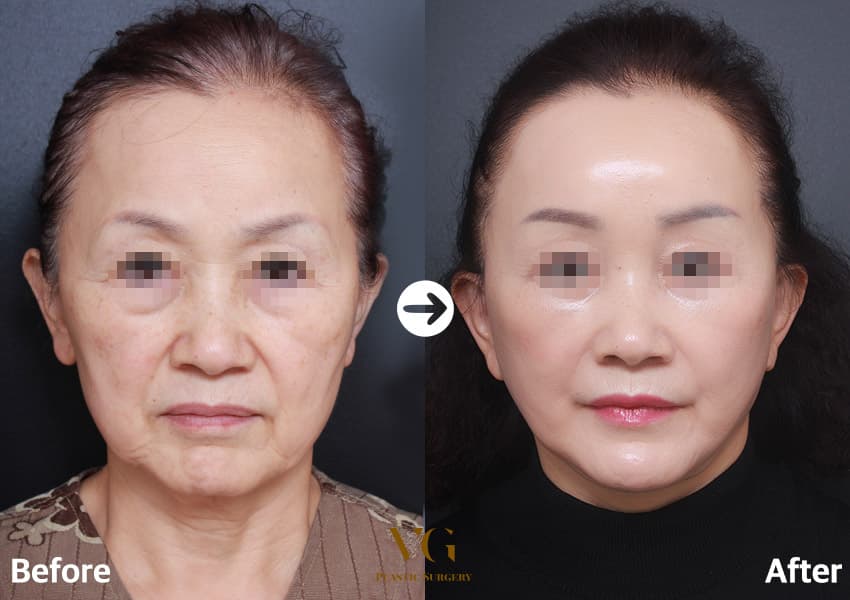
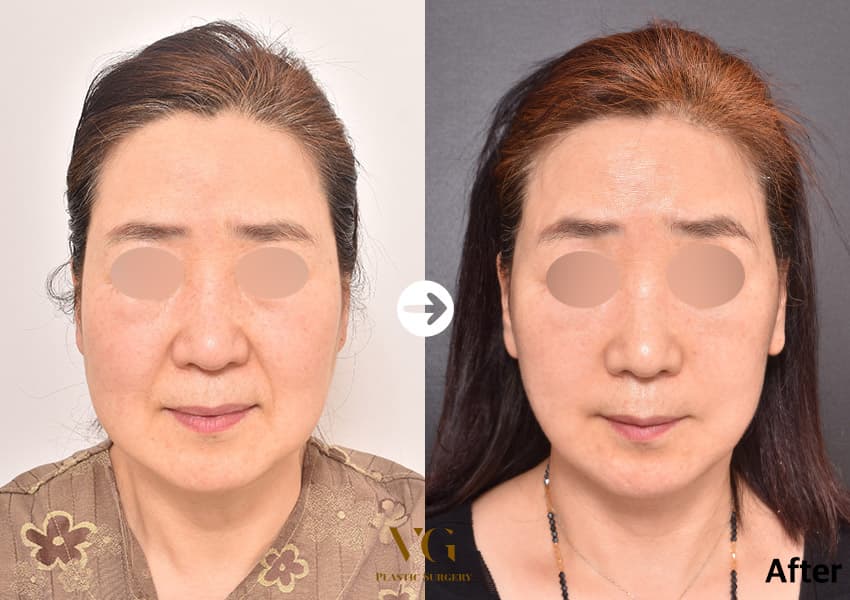
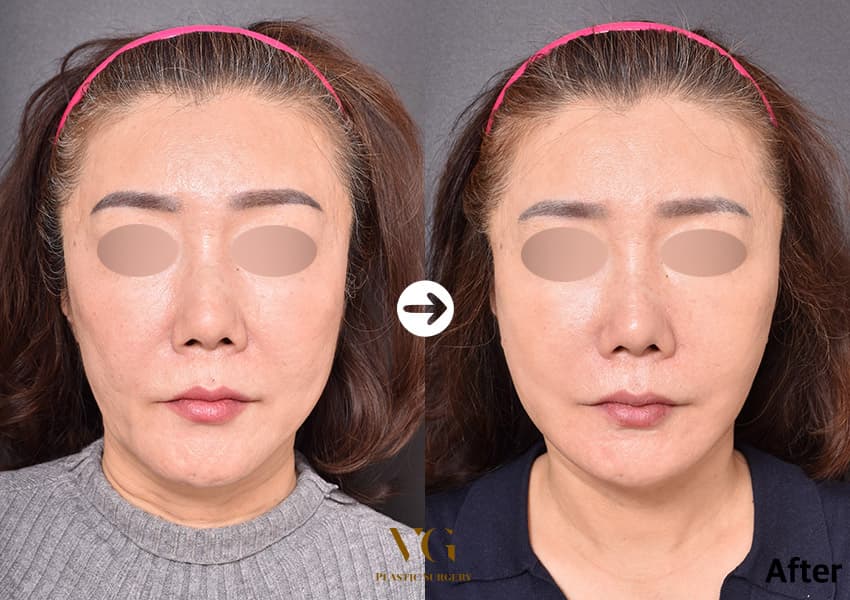
Facelift before & after — more cases
Real patients from our archive, all photographed 3 months after surgery. Tap a case to compare it full size.
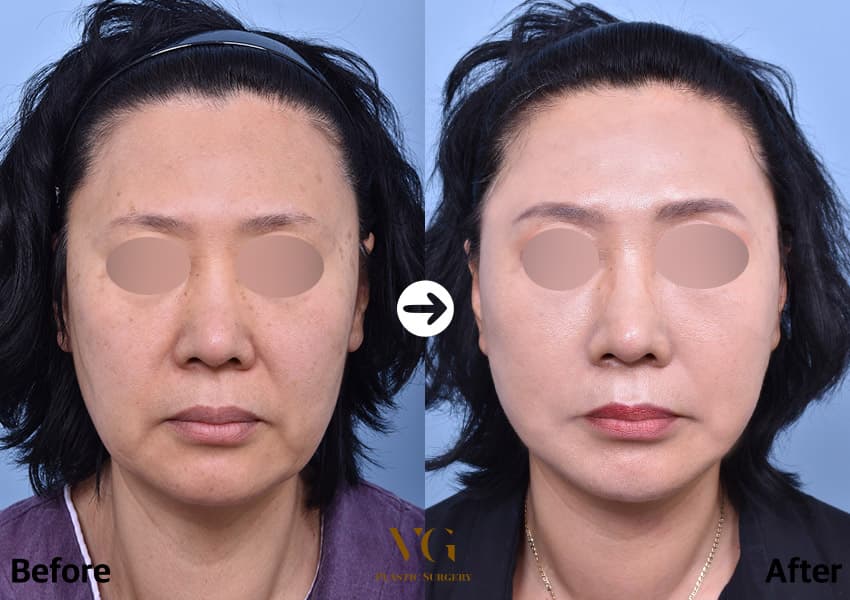
Face Lift3 months after surgery
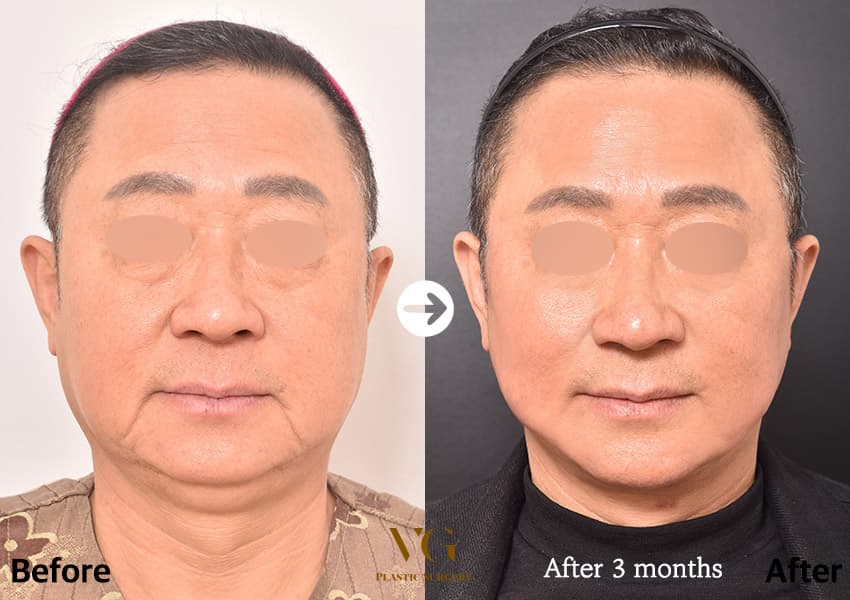
Face Lift3 months after surgery
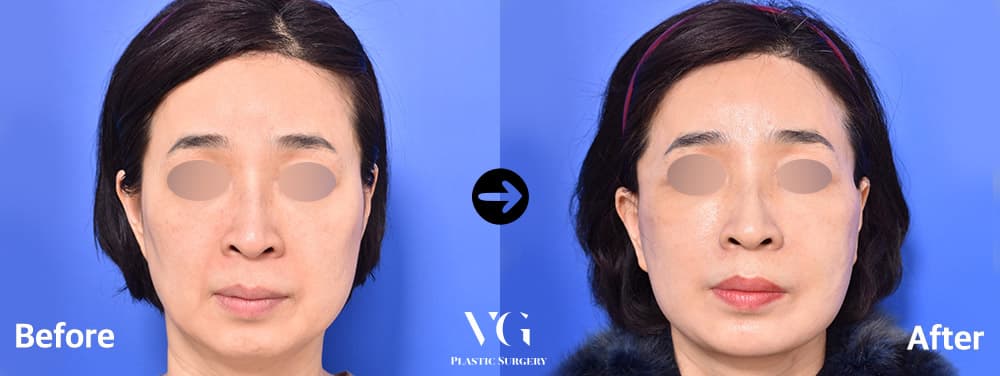
Face Lift3 months after surgery
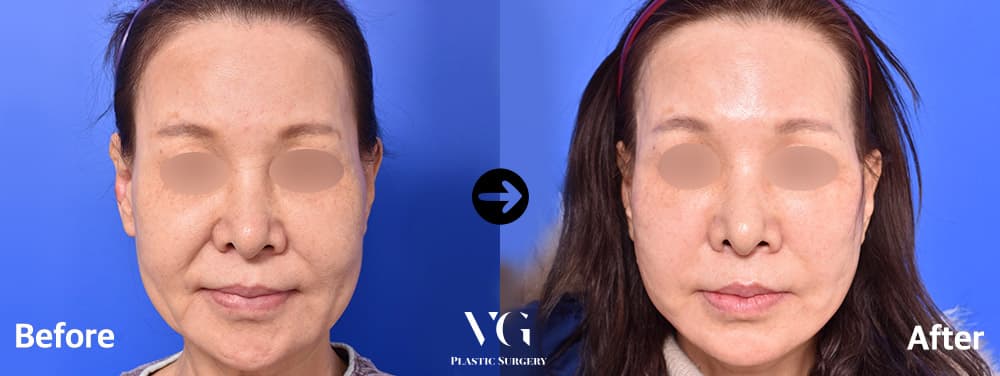
Face Lift3 months after surgery
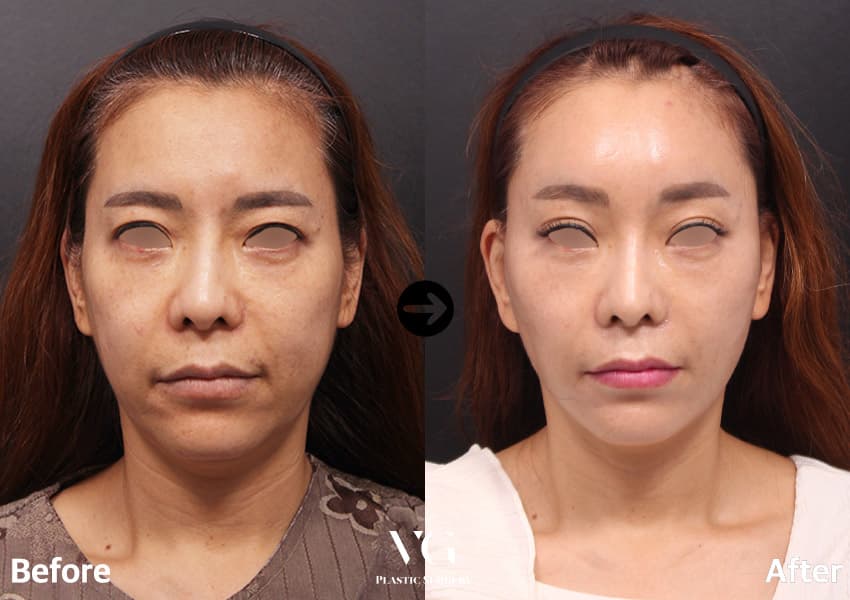
Face Lift3 months after surgery
FAQ
Questions patients ask
Is a ponytail lift the same as an endoscopic brow lift?
They overlap. Many ponytail-style lifts include an endoscopic brow and temple lift, then add some lifting of the midface through the same hairline incisions. A brow lift on its own moves the brows and outer eye corners. Ask any surgeon which tissues the proposed lift actually moves, and whether the cheek is included.
Can upper eyelid surgery be done in the same operation?
It is often combined in general practice. The order of thinking matters more than the scheduling: the brow position is assessed first, because removing lid skin when the brow is low can pull the brow down and leave the eye looking heavier. Once the brow is where it should be, the amount of lid skin to remove becomes clear.
Am I too young for a facelift in my thirties?
Age isn't the rule; how much tissue has descended is. If sagging is slight, surgery now trades incisions and recovery for a small change. Early brow descent or a heavy upper lid can still be worth addressing. I'll tell you plainly if your face doesn't need surgery yet.
What kind of anesthesia is used, and who monitors me?
Lifts are commonly done under IV sedation or general anesthesia, depending on how much is being lifted and your health history. Here, a board-certified anesthesiologist on staff watches your blood pressure, pulse and breathing from the first injection until you are awake again, so the operating surgeon does nothing but operate.
How long does an upper-face lift last compared with a full facelift?
No lift stops aging; tissue keeps descending after surgery. Lifts that reposition deeper layers are generally expected to hold longer than skin-only tightening, but there is no fixed number of years. Skin quality, sun exposure, smoking and weight changes all affect how long the change stays visible.
Sources
This article explains general medical information. Whether surgery suits you, and which method, is decided only after a consultation with the surgeon.
Written by
Im Young Min
Chief Director · Plastic Surgery
- Ph.D. in Medicine
- Internship and residency, Seoul St. Mary's Hospital
- Board-certified plastic surgeon, Seoul St. Mary's Hospital
- Adjunct professor of plastic surgery, Seoul St. Mary's Hospital
- Former director, Topface Plastic Surgery
Next step
Send two photos. Get a surgeon’s answer.
Front and side, natural light, no filter. Dr. Im Young Min reviews them and tells you which method fits and how many days to stay in Seoul.
International patients pay the same surgical fee as Korean patients. Pricing policy
Keep reading
Facelift
Facelift Results Duration Korea: The Layer Sets the Years
A facelift that repositions the deeper SMAS layer commonly holds around ten years; a mini or skin-only lift holds fewer. Sun, nicotine and weight swings after you fly home shorten either one.
Im Young Min ·
Facelift
Endoscopic Facelift Korea: What It Won't Lift, Who Should Skip It and What Sets the Cost
An endoscopic lift raises the brow, forehead and upper cheek through short incisions in the hair. It does little for jowls or a loose neck, so the first question is where your face has dropped.
Im Young Min ·
Facelift
Facelift Cost South Korea 2025: What Moves Your Quote? Lift Type, Add-Ons and Days in Seoul
A facelift quote in Korea is set by which layer of your face has dropped, how far the lift reaches (cheek only, or jawline and neck), what joins the same operation, the anesthesia, and your days in Seoul.
Im Young Min ·