Eyes
Korean Eyelid Surgery Before and After: How to Read the Photos
An eye surgeon in Seoul explains how to read Korean eyelid surgery before and after photos — when they were taken, how light and makeup change them, what crease height and ptosis correction look like, and how to compare them with your own eyes.
· 6 min read · Last updated
In this article
- 01Why the same result can look different in two photos
- 02Step one: when was the after photo taken?
- 03Step two: light, angle and makeup
- 04Step three: crease height and ptosis correction
- 05Step four: compare the before photo with your own eyes
- 06What a before-and-after photo cannot show you
- 07If you come to Seoul for eye surgery
- 08Where to go next
The short answer
Read Korean eyelid surgery before and after photos by checking four things before you judge the result: how long after surgery the after photo was taken, whether the light, angle and makeup match, how high the crease was set, and whether the eye-opening muscle was also corrected. A photo taken at three months shows a crease that has mostly settled but is not yet final. The useful question is not "is this eye pretty" but "does this starting eye look like mine".
- Check the time label first: incisional results look natural at around 2–3 months and are final at about 6 months; non-incisional results settle faster.
- Light, camera angle, eyebrow makeup and lashes change an after photo more than most people expect — compare the eye opening and the crease, not the overall glow.
- A crease alone and a crease with ptosis correction are different operations; the second shows more of the iris in the after photo.
- Pick cases whose before photo looks like your eyes now — lid thickness, how much the iris is covered, and whether you lift your brows to open your eyes.
- Eye surgery in Seoul needs a stay of at least 7 days, and we review your photos for three months after you fly home.
I am Hong Dae Won, a board-certified plastic surgeon at VG Plastic Surgery in Seoul, trained at Asan Medical Center and a full member of the Eyelid Surgery Research Group of the Korean Society of Plastic and Reconstructive Surgeons. Most of my work is eye and nose surgery. Patients abroad often send me a screenshot of Korean eyelid surgery before and after photos and ask, "Can I get this?" — so this is how I teach them to read those photos in consultation.
Profile
Hong Dae Won
Director · Board-certified in Plastic Surgery
Why the same result can look different in two photos
A before-and-after pair is two separate photographs, taken months apart. Anything that changed between them — light, camera height, how the patient held the brows, makeup — ends up looking like part of the result. The eye itself is only one of the variables.
So before you decide whether a result is good, check whether the two photos are fair to each other. Then look at what was actually done. Only then compare it with your own eyes.
| Check | What to look for | Why it matters |
|---|---|---|
| Time after surgery | A label such as "3 months after surgery" | Swelling makes an early crease look higher and thicker than it will be |
| Light | Same brightness and colour in both photos | Warmer, brighter light smooths skin and darkens lashes |
| Angle and gaze | Camera at eye level, eyes looking straight ahead | Looking down hides the crease; looking up exaggerates it |
| Brows | Brow height and brow makeup in both photos | Raised brows open the eye; filled brows make the after look sharper |
| Lashes and makeup | Mascara, extensions or liner in the after photo | Dark lashes make the eye read larger without any surgery |
| What was done | Crease only, or crease plus ptosis correction or canthoplasty | Different operations produce different amounts of change |
Step one: when was the after photo taken?
The eye cases in our archive are photographed at three months, and the template labels each one with that time. Three months is a fair checkpoint, not the finish line. Here is how swelling usually runs for the operations you will see most often.
| Procedure | Swelling peaks | Looks natural | Final result |
|---|---|---|---|
| Non-incisional double eyelid | 2–3 days | About 1 month | About 3 months |
| Incisional double eyelid | 3–5 days | 2–3 months | About 6 months |
| Non-incisional ptosis correction | 2–3 days | About 1 month | About 3 months |
| Epicanthoplasty (inner or outer corner) | 2–3 days | 1–2 months | About 3 months |
This changes how you read a photo. An incisional crease at one month can still sit higher and look thicker than it will at six months. If a clinic shows a photo taken a week after surgery, you are mostly looking at swelling. If you see a crease at three months that looks slightly heavy, it usually still has room to soften.
Step two: light, angle and makeup
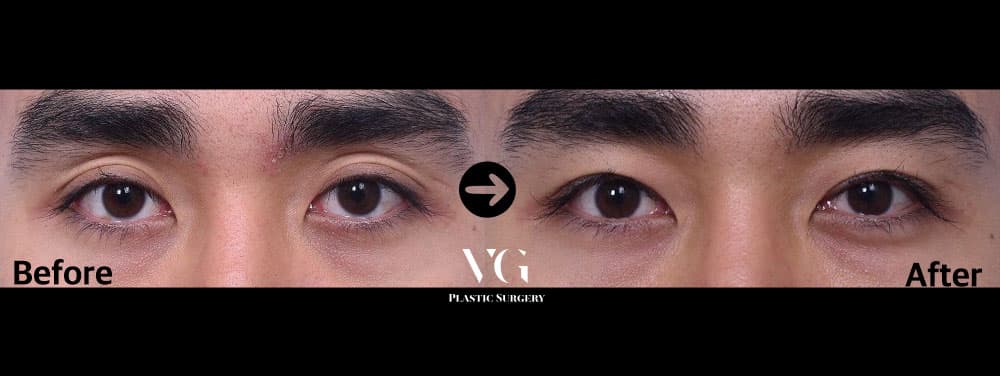
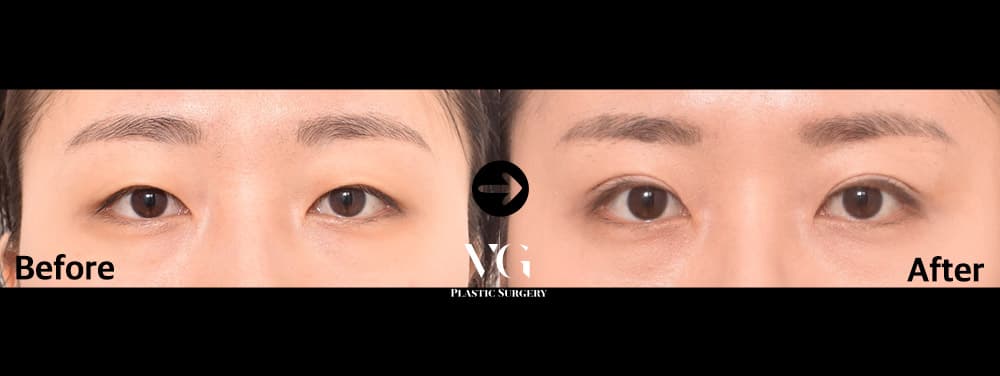
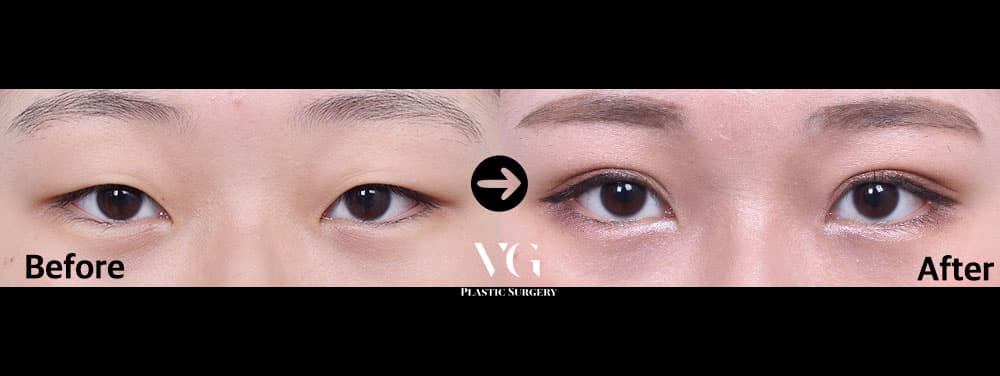
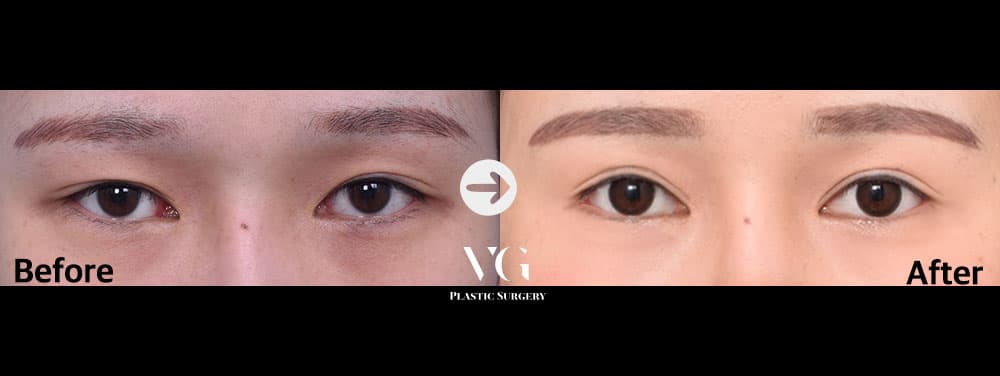
Look at the two cases below. Both are natural adhesion double eyelid cases — a crease made without an incision. The surgical change is real in both, but notice how much of the impression comes from things around the eye.
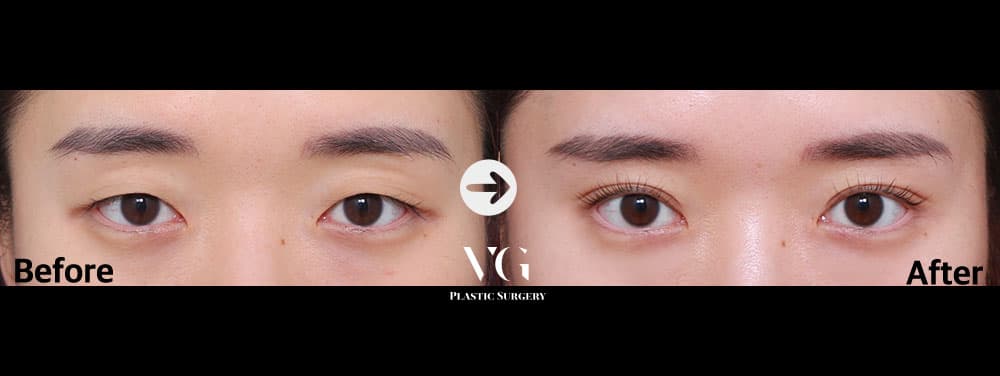
In the first case, the after photo is warmer and the brows look more defined. Cover the brows with your thumb and look only at the lid: the change is a thin, low crease that now shows along the whole eye. That is the part surgery did.
In the second case, the lashes are darker in the after photo — ignore them. Look at how much of the coloured part of the eye the upper lid covers: before, the lid sits over the top of the iris; after, more of it shows. That change comes from the non-incisional ptosis correction added to the crease, not from the lashes.
Step three: crease height and ptosis correction
Two things decide most of what you see in Korean eyelid surgery before and after photos: how high the crease was set, and whether the muscle that lifts the eye was adjusted.
Crease height and line style
We choose the line with each patient from four styles. An in line tucks inward at the front, close to the inner fold, and reads calm. An in-out line is tucked at the front and opens toward the tail — the line most of our patients choose. A semi-out line shows a little more at the front, and an out line shows from the front onward for a defined, open look.
When you look at a photo you like, ask which of these it is, not just whether it is "big" or "natural". Which line suits you depends on lid thickness and eye shape, so we decide it in person.
With or without ptosis correction
If you raise your forehead to open your eyes, or people tell you that you look sleepy, a crease alone will not change that. Ptosis correction adjusts the lifting force itself. Non-incisional correction uses sutures and recovers faster, but it has a limit; for heavier droop we suggest the incisional route.
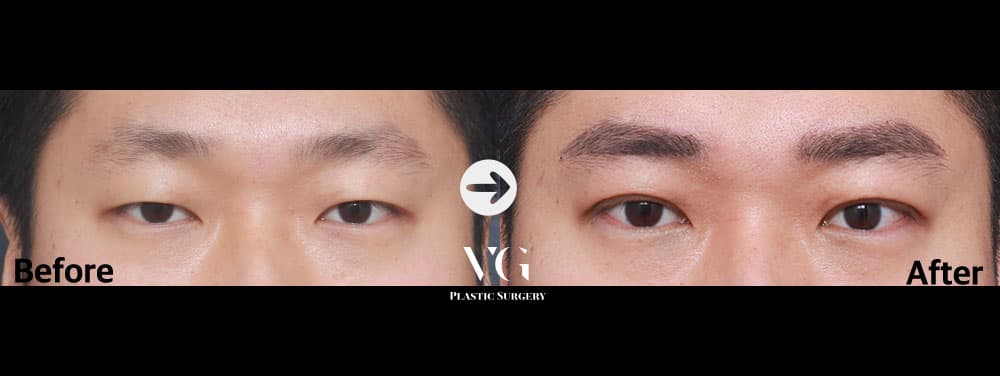
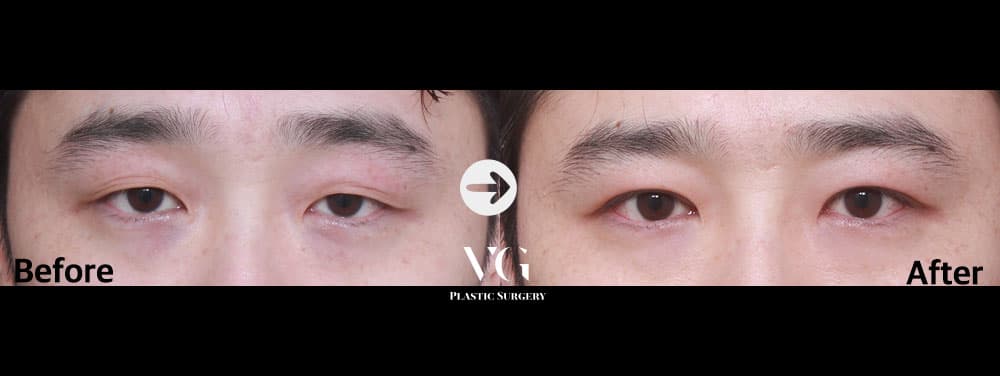
Both men started with lids that covered much of the iris. After surgery the crease is visible and the eyes open further, which is the ptosis correction at work. In the second case the lid edges are still slightly pink at three months — a reminder that an incisional result keeps settling until about six months.
Send two photos of your eyes — one looking straight ahead, one with eyes gently closed — and I will tell you which of these cases your eyes are closest to.
Step four: compare the before photo with your own eyes
The most useful photo in a before-and-after pair is the before. If the starting eye is not like yours, the after photo cannot tell you much about your result. Before I plan surgery I look at facial proportion, eye shape, eye length and spacing, the height of the eye tail, whether ptosis is present, and skin thickness and muscle.
- Take your own photo in daylight, camera at eye level, no eye makeup, brows relaxed.
- Find cases whose before photo matches yours: similar lid thickness, similar amount of iris covered, similar fold or no fold.
- Check what was done in those cases — crease only, or crease plus ptosis correction or corner surgery.
- Compare the after photo only with that starting point. A thin-lidded eye with a crease is not a preview of a thick, heavy lid with the same crease.
You can filter our eye surgery before and after archive by concern and by procedure, so you can look only at cases that started where you are. If you want to see the non-incisional case above on its own page, it is natural adhesion crease with ptosis correction, case 613.
What a before-and-after photo cannot show you
A photo shows a result at one moment. It does not show who was a poor candidate and was told so. We do not operate on untreated dry eye or blepharitis — we ask you to see an ophthalmologist first. We also say no when a travel schedule is too short for stitch removal and the first follow-up, or during pregnancy or with an uncontrolled thyroid or bleeding disorder.
It also cannot give you someone else's eyes. If you bring a celebrity photo, a different eyelid structure will not produce the same shape. And a photo does not show what can go wrong: a crease that fades, two sides that settle at different heights, a line set too high. These are the problems we see in revision, which is planned at least 6 months after the first operation.
If you come to Seoul for eye surgery
Eye surgery takes 30 minutes to 2 hours under sedation, and you usually go back to your hotel the same day. Plan to stay in Korea at least 7 days — that covers stitch removal and the first follow-up before you fly. Do not book your return for the day of your last appointment, because appointments move.
After you fly home, we keep reviewing your photos: at week 1 for swelling and the incision, at month 1 as the line settles, and at month 3. The surgeon who operated answers in writing. In other words, you will be taking your own before-and-after photos — and the same rules apply: same light, eye level, no makeup.
International patients pay the same surgical fee as Korean patients, confirmed in one itemised written quote; our pricing policy explains how that works. Interpretation is free through consultation, the design check on the morning of surgery and every follow-up — see what international patients receive.
Where to go next
If you are still choosing between methods, read incisional vs non-incisional double eyelid surgery in Korea. If your concern is extra skin rather than a missing crease, blepharoplasty in Korea covers upper and lower lid surgery. For photos across nose, contouring and body surgery, see Korean plastic surgery before and after. The full picture of our eye centre is on the eye surgery page, and you can read my background on my profile.
Eyes before & after — more cases
Real patients from our archive, all photographed 3 months after surgery. Tap a case to compare it full size.
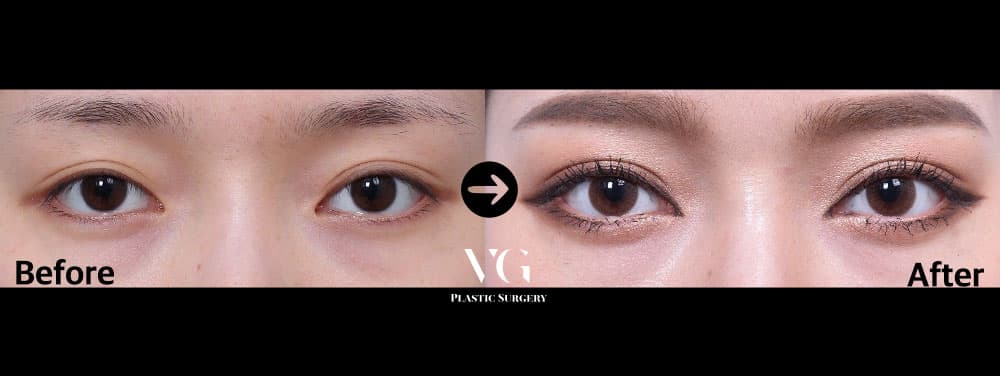
Natural-Adhesion Double Eyelid3 months after surgery
Incisional Ptosis Correction3 months after surgery
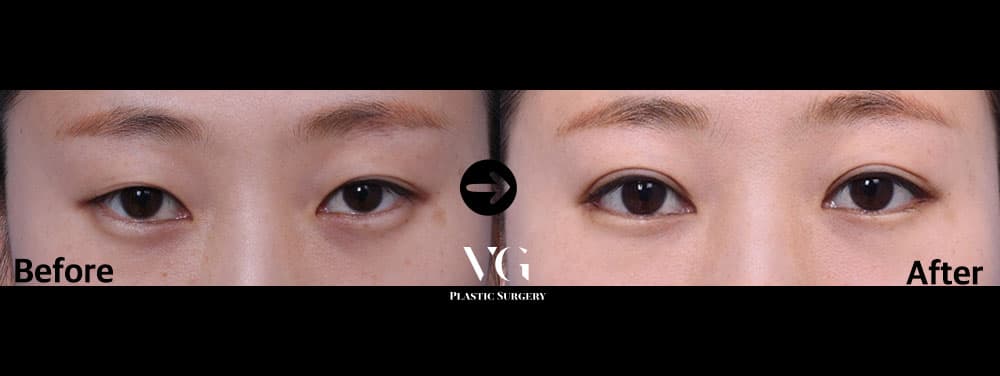
Incisional Double Eyelid3 months after surgery
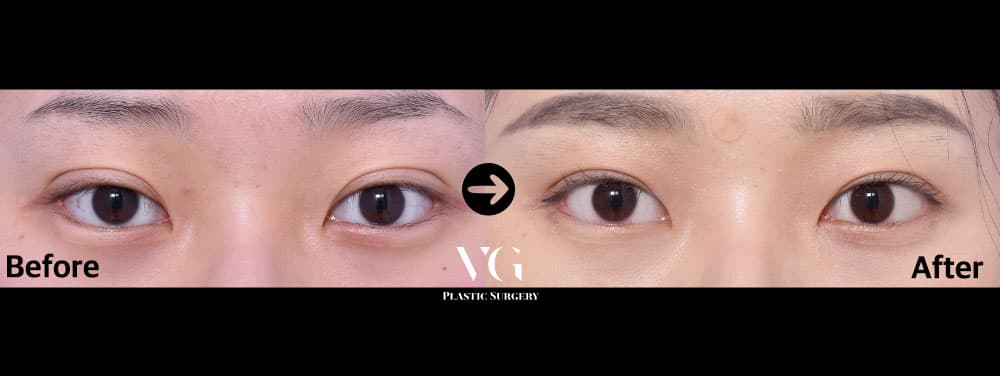
Incisional Double Eyelid3 months after surgery
Incisional Ptosis Correction3 months after surgery
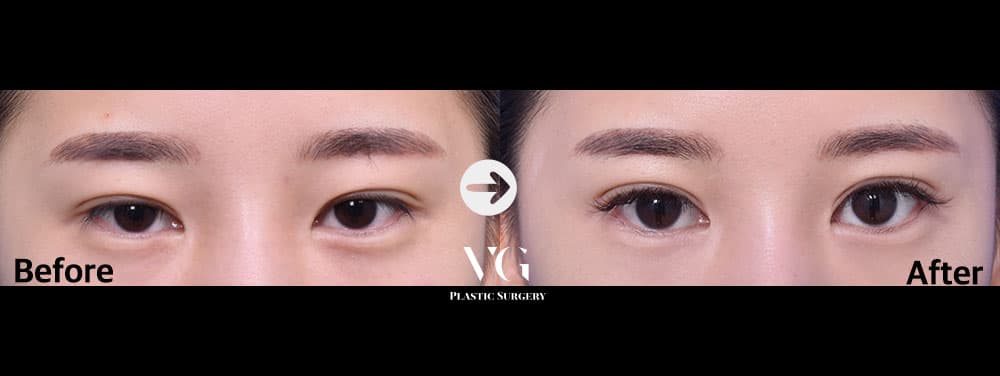
Natural-Adhesion Double Eyelid3 months after surgery
FAQ
Questions patients ask
How long after eyelid surgery are before and after photos usually taken?
Our eye cases are photographed at three months after surgery. At that point a non-incisional crease is close to final, while an incisional crease usually looks natural at 2–3 months and is final at about 6 months.
Why do Korean eyelid surgery before and after photos look so dramatic?
Part of it is the surgery, and part is the photo — warmer light, brow makeup and darker lashes in the after shot all make the eye look larger. Compare only how much of the iris the lid covers and where the crease sits.
How can I tell if ptosis correction was done in a photo?
Look at how much of the coloured part of the eye shows. With a crease alone, the eye opening changes little; with ptosis correction, the upper lid sits higher on the iris in the after photo. The case description usually names it too.
Will my eyes look like the after photo?
Only if your starting eye is similar. Find cases whose before photo matches your lid thickness, fold and eye opening, then look at their result. A different eyelid structure cannot produce the same shape.
How swollen will I look in the first week?
Swelling peaks at 2–3 days for non-incisional methods and 3–5 days for incisional surgery, then settles. That is why we plan a stay of at least 7 days and review photos again after you fly home.
Can I send my own photos for an opinion?
Yes. Send one photo looking straight ahead and one with your eyes gently closed, in daylight and without eye makeup. We will tell you which kind of case your eyes are closest to; the exact method is decided in consultation.
This article explains general medical information. Whether surgery suits you, and which method, is decided only after a consultation with the surgeon.
Written by
Hong Dae Won
Director · Plastic Surgery
- Board-certified plastic surgeon, Asan Medical Center, Seoul
- Plastic surgery fellowship, Florence University Hospital, Italy
- International Confederation for Plastic, Reconstructive and Aesthetic Surgery (IPRAS)
- American Society of Plastic and Reconstructive Surgeons (ASPRS)
- American Society for Aesthetic Plastic Surgery (ASAPS)
Next step
Send two photos. Get a surgeon’s answer.
Front and side, natural light, no filter. Dr. Hong Dae Won reviews them and tells you which method fits and how many days to stay in Seoul.
International patients pay the same surgical fee as Korean patients. Pricing policy
Keep reading
Eyes
How Much Does Double Eyelid Surgery Cost in Korea? Results, How Long It Lasts, Reviews and When to Spend Less
There's no single figure: the method your lids need, any ptosis or inner-corner work, the anesthesia and your days in Seoul set the quote, and foreigners pay the same surgical fee as Korean patients.
Im Young Min ·
Eyes
Lower Blepharoplasty Korea Cost: Fat, Skin or Lid Support? Reviews, Methods and Recovery
Your lower blepharoplasty cost in Korea follows what is causing the bags: bulging fat, a hollow beneath it, loose skin or a slack lower lid, plus the anesthesia and the days you plan in Seoul.
Im Young Min ·
Eyes
Double Eyelid Surgery Cost in Korea: What Changes Your Quote? Results, Reviews and Methods
Quotes for double eyelid surgery in Korea differ because they describe different operations: suture or incision, fat removal, ptosis correction, inner-corner work and revision.
Im Young Min ·