Nose
Big Nose Korean Rhinoplasty: Will I Still Breathe Well?
Big nose Korean rhinoplasty means reducing the hump, nasal bones, tip or nostrils. The risks that matter are over-reduction and breathing, and some noses should wait.
In this article
The short answer
Big nose Korean rhinoplasty is a reduction: lowering a hump, narrowing wide nasal bones or refining a heavy tip, instead of the bridge-raising most people picture when they think of noses done in Seoul. The worry underneath it is usually more specific than whether a Korean clinic can make a nose smaller: if mine gets smaller, will I still breathe through it properly once I'm back home? Here an ENT specialist practises alongside the plastic surgeons in the rhinoplasty centre, so your septum and airway are assessed together with the shape.
- Big nose Korean rhinoplasty is a reduction of the hump, nasal bones, tip or nostrils.
- Narrowing the middle of the nose too far can make breathing worse.
- Thick skin limits how small a tip can look.
- A growing face, a recent break or an unexamined airway are reasons to wait.
- An ENT specialist works in the rhinoplasty centre alongside the plastic surgeons.
I'm Im Young Min, chief director of VG Plastic Surgery in Gangnam and a board-certified plastic surgeon trained at Seoul St. Mary's Hospital. I'd rather tell you up front which large noses I would leave alone or ask to wait, because tissue taken out of a nose is harder to put back than tissue added to a flat one.
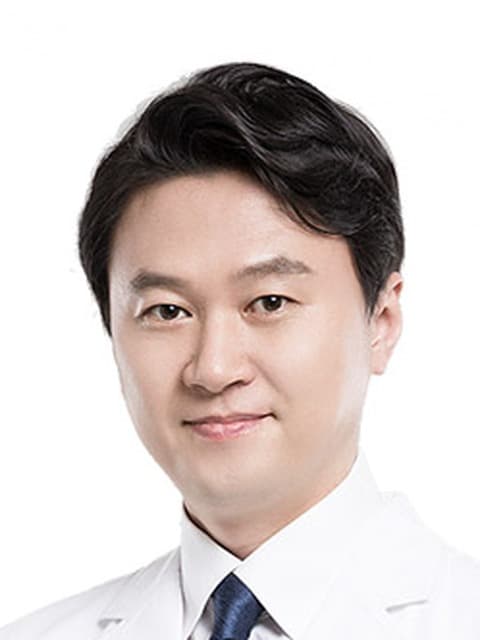
Profile
Im Young Min
Chief Director · Board-certified in Plastic Surgery
If breathing is the part you're unsure about, take three daylight photos of your nose (front, side, and from below looking up at the nostrils) and send them on WhatsApp with one line on whether either side blocks up at night. Add the one question that's bothering you most, for example whether your airway has room for the narrower bridge you want. Writing down which side blocks, and when, gives you something concrete to point to in any consultation, here or at home.
Send your nose photos and your breathing question on WhatsApp
What a reduction takes away, and what has to close up after
A hump is bone in its upper part and cartilage below. Shaving it down leaves an open strip along the bridge, so the nasal bones are usually moved inward to close the gap. A wide tip is narrowed by trimming or stitching cartilage. Then the skin has to shrink over a smaller frame.
That last step is the one no surgeon fully controls. Thin skin settles close to the new shape. Thick, oily skin contracts less, so a tip made much smaller underneath can still look full or blunt from the outside. How skin thickness caps what tip work can show is covered in why your skin sets the limit on the tip.
A big nose is also rarely big everywhere. Often it's high at the hump and short of support somewhere else: a tip that droops when you smile, or a long nose with a weak base. In Ishii's 2014 review of Asian rhinoplasty, most of the discussion is about adding height and tip support, and a reduction can need that same support work at the tip while height comes off the bridge. Taking away and holding up usually happen in the same operation.
Will a smaller nose make it harder to breathe?
In short, it can, if the narrowing goes too far in the wrong place. The tightest point of your airway sits inside the middle third of the nose, where the upper side cartilages meet the septum. Narrow that area too much and air loses room exactly where it was already tight.
When a hump is removed, the roof over that point is opened and then closed again. Surgeons generally watch for the middle of the nose collapsing inward, which shows later as a pinched look below the bridge and a nose that blocks when you breathe in hard. Keeping or rebuilding that width is part of planning any reduction, and it's one reason a reduced nose may stay a little wider in the middle than a photo you saved.
The other half is what's already there. A deviated septum, swollen turbinates or nasal walls that cave in on a deep breath won't improve because the outside looks better, and a reduction can make a borderline airway feel worse. On our team, an ENT specialist joins the rhinoplasty centre to look after the septum, the airway and whether you can breathe, and that assessment belongs to the same plan as the shape.
If one side already blocks at night, or you've broken your nose before, say so at the start. Those two facts can change the plan more than the size of the hump does.
If you've had a broken nose, a septum operation or a sinus scan, a photo of the report, or just the year it happened, is worth adding to your WhatsApp message alongside the nose photos. Ask whether that history changes how much can safely come off.
Send your nose photos and your breathing question on WhatsApp
When big nose Korean rhinoplasty should wait, or not happen
Some large noses are better left as they are, and some should wait a season or longer. As general medicine, these are the situations where a careful surgeon slows down:
- Thick skin with a request for a small, sharp tip. The skin may not shrink to match, and removing more cartilage to force it can weaken the tip.
- A face that's still growing. Surgeons generally wait until facial growth has finished, which for most people means the late teens.
- A recent break. Bone and swelling need months to settle before anyone can read the true shape.
- A blocked airway nobody has examined. That is assessed first, and it may change what's safe to remove.
- A nose in proportion, made to look big by a short chin. Taking tissue off the nose won't change the chin, and that conversation is worth having first.
- Pregnancy or breastfeeding, smoking you can't pause, or blood thinners you can't stop.
- A goal of matching one particular photo, or distress about your nose that nothing else has eased. That deserves a different kind of help before surgery.
Saying no is part of the job. I tell people whether surgery suits them, and when it doesn't, I say so plainly. With a reduction the bar sits a little higher, because cartilage and bone that come out can't simply be put back the way they were.
What can go wrong once tissue comes off?
Most of what you'll notice early is temporary. The problems that matter with a reduction come from taking too much or from the airway, and those can mean a second operation.
Risks and side effects to know
Swelling, bruising around the eyes, a blocked feeling from swelling inside, numbness at the tip and occasional nosebleeds are expected early on. The American Society of Plastic Surgeons lists breathing difficulty, numbness, an uneven result, poor healing or scarring, a hole in the septum and the possibility of revision surgery among rhinoplasty risks. ASPS and the NHS both describe the final shape appearing gradually over months as swelling goes.
Over-reduction is the risk I take most seriously with a big nose: a bridge scooped too low, a fullness just above the tip (often called a pollybeak), a pinched middle third, or a tip that loses support and droops. Unevenness after the bones are moved is also possible. Most of these can be improved, but correcting a nose that's too small usually means adding cartilage back, a larger operation than the first.
Narrowing the nostrils through small cuts at the base leaves scars in the crease beside each nostril. They usually fade, but they're scars you keep, and the nostrils don't widen again if you later feel they've gone too small.
The situations in the section above, from pregnancy to an airway nobody has examined, are the main reasons to wait.
Once you're home, the CDC's advice for medical travel applies: arrange follow-up before you leave and carry copies of your records. For a nose, that means knowing a local doctor who will see you and knowing the warning signs: bleeding that pressure doesn't stop, fever with growing redness or pain, sudden swelling on one side, or breathing that gets worse instead of better. Calf pain or sudden breathlessness after the flight needs emergency care where you are. Results and healing vary from person to person, and whether a reduction suits your nose is decided at the in-person exam.
Is a closed approach enough for a big nose?
Sometimes. If the main problem is a hump, a closed approach with incisions inside the nostrils can reach it. When the tip needs real reshaping or support, many surgeons prefer an open approach, which adds a small scar across the strip between the nostrils in exchange for seeing the cartilage directly.
Neither approach wins in general; what your nose needs most decides it. The trade-offs are laid out in closed rhinoplasty versus the open approach. Either way, the tip is the slowest part to settle, and early photos usually show a fuller nose than the one you'll end up with; what to know about swelling before you book goes through that timing.
Who's in the room for your nose
A reduction is a long run of small decisions made under anesthesia, so the people around the table matter. Three board-certified anesthesiologists work at VG Plastic Surgery full time, and one is dedicated to each operation, watching your blood pressure, pulse and breathing from the first injection until you're awake again. They don't perform cosmetic surgery, which lets the surgeon concentrate on the nose.
Every surgeon here is board-certified and operates under their own name, and which centre each belongs to and where they trained is published, so you can check who would handle your nose before you fly. If you're comparing clinics from abroad, the questions in how to choose a rhinoplasty surgeon in Korea from abroad apply here too. The surgeons by centre and the address in Gangnam are on the VG Plastic Surgery home page.
Your first WhatsApp message can be short: the weeks you could travel and, in your own words, the one change to your nose that matters most to you. Starting from that one change keeps the plan from growing beyond what your big nose Korean rhinoplasty actually needs.
Related pages:
Nose before & after — more cases
Real patients from our archive, all photographed 3 months after surgery. Tap a case to compare it full size.
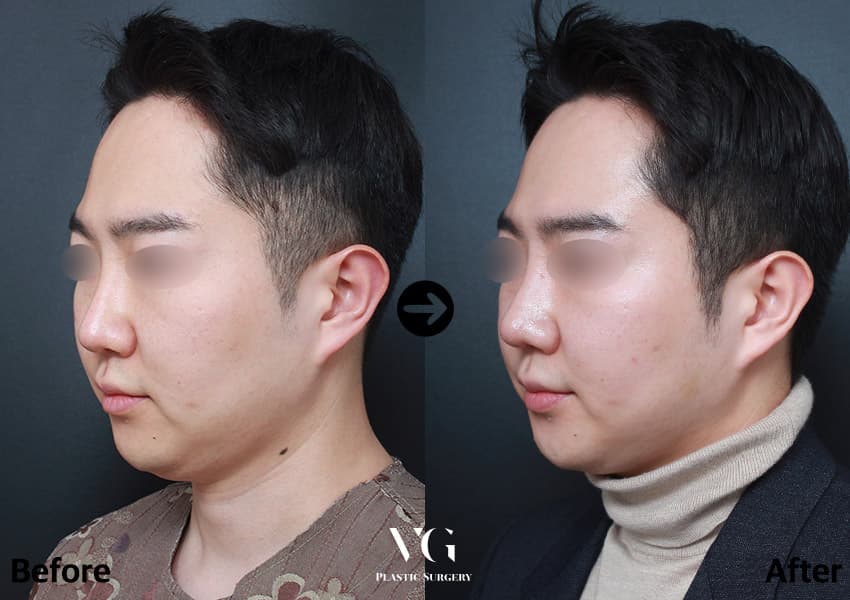
Male Rhinoplasty3 months after surgery
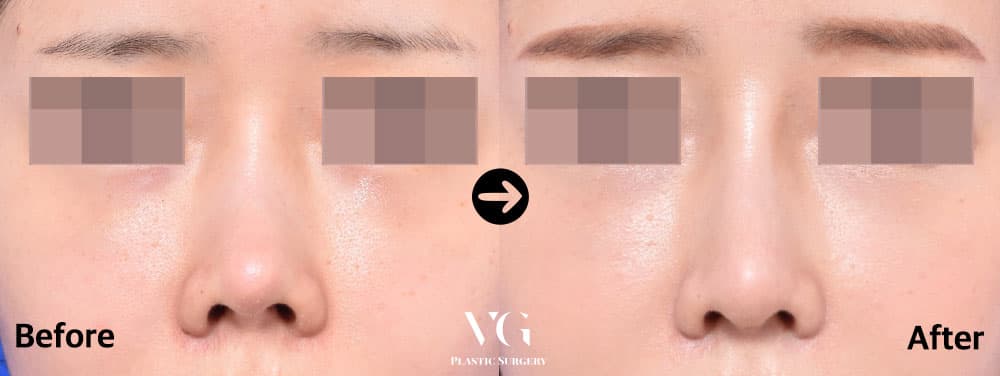
Revision Rhinoplasty3 months after surgery
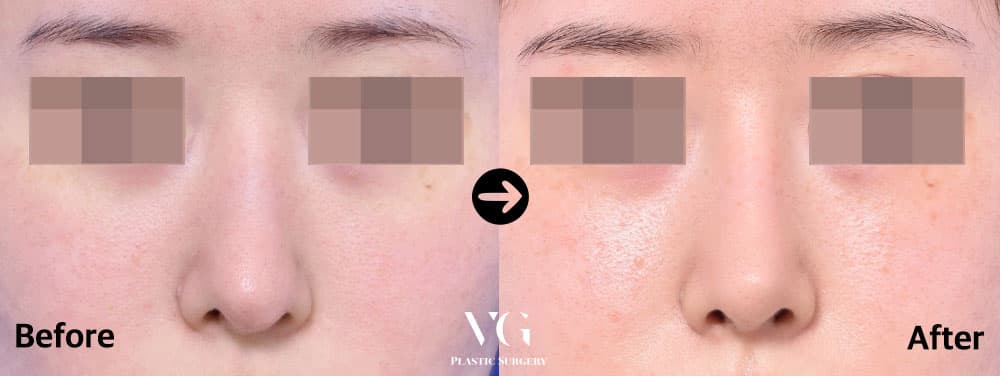
Revision Rhinoplasty3 months after surgery
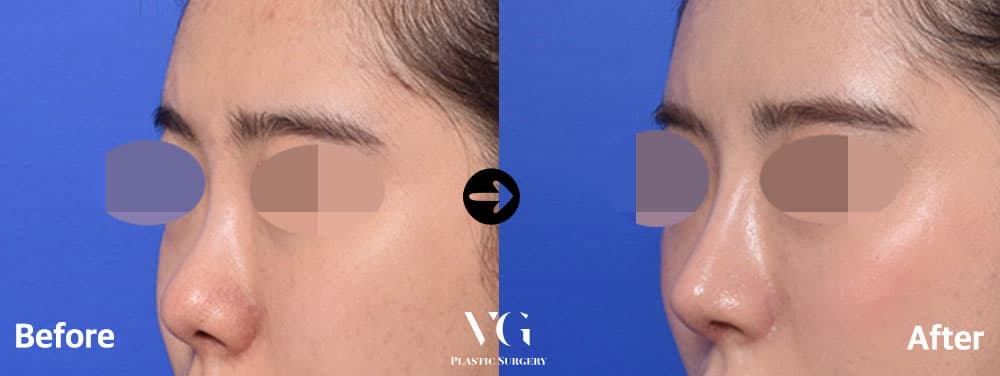
Rhinoplasty3 months after surgery
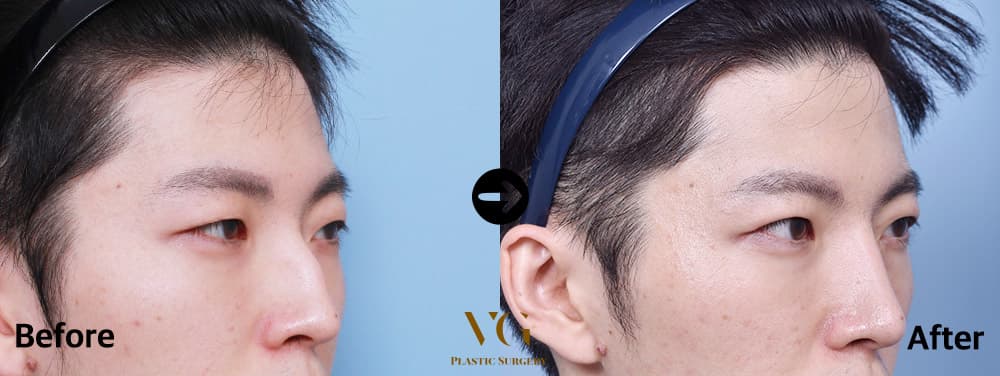
Male Rhinoplasty3 months after surgery
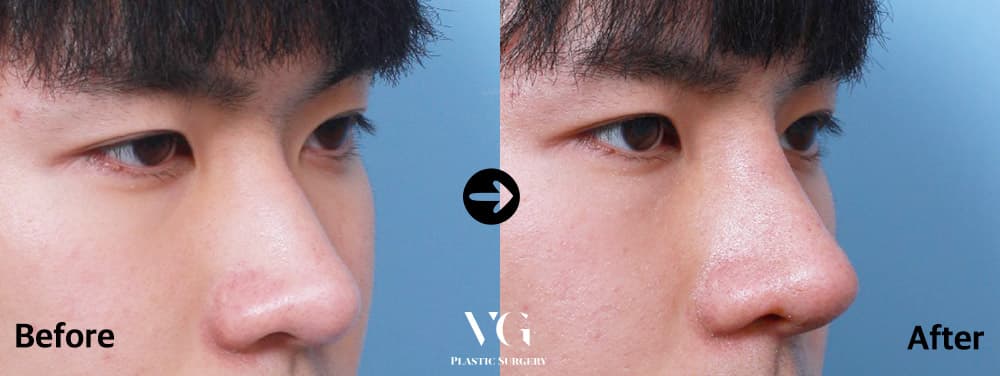
Male Rhinoplasty3 months after surgery
FAQ
Questions patients ask
Does Korean rhinoplasty only make noses higher?
No. Augmentation gets most of the attention, but lowering a hump, narrowing the nasal bones, refining a wide tip and narrowing the nostrils are all part of rhinoplasty. A big nose Korean rhinoplasty often combines removal at the bridge with added support at the tip, so the nose comes down in size without the tip dropping.
Can a bulbous tip be made smaller if my skin is thick?
Usually somewhat, but thick skin shrinks less over the new cartilage, so the visible change tends to be smaller than the change underneath. Trying to force a very fine tip by removing more cartilage can weaken it. A modest, well-supported refinement is the more reliable goal for thick skin.
Will people be able to tell my nose was reduced?
A reduction kept in proportion with your face is less likely to draw attention than a dramatic one, and incisions sit inside the nostrils or in small creases. Early swelling makes the nose look fuller for a while, so the shape people see months later is the one to judge.
Can the nostrils be narrowed in the same operation?
Often, yes. Nostril narrowing is done through small cuts where the nostril meets the cheek and is commonly combined with bridge or tip work. Because both the scar and the narrower shape stay with you, taking off less rather than more is the safer choice.
Should a deviated septum be fixed at the same time?
If it affects your breathing, generally yes, since the septum also supports the middle and lower nose. At VG Plastic Surgery, rhinoplasty is reviewed with an ENT specialist so breathing and internal structure are assessed alongside the shape, and a deviated septum is treated as part of the operation instead of being left to someone else.
Sources
This article explains general medical information. Whether surgery suits you, and which method, is decided only after a consultation with the surgeon.
Written by
Im Young Min
Chief Director · Plastic Surgery
- Ph.D. in Medicine
- Internship and residency, Seoul St. Mary's Hospital
- Board-certified plastic surgeon, Seoul St. Mary's Hospital
- Adjunct professor of plastic surgery, Seoul St. Mary's Hospital
- Former director, Topface Plastic Surgery
Next step
Send two photos. Get a surgeon’s answer.
Front and side, natural light, no filter. Dr. Im Young Min reviews them and tells you which method fits and how many days to stay in Seoul.
International patients pay the same surgical fee as Korean patients. Pricing policy
Keep reading
Nose
Rhinoplasty Cost in South Korea in Rupees: What Changes It for a Flat Nose or Crooked Septum? Reviews, Methods and Recovery
There's no honest rupee figure for a nose nobody has examined. The cost follows the method, septum work, revision, anesthesia time and days in Seoul; send photos on WhatsApp to ask about yours.
Im Young Min ·
Nose
What Decides the Cost of Rhinoplasty in South Korea? Reviews, Methods and Recovery
There is no single price for a nose job in Korea: the method, the cartilage source, septum work, revision status and anesthesia set the figure for your nose.
Im Young Min ·
Nose
How Much Does a Nose Job Cost in Korea? Four Cost Drivers, Reviews, Methods and Recovery
A nose job in Korea is priced from four parts: the scope of the change, the building material, any breathing work and the anesthesia. Foreigners pay the same surgical fee as Korean patients, with a written estimate.
Im Young Min ·