Facial Contouring
Facial Contouring Surgery Cost in Korea: Which Bone Work Can You Skip? Reviews, Methods and Recovery
Facial contouring surgery cost in Korea is set by how many areas are reduced, how much bone comes off, anesthesia time and days in Seoul. A plan built from your CT can also drop areas you don't need.
In this article
- 01Bone, muscle or dropped tissue: where your width comes from
- 02What decides facial contouring surgery cost in Korea for your face?
- 03Which methods fit which kind of width?
- 04When would I tell you to spend less, or nothing?
- 05What do reviews of facial contouring in Korea get right?
- 06Recovery: what the first weeks ask of your schedule
- 07Risks and side effects to know
The short answer
Worried that facial contouring surgery cost in Korea will climb once a surgeon in Seoul has seen your CT, after the flight is already booked? It usually moves only when the plan moves: which bones are reduced, by how much, and how long you stay. A figure built from your own face holds up far better than any average you find online.
- The cost of facial contouring is set by the number of areas, how much bone comes off, anesthesia time and your days in Seoul.
- Bone surgery only narrows width that comes from bone; muscle or descended tissue needs a different plan.
- Foreign patients pay the same surgical fee as Korean patients at VG Plastic Surgery.
- Arrange follow-up care at home before you fly.
Before you plan your leave around it, read this through.

Profile
Im Young Min
Chief Director · Board-certified in Plastic Surgery
By the end you'll know what moves the cost, which methods fit which kind of width, what reviews get right and wrong, and what recovery asks of your calendar. That makes it easier to tell whether your face needs bone work at all, or a smaller plan that suits your budget.
Hello, I'm Dr. Im Young Min, Chief Director and board-certified plastic surgeon at VG Plastic Surgery in Gangnam, Seoul. Facial contouring is one of the five centers I cover here, alongside eyes, nose, breast and body.
Before contouring, we map nerves and bone thickness on CT. Three board-certified anesthesiologists work here full time, one dedicated to each operation, so the surgeon does nothing but operate. And foreign patients pay the same surgical fee as Korean patients.
I'm writing this because the costly mistake in contouring is rarely the fee itself. It's paying to reduce bone when the width comes from muscle, fat or skin that has moved down.
The figure worth asking for is one built from your photos and, ideally, a CT. The number of areas, how much bone comes off and the time under anesthesia set it, and part of what you assumed you needed may turn out to be unnecessary.
For a starting point, send one front photo and one side photo taken in daylight on WhatsApp, and ask which of the three areas, cheekbone, jaw angle or chin, is really driving your width. Then your question rests on your own face.
Send a front and side photo on WhatsApp
Bone, muscle or dropped tissue: where your width comes from
A face looks wide for one of three reasons, and only one of them is changed by cutting bone. The cheekbone or the corner of the jaw may sit wide. The masseter, the chewing muscle over the jaw angle, may be thick. Or soft tissue that once sat high on the cheek has drifted toward the jawline, which tends to show from the mid-forties on.
You can test part of this yourself. Put your fingertips on the corner of your jaw and clench your teeth. If a firm mound pushes out under your fingers, a good share of that width is muscle, and shaving the bone underneath changes less than most people expect.
Our homepage puts it in one line: bone does not grow back, so we leave everything that does not need to go. For you, that line has a practical side. When imaging shows the bone isn't the main cause in one area, that area has no reason to be in the plan, or in the estimate.
What decides facial contouring surgery cost in Korea for your face?
No menu price fits a face, because a contouring operation is assembled from parts. These are the parts that move it.
| What changes | Why it moves the cost | What to ask |
|---|---|---|
| Number of areas | Cheekbones, jaw angles and chin are separate procedures; doing two or three in one session lengthens surgery and anesthesia | Which areas would you include, and which would you leave out? |
| Extent and symmetry | A modest trim on both sides is a different job from correcting a jaw that sits lower or wider on one side | Is my asymmetry in the bone, and is each side planned separately? |
| Anesthesia time | Bone contouring is usually done under general anesthesia, and that time grows with the operation | How long would my combination take? |
| Imaging and checks | A CT before surgery and check-ups before you fly home belong to the same plan | Are the CT and post-op checks included? |
| First surgery or revision | Bone that has been cut before is harder to read and to work on | Does a previous operation change the plan? |
| Days in Seoul | Hotel nights and meals sit outside the surgical fee but inside your budget | How many days should I plan for these areas? |
Asymmetry deserves its own paragraph, because “facial asymmetry surgery cost” is what many people actually type. Matching one side to the other can mean different amounts of reduction on each side, and sometimes the chin needs moving as well as narrowing. That adds planning and time, so it adds cost, and it's often what makes the face read as balanced from the front.
The figure for your own case is these lines filled in for your face. List the areas that bother you and ask on WhatsApp what it would cost for your case.
Which methods fit which kind of width?
Facial contouring usually means one or more of three operations. Cheekbone reduction narrows the front of the cheekbone and the arch beside it, typically through an incision inside the mouth and a small one near the sideburn. Jaw angle reduction takes in the corner of the lower jaw, usually from inside the mouth so there's no scar on the skin. Chin surgery narrows, shortens or moves the chin bone, and it's often what makes a jaw reduction look finished from the front.
Which of these suits you follows from your CT and your profile. The guide to choosing between cheekbone, jaw or chin surgery goes area by area. What matters for your budget is that each area added means more time in the operating room, and time is a large share of cost.
If you'd like to see how the contouring center sits alongside the other surgical centers, the VG Plastic Surgery English homepage lays them out.
When would I tell you to spend less, or nothing?
I recommend only the operations a face actually needs and leave out the ones it doesn't, the way I would for my own family. In contouring that affects your bill directly, because every area you skip is time and anesthesia you don't pay for. That's the part of facial contouring surgery cost in Korea people rarely factor in: the areas you don't need.
Say you're 48 and live in Chicago. Your jaw has always been square, but what bothers you in photos now is a heavier lower face and a softer jawline. If the CT shows jaw angles that are only moderately wide, and the fullness sits in tissue that has slipped down from the cheek, reducing bone would narrow the base of the face while leaving less support under skin that's already looser. In that situation I'd want to talk about which layer has descended, and a facelift may answer your question better than bone work.
Two more situations where I'd hold back. One is width that is mostly masseter muscle. The other is a face that looks tired because of the upper lids: a lid that covers part of the eye changes how the whole face reads, and that's a ptosis correction question rather than a bone one.
Men often want the opposite of narrowing, a jaw that stays strong while something else changes. That's the thinking behind plastic surgery for Korean men that keeps a stronger face.
If you have a CT or jaw X-ray from home, attach it on WhatsApp with the month you're thinking of traveling, and ask whether a lift belongs in the conversation alongside contouring.
Send a front and side photo on WhatsApp
What do reviews of facial contouring in Korea get right?
Review threads tend to repeat three claims, and they hold up to different degrees.
“Swelling takes months.” Mostly true. Facial bone surgery causes deep swelling; much of it settles over the first weeks, while the last part of the final shape can take months to show. Photos posted at two weeks show a midpoint.
“Contouring makes your cheeks sag.” Partly true. Korean surgical literature on reduction malarplasty treats cheek soft-tissue drooping as an unfavorable result to plan against, and it's more of a concern when the skin is already loose. It's one reason age changes the plan.
“Numb lips mean the nerve is damaged for good.” Usually not. Numbness of the lower lip or chin after jaw or chin work is common early on and in many people improves over time. The nerve that runs through the lower jaw can be injured, though, which is why surgeons plan around it on imaging, and Korean aesthetic surgery journals have published technique papers on exactly that.
What reviews can't show is whether the reviewer's width was bone to begin with. A list of clinics can't show that either, which is the point of five things a clinic list can't show about your bone.
Recovery: what the first weeks ask of your schedule
Recovery after bone contouring is slower than after eyelid or nose surgery, and it shapes your trip budget as much as the fee does. In general, expect marked swelling and bruising in the first days, a soft diet for a while after any work done inside the mouth, a compression band for part of the day if your surgeon uses one, and numbness that fades gradually.
Ask how many days in Seoul to plan for your combination of areas before you book the return flight. I won't put a number on a face I haven't examined.
The US Centers for Disease Control and Prevention advises medical travelers to arrange follow-up care at home before they leave, and notes that flying soon after surgery raises the risk of blood clots. Bring your operation summary and imaging home with you, and know which doctor at home you'd see if something felt wrong.
Risks and side effects to know
Common temporary effects after contouring are swelling, bruising, stiffness when opening the mouth wide, and numbness of the cheek, lip or chin. For most people these ease over weeks to months, and how fast differs from person to person.
Less common but serious problems include bleeding that collects under the tissue, infection, nerve injury, and bone that heals unevenly. A published five-year review of 588 mandibuloplasty cases catalogued complications of these kinds, and a case report describes bleeding after jaw surgery that needed treatment in hospital.
You'd generally be advised to wait or skip contouring if your face is still growing, if you're pregnant or breastfeeding, if you have a bleeding disorder or take blood thinners that can't be paused safely, if you have an active dental or gum infection, or if you smoke and can't stop around surgery. Whether you're a candidate at all is decided at the in-person exam, with the CT in front of us.
If you're home and notice swelling that suddenly increases on one side, fever, pus from an incision inside the mouth, or any difficulty breathing or swallowing, go to an emergency department first, then send us your operation summary and what you're seeing.
A first message can be small. One front photo in daylight is enough on WhatsApp, and you can ask before booking anything. Ask the question that matters most for your budget: which of these areas would you leave out for my face? When you come to Seoul, I'll examine you with the CT and recommend only the operation that fits.
Related pages:
Facial Contouring before & after — more cases
Real patients from our archive, all photographed 3 months after surgery. Tap a case to compare it full size.
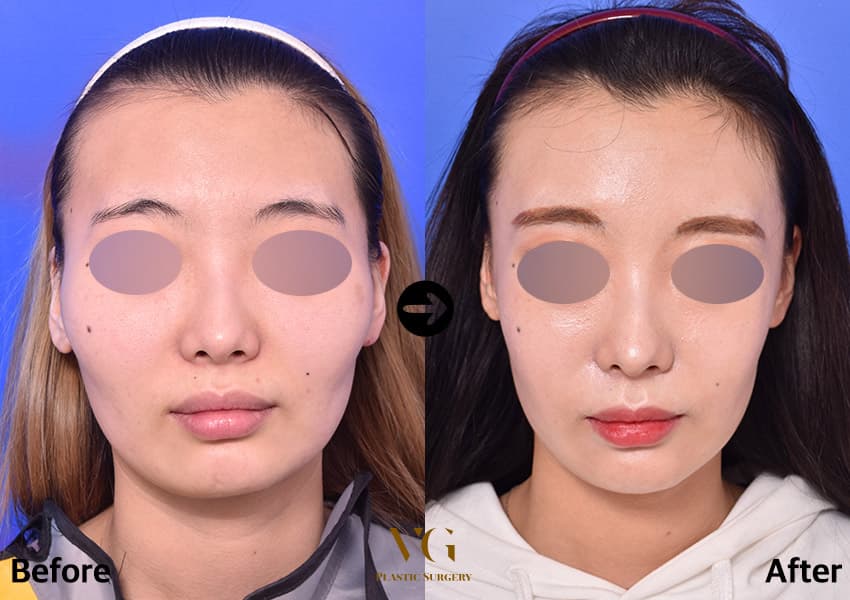
Cheekbone (Zygoma) Reduction3 months after surgery
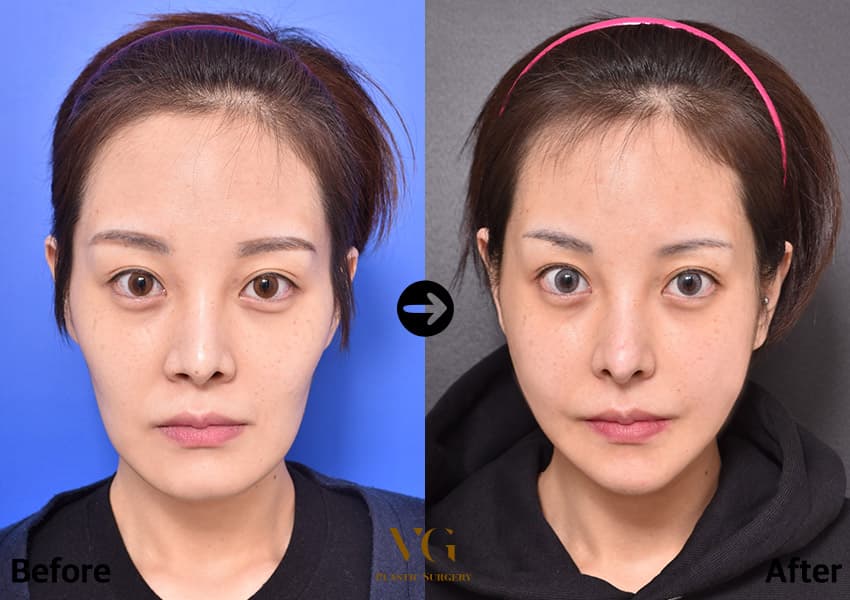
Cheekbone (Zygoma) Reduction3 months after surgery
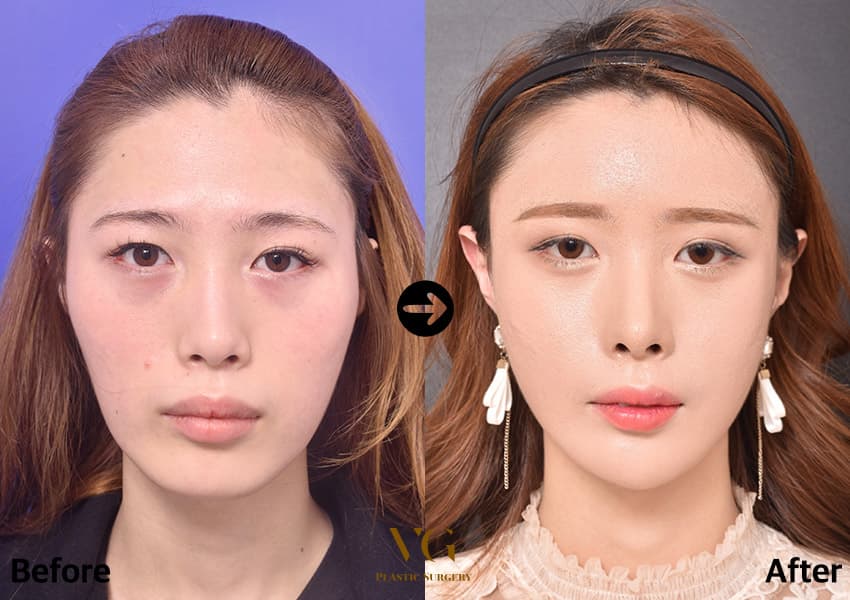
Cheekbone (Zygoma) Reduction3 months after surgery
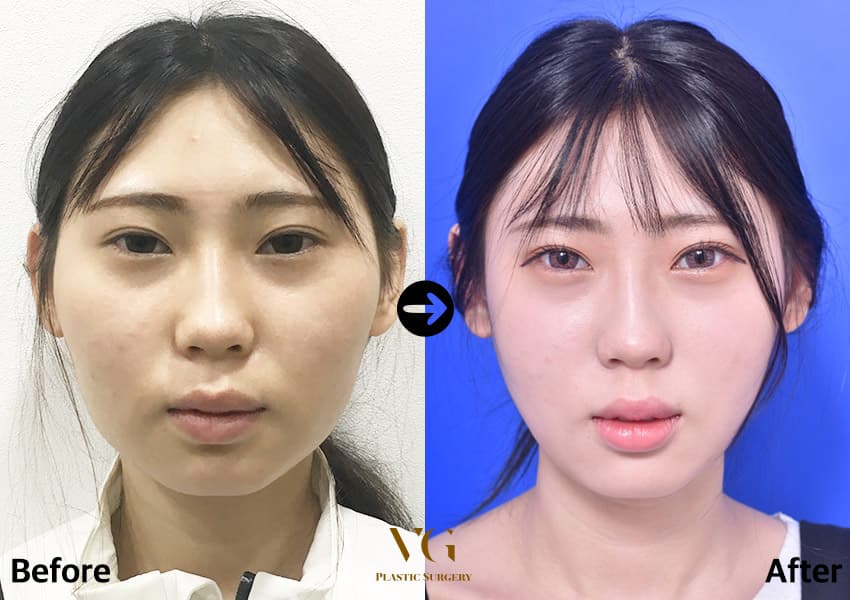
Cheekbone (Zygoma) Reduction3 months after surgery
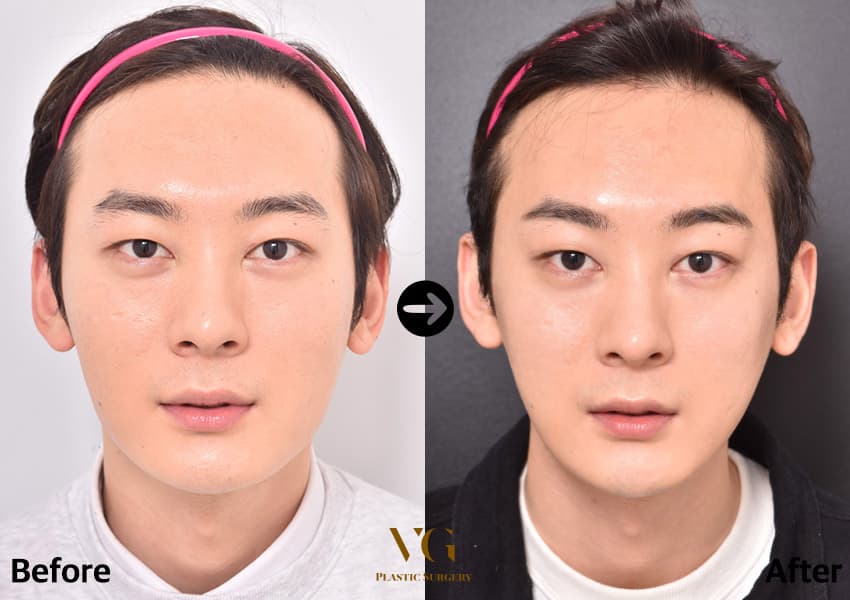
Square Jaw Reduction3 months after surgery
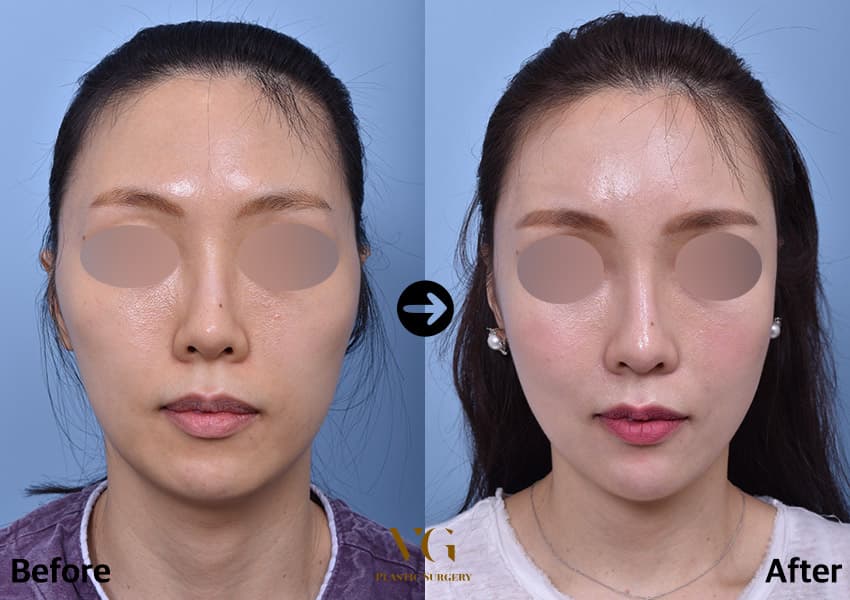
Cheekbone (Zygoma) Reduction3 months after surgery
FAQ
Questions patients ask
Is a Korean facial the same as facial contouring?
No. A “Korean facial” or “glass skin facial” at a spa is a skin treatment and doesn't change bone. Facial contouring is surgery on the cheekbones, jaw angles or chin, usually under general anesthesia. VG Plastic Surgery does surgery, not spa facials.
Can cheekbone and jaw reduction be done in one trip?
Often they can be done in one operation under one anesthetic, which saves a second trip. The trade-off is a longer surgery and more swelling at once, so whether combining makes sense comes down to your health and how much each area needs.
Why might the figure change after the consultation in Seoul?
Photos show the outline of your face; a CT shows the bone, its thickness and where the nerve runs. If the CT shows an area doesn't need reducing, it comes out of the plan; if it shows asymmetry the photos missed, planning takes more time. Ask in advance which findings would change your figure.
Is there an age limit for facial contouring?
There's no single cutoff once the face has finished growing. From the mid-forties, skin elasticity and tissue descent weigh more in the decision, because reducing bone under loose skin can make sagging more visible.
Will contouring change how I chew or smile?
Jaw stiffness and reduced mouth opening are common in the first weeks and usually ease. Smiling relies on facial muscles that contouring doesn't cut, but numbness can make the lower lip feel odd for a while.
Sources
- Prevention of Complication and Management of Unfavorable Results in Reduction Malarplasty (Archives of Plastic Surgery, 2008;35(4):465-470)
- Avoidance of Injury to the Inferior Alveolar Nerve in Mandibular Angle Contouring; Maneuver of One Inch (J Korean Soc Aesthetic Plast Surg, 2003;9(2):33-36)
- Incidence of Complications Associated with Mandibuloplasty: A Review of 588 Cases over 5 Years (Plastic and Reconstructive Surgery Global Open, 2014)
- In-hospital surgical treatment for haemorrhage after aesthetic mandibular osteotomy performed as an office-based day surgery: A case report (Ann Med Surg, 2017;24:15–18)
- Medical Tourism
This article explains general medical information. Whether surgery suits you, and which method, is decided only after a consultation with the surgeon.
Written by
Im Young Min
Chief Director · Plastic Surgery
- Ph.D. in Medicine
- Internship and residency, Seoul St. Mary's Hospital
- Board-certified plastic surgeon, Seoul St. Mary's Hospital
- Adjunct professor of plastic surgery, Seoul St. Mary's Hospital
- Former director, Topface Plastic Surgery
Next step
Send two photos. Get a surgeon’s answer.
Front and side, natural light, no filter. Dr. Im Young Min reviews them and tells you which method fits and how many days to stay in Seoul.
International patients pay the same surgical fee as Korean patients. Pricing policy
Keep reading
Facial Contouring
South Korea Genioplasty Cost Range: What Moves the Number? Methods, Reviews and Recovery
A South Korea genioplasty cost range is wide because moving bone, shortening a chin and placing an implant are different operations; the method, anesthesia and days in Seoul set your figure.
Im Young Min ·
Facial Contouring
Three Dates That Shape a Zygoma Reduction Korea Trip, From CT to Flight Home
Zygoma reduction in Korea is bone surgery you fly home from, so plan around three dates: the consultation and CT before surgery, the check-up that clears you to fly, and your first appointment at home.
Im Young Min ·
Facial Contouring
Is chin lipo Korea Right for Your Full Chin? Cost, Reviews and What It Can't Fix
What chin lipo Korea does is remove fat under the chin and along the jaw. It won't shorten a long chin or narrow a square one, and it suits people at a stable weight whose skin still has some spring.
Im Young Min ·