Breast
Considering Fat Transfer Breast Augmentation Korea? Price, Recovery and Trip Days
Fat transfer breast augmentation moves your own fat from the belly, flanks or thighs into the breast in thin layers. Only part of it stays, so it suits a modest, soft change in people with fat to spare.
· 8 min read · Last updated
Edited by Im Young Min
In this article
- 01What happens to the fat on its way from your belly to your breast
- 02How much of the injected fat stays?
- 03Who fat transfer suits, and who usually does better with an implant
- 04Fat in the breast and your future mammograms
- 05Planning the trip around a two-site operation
- 06When one session isn't enough
- 07What decides the cost of fat transfer breast augmentation?
- 08What to take home for your own doctor
The short answer
Worried that fat transfer breast augmentation Korea might leave you with less than you paid for, because so much of the fat disappears?
- Fat transfer to the breast is liposuction and breast grafting in one operation, with fat injected in thin layers.
- A 2024 review puts retention across studies at roughly one-third to two-thirds of the fat transferred.
- It suits a moderate, soft change in people with spare fat; a large increase or real sagging usually points to an implant or a lift.
- Grafted fat can leave oil cysts or calcifications, so every future breast scan should note the surgery.
- The final shape settles over months, so most of it is judged after you are back home.
It's worth reading on before you book a flight or decide on fat over an implant.
Profile
Im Young Min
Chief Director · Board-certified in Plastic Surgery
After reading you will know what the fat goes through from your belly to your breast, what decides the price, how recovery runs day by day, and how many days to plan in Seoul.
Hello, I'm Im Young Min, Chief Director and a board-certified plastic surgeon.
I trained at Seoul St. Mary's Hospital and I'm a full member of the American Society for Aesthetic Plastic Surgery (ASAPS). Our team includes plastic surgeons who belong to the Korean Society of Plastic and Reconstructive Surgeons' fat grafting and breast surgery research groups, and anesthesiologists, which matters when two areas of the body are operated on.
I wrote this because many people assume the fat they see on the day of surgery is the volume they will keep.
The short answer: fat is taken by liposuction from your belly, flanks or thighs, purified, and injected in thin layers into the breast. It gives a softer and usually more modest increase than an implant. Only part of the fat survives, and the last swelling settles after most visitors have flown home.
Send your height, weight and travel dates on WhatsApp
What happens to the fat on its way from your belly to your breast
Fat transfer is three steps in one operation: harvest, purify, inject in layers. The harvest is liposuction through small openings in the belly, flanks or thighs, with the fat handled so the cells stay alive instead of being thrown away.
The purification step separates usable fat from blood, fluid and the oil released by cells that broke during suction. What goes back in is then placed through a fine cannula as many thin threads at different depths of the breast, so that each small parcel of fat sits close to tissue that can feed it. A large pool of fat injected in one spot can't get a blood supply to its center, and that center is what later turns into oil cysts or firm lumps.
A 2024 narrative review in the Journal of Clinical Medicine notes that mature fat cells are fragile, while their precursor cells tolerate handling and low oxygen better and make up the largest share of what survives. That is why the gentle handling of the harvest matters as much as the injection. On our own fat grafting page the measure is put simply: what counts is how much of the fat stayed, and the amount that went in is only the starting figure.
If you've read about liposuction in Korea, the harvest uses the same principle, with the difference that the fat is kept and reused.
How much of the injected fat stays?
Roughly one-third to two-thirds. That is the retention range across published studies in the same 2024 review, and it explains most of what surprises people after this operation: the breast looks fullest in the first weeks, partly from swelling, and then settles.
The review also collects figures that matter when you plan from abroad:
| Figure from the review | What it means for your plan |
|---|---|
| About 1/3 to 2/3 of transferred fat retained | The first-week size is not the final size |
| First-year loss reported from about 20% to 90% across studies | Technique and fat handling make a large difference |
| 3D photo tracking showed around 40% to 50% survival; larger volumes persisted better | Very small transfers can fade more than expected |
| Breast volume moves about −5.5% to +8.1% over a menstrual cycle | Compare photos taken at the same point in your cycle |
Risks and side effects to know
The last two rows are why I'd be careful with any early photo, including your own. Breast volume also shifts with weight change and swelling, so the review's authors point out that measurement itself is hard to standardize. For a traveler, that means the honest assessment of the result happens months later, at home.
Who fat transfer suits, and who usually does better with an implant
Fat transfer suits people who want a moderate, soft increase, have spare fat in the belly, flanks or thighs, keep a stable weight, and would rather not have an implant. It's also used for mild asymmetry, because each side can receive a different amount, and the review lists breast hypoplasia and tuberous breast shape among its cosmetic uses.
People who look into fat transfer breast augmentation Korea often arrive with one of the situations below:
| Your situation | Fat transfer alone | Usually discussed instead |
|---|---|---|
| Want a moderate, soft change and have fat to spare | Often a good match | Nothing else needed |
| Very slim, little fat anywhere | Limited volume available | Implant augmentation |
| Want a large increase in one operation | May need more than one session | Implant, discussed at the exam |
| Nipple sits low, skin has stretched | Volume won't lift the breast | Breast lift, sometimes with volume |
Say you are 165 cm tall, slim but with some softness on your lower belly and outer thighs, and you want to go up by about one cup. You are flying in from abroad for a limited number of days. I would first look at whether those two areas can supply enough fat for the breast. I would also explain that only part of the injected fat stays, so the final size will probably be smaller than what you see right after surgery.
Then we would talk about whether a modest, softer change is what you want. If you are hoping for a clearly larger change, I would raise the implant option and let you compare the two. I would also talk through how you would follow the final settling at home.
Fat in the breast and your future mammograms
Fat that doesn't survive can leave oil cysts, firm areas of fat necrosis or small calcifications, and on imaging some of these can look like changes that need a biopsy. This is the main long-term risk to understand, and it is why everyone who has this operation should tell every radiologist about it.
The evidence has gone in both directions. The authors argued the procedure should stop; a paper in the same journal a month earlier found follow-up imaging was not a problem, and the society called for more evidence.
The 2024 review adds that MRI is the most sensitive way to see these changes and that oncologic safety still needs to be established before the technique is broadly accepted.
The practical side is clear:
- If you have a personal or strong family history of breast cancer, this needs a detailed discussion and recent imaging, and fat transfer may not be advised.
- Have baseline breast imaging before surgery and keep the report.
- At the donor sites, bruising, temporary numbness and uneven contour are the common issues; infection and anesthesia risks apply as with any operation.
For breast surgery here, an ultrasound comes before the plan, and the anesthesiologist watches blood pressure, pulse and breathing from the first injection until you are awake. Whether you are a candidate is decided at the in-person exam, after the ultrasound and a look at your donor areas.
Planning the trip around a two-site operation
The trip has to account for two recoveries at once: soreness and a compression garment at the donor sites, and a breast that should not be squeezed while the graft takes. Most people researching fat transfer breast augmentation Korea find the donor sites are what they feel most in the first days.
Flying is the other variable. The U.S. Centers for Disease Control and Prevention's medical tourism guidance notes that flying soon after surgery increases the risk of blood clots, so the plan should leave real recovery time before the flight home. After that, the result keeps changing slowly for months, and your own doctor and breast imaging at home take over the long view.
If timing is what's holding you back, send your possible travel dates and the date you need to be back at work on WhatsApp. The doctor reviews them alongside your height and weight and tells you how many days to plan in Seoul and what would change that number, such as a larger liposuction area.
Send your height, weight and travel dates on WhatsApp
When one session isn't enough
A second session is sometimes planned when a larger change is wanted with fat alone. The spacing depends on when the first graft has settled, since the second round is placed into tissue that has healed. The 2024 review notes that the number and timing of sessions varied widely across studies, which is one reason published results are hard to compare.
For a traveler, two sessions means two trips. If that doesn't fit your life, the exam is the place to talk about whether an implant reaches your goal in one operation. Readers comparing options across the body may also find our overview of Korean plastic surgery useful.
What decides the cost of fat transfer breast augmentation?
The operation has two surgical sites, so the work adds up on both. How much fat can be taken from your belly, flanks or thighs, and how much the breast needs, sets the amount of work. The method of purifying and injecting the fat, and whether one or two areas are treated for harvesting, also matter. So does the type of anesthesia, which depends on the extent of the surgery.
The days you spend in Seoul, and the follow-up you want to arrange with your own doctor at home, change the plan too. If a second session is likely because part of the fat will not stay, that belongs in the estimate as well. To get the figure for your case, ask on WhatsApp and attach one photo of the areas you have in mind.
What to take home for your own doctor
The months after surgery happen in your home country, so leave with a written record your own doctor can use:
- The date of surgery and the areas fat was taken from
- The amount of fat placed in each breast
- Your pre-surgery breast imaging report
- A note for your radiologist that you have had fat grafting to both breasts
That last line saves time and worry at a future screening, because a radiologist who knows about the graft reads calcifications in that context.
A first message can be short. On WhatsApp, send one photo, your height and weight, where on your body you think you carry spare fat, and the one question that's stopping you from deciding. One photo is enough, and you can ask before booking anything. When you come to Seoul, I examine you and recommend what fits your body, whether that is fat transfer, an implant, or something else.
Related pages:
Breast before & after — more cases
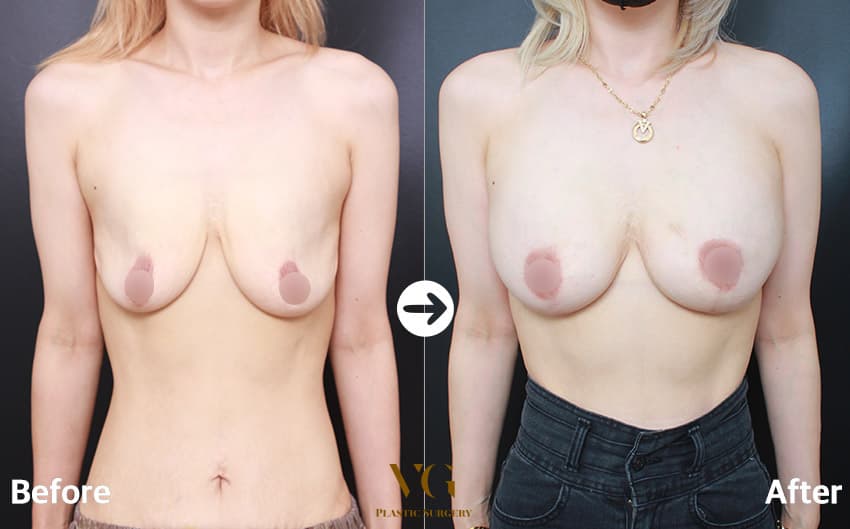
Real patients from our archive, all photographed 3 months after surgery. Tap a case to compare it full size.
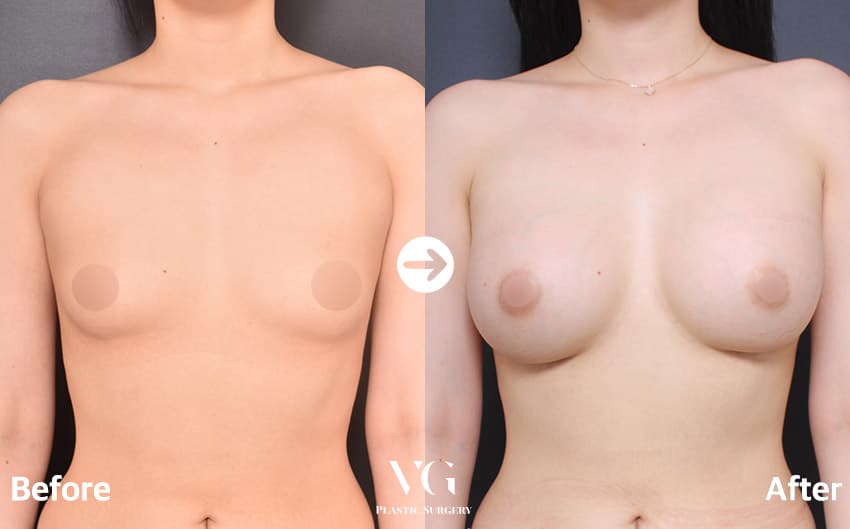
Breast Augmentation3 months after surgery
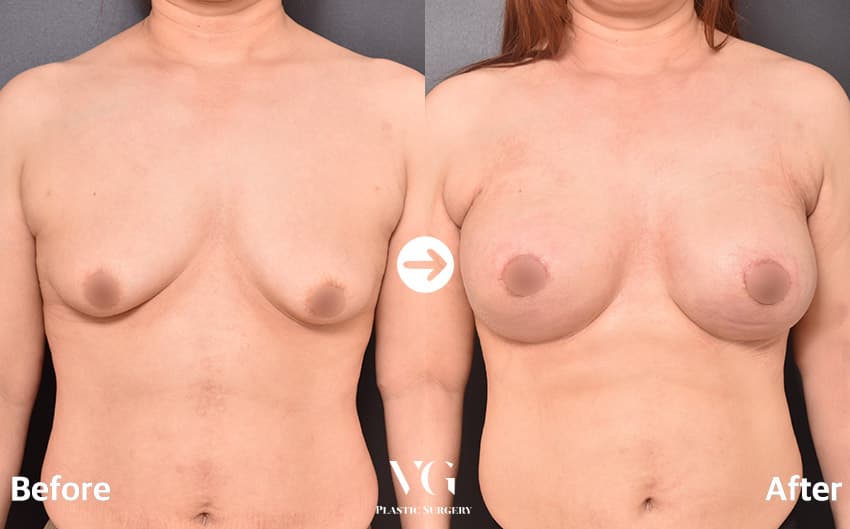
Breast Augmentation3 months after surgery
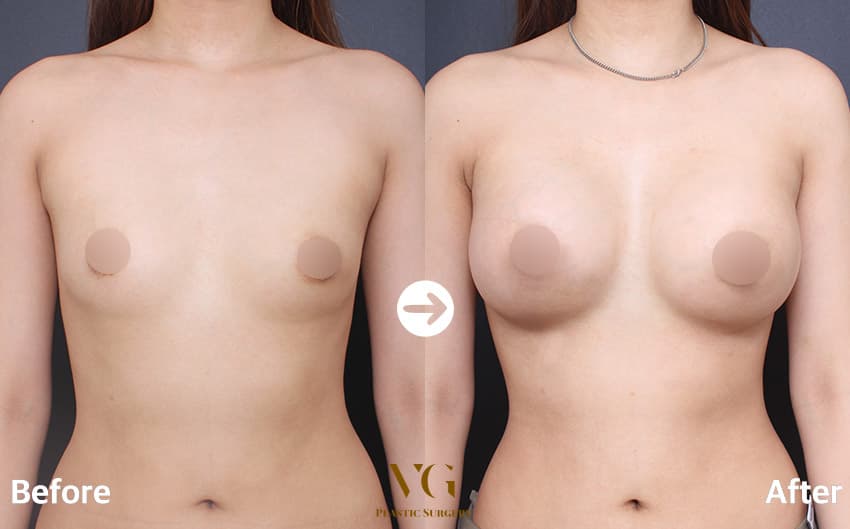
Breast Augmentation3 months after surgery
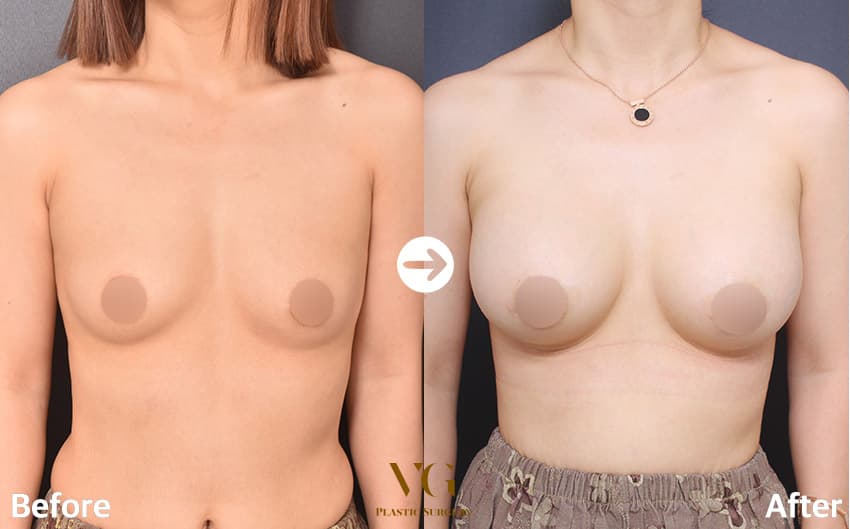
Breast Augmentation3 months after surgery
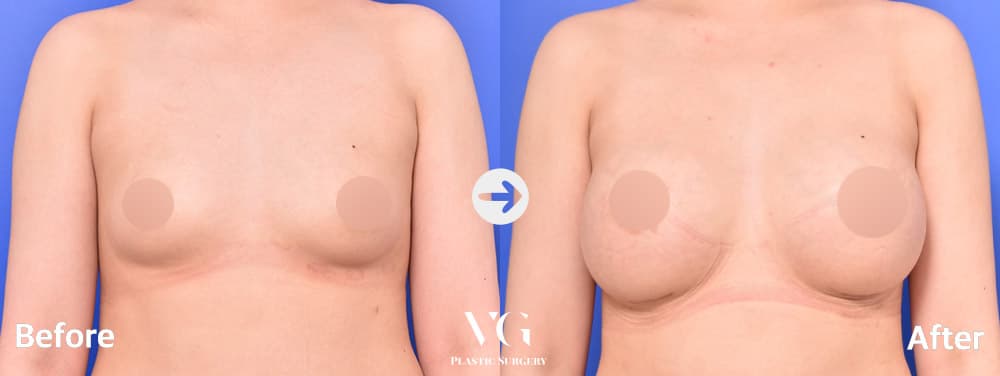
Breast Augmentation3 months after surgery
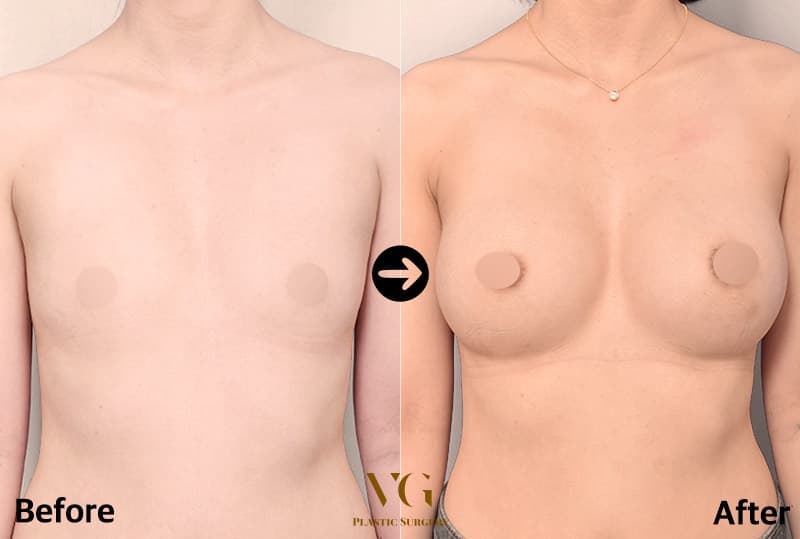
Breast Augmentation3 months after surgery
FAQ
Questions patients ask
Does the fat that survives in the breast last?
Fat that has established a blood supply after the first months generally behaves like the rest of your body fat. It grows and shrinks with your weight, so a large weight loss later can reduce the breast as well. Keeping a stable weight pre- and post-treatment surgery helps the result hold.
Can fat transfer correct breasts of different sizes?
Often, yes, for mild asymmetry, because a different amount can be placed in each side. Larger differences or shape problems such as a tuberous breast may need more than fat. The exam and ultrasound decide which approach fits.
I'm very slim. Can I still have fat transfer to the breast?
Possibly, but the volume available may be limited to a small change. If your goal is larger than your spare fat allows, an implant is usually discussed instead. Sending your height and weight on WhatsApp is a quick way to get an early read from the doctor.
Is under-eye fat grafting the same procedure?
It uses the same principle of harvesting, purifying and injecting small amounts of your own fat, but in a very different area and at a much smaller volume. Under-eye hollows are also treated by repositioning the fat already there. That is a separate consultation from breast surgery.
Is fat transfer breast augmentation Korea an option if I have a family history of breast cancer?
It needs a careful discussion first. Grafted fat can create calcifications that complicate future imaging, and a 2024 review notes oncologic safety is still being established. The doctor reviews your history and recent breast imaging before deciding whether to proceed.
Will I need to wear a compression garment?
Usually on the donor areas, such as the belly or thighs, to control swelling. The breasts themselves should not be squeezed while the graft takes.
Sources
This article explains general medical information. Whether surgery suits you, and which method, is decided only after a consultation with the surgeon.
Written by
Im Young Min
Chief Director · Plastic Surgery
- Ph.D. in Medicine
- Internship and residency, Seoul St. Mary's Hospital
- Board-certified plastic surgeon, Seoul St. Mary's Hospital
- Adjunct professor of plastic surgery, Seoul St. Mary's Hospital
- Former director, Topface Plastic Surgery
Next step
Send two photos. Get a surgeon’s answer.
Front and side, natural light, no filter. Dr. Im Young Min reviews them and tells you which method fits and how many days to stay in Seoul.
International patients pay the same surgical fee as Korean patients. Pricing policy
Keep reading
Breast
Worried About Korean Breast Implants? Cost Factors, Tissue Limits and Long-Term Checks
Korean breast implants carry the same risks the U.S. FDA lists for any breast implant, and they are not lifetime devices. Your tissue limits the size, the flight home needs room, and the checks continue for years.
Im Young Min ·
Breast
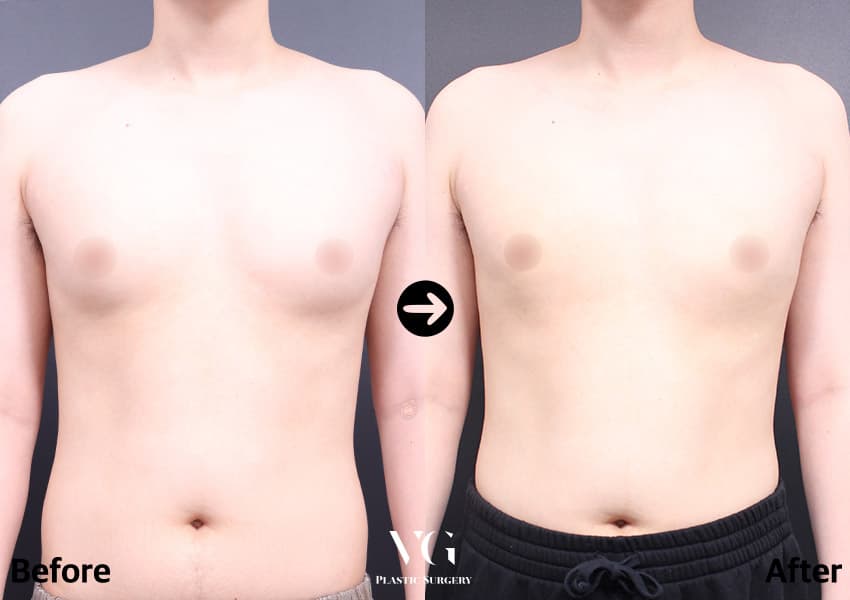
Gynecomastia Surgery Cost Korea: How the Fee Is Set and Your Stay
A plastic surgeon in Seoul explains what decides the fee for gynecomastia surgery, why the gland and the fat are both treated, real cases from our breast surgery team, recovery, and how your days in Korea are planned.
Im Young Min ·
Breast
Breast Lift in Korea: Sagging, Volume and the Trip, From the Surgeon
A plastic surgeon in Seoul explains how a breast lift is planned for patients flying in: when sagging needs a lift and when it needs volume too, the ultrasound check, recovery, the trip and how the fee is set.
Im Young Min ·