Eyes
Is Double Eyelid Surgery Common in Korea? Yes, Not One Fold
Double eyelid surgery is common in Korea, but common doesn't mean standard. The method still follows your own lid skin, fat and lifting muscle, and that also shapes how many days your trip needs.
Send your concern and a front and side photo. Replies in English, no obligation.
In this article
- 01Is double eyelid surgery common in Korea, or only common online?
- 02What a double eyelid actually is
- 03Common doesn't mean one quick, standard procedure
- 04The Korean crease is not one height
- 05Say you have nine days off
- 06What decides the cost of double eyelid surgery for you
- 07Asymmetry, a fading crease, dry eyes: the real risks
- 08What to check wherever you go
- 09Where I stand on it
The short answer
Is double eyelid surgery common in Korea, common enough that you can fly in on a short break, pick a crease and be back at work looking rested? It is common: surgeons who write about Asian eyelids describe crease surgery as a very frequently performed cosmetic operation across East Asia. What that popularity doesn't give you is a standard operation, because the method still follows your own lid skin, fat and lifting muscle, and that also shapes how many days you need before the flight home.
- Double eyelid surgery is common in Korea, yet each lid still needs its own plan.
- A monolid is normal anatomy; the crease depends on how the lifting tendon meets the skin.
- Thin lids with little fat may suit stitches; thick or heavy lids usually need an incision.
- Method, added steps and any revision move the cost; foreigners pay the same fee as Korean patients, with a written estimate.
- Weak lid lifting (ptosis) changes the operation, so it is checked before the crease is planned.
Hello, I'm Dr. Im Young Min, Chief Director at VG Plastic Surgery and a board-certified plastic surgeon.

Profile
Im Young Min
Chief Director · Board-certified in Plastic Surgery
I operate across every field, eyelids included, and with that range behind me I recommend only the operation your lids actually need and leave out the ones they don't. Before deciding whether to cut at all, we check lid thickness, fat and lifting strength. A medical interpreter for your language is provided at no extra charge, so the details of your own lids don't get lost in translation.
If you can't tell what kind of lid you have, take one photo of your eyes open, looking straight ahead in daylight without makeup, and send it on WhatsApp with the dates of your break. Ask whether your lids look closer to a stitch-method case or an incision case.
Send a photo of your eyes open on WhatsApp
Is double eyelid surgery common in Korea, or only common online?
In short, it's common in Korea and talked about openly, which is why it fills your feed. Popularity, though, describes how many people choose it, and says nothing about how alike their operations are.
In Korea, many people now treat plastic surgery as one way of looking after themselves, and I see that as a culture in its own right. That openness is part of why eyelid surgery is discussed so plainly here. It also feeds a belief visitors bring with them: that something this widespread must be one fixed operation with one fixed look, done the same way for everyone who walks in.
The reality inside a consulting room is the opposite. Two people with the same wish, a visible crease, can need two different operations, because the lids underneath are built differently.
What a double eyelid actually is
A crease forms where fine fibers from the tendon of the lid-lifting muscle reach through to the skin. When the eye opens, the muscle pulls on those fibers and the skin above folds in along that line.
Think of a curtain on a rod. Where hooks pinch the fabric, it folds; with no hooks, it hangs flat. In many East Asian lids those connections are fewer or sit lower, and a pad of fat sits lower and further forward, so the skin hangs smoothly. That's a monolid, or a low crease that only shows at the outer half. Heavier fabric needs firmer hooks, which is why a lid with thick skin and full fat is harder to hold with stitches alone.
None of this is a defect. A monolid is normal anatomy, and plenty of people in Korea are born with a crease, so a double eyelid isn't rare here either. The question for you is simply what your lid is made of.
Common doesn't mean one quick, standard procedure
There are two broad ways to make a crease, and the lid decides between them more than preference does.
- Non-incisional (buried stitch) method: small punctures and buried stitches create the attachment. It usually suits thin skin, little fat and good lifting strength. Stitches can loosen over time, more so on heavier lids.
- Incisional method: a cut along the planned crease line lets the surgeon remove extra skin or fat and fix the crease directly. It usually suits thick skin, full fat, excess skin, a revision, or a lid that also needs lifting.
| Your lid | What usually fits | Why |
|---|---|---|
| Thin skin, little fat, strong lift | Stitch method is often considered | Less weight for the stitches to hold |
| Thick skin or full fat | Incision, usually | Fat or skin may need removing |
| Weak lift (eyes look tired) | Ptosis correction with the crease | A crease alone can make a droopy lid look heavier |
| Extra skin hanging over the lid | Incision with skin removal | Stitches can't take skin away |
That third row surprises people. If the muscle lifts weakly, the eye looks sleepy even with a crease, and the right operation includes correcting the lift itself. Some people also ask about inner-corner surgery, which is a separate step on a separate decision. I go through how incision and non-incision compare for recovery in double eyelid surgery in Korea: incision or not, and the eye surgery overview sits on VG Plastic Surgery's English homepage.
The Korean crease is not one height
Creases come in two main shapes. An in-fold starts inside the small skin fold at the inner corner and tapers outward; an out-fold runs parallel to the lash line all the way across. Height is a separate choice again.
A crease set high on a thick lid tends to look heavy and puffy, while the same height on a thin lid can look fine. So bring a photo or two of the look you like, by all means, but expect the conversation to be about what your lid can carry. When a lid can't hold the crease someone wants, I'll say so, and I'll say plainly when surgery doesn't suit you at all.
Say you have nine days off
Say you're 27, teaching English in Taipei, with a nine-day winter break. Your lids are fairly thick and the crease shows only at the outer half. The stitch method is tempting: smaller wounds, quicker to look presentable.
On a lid like that, though, the stitches have more weight to hold, and a crease that fades within a year would mean a second trip and a second bill. I'd walk you through the incision option even though it asks more of your break. If nine days can't cover stitch removal and the worst of the swelling before you board, I'd suggest saving it for a longer holiday. If your lids do fit the stitch method, fitting non-incisional surgery into one week of leave shows how that kind of trip is usually laid out.
What decides the cost of double eyelid surgery for you
The figure follows the same choices as the method. These are the factors that move it:
- Method: stitch or incision.
- Added steps: ptosis correction, fat or skin removal, inner-corner surgery.
- Revision: correcting an earlier operation is planned differently from a first one.
- Anesthesia: the approach chosen for your operation.
Foreigners pay the same surgery fee as Korean patients here, and the estimate is given in writing. I explain why the method moves the number in how much double eyelid surgery costs in Korea. For your own figure, send a straight-on photo on WhatsApp and ask what it would cost for your lids; you can ask in the same message how the deposit and payment are handled, since those are settled after the consultation.
Asymmetry, a fading crease, dry eyes: the real risks
Common and temporary: swelling, bruising, a tight feeling, watery or dry eyes, and blurry vision from ointment in the first days. These usually ease as the lids settle, and how fast depends on skin thickness and how much was done.
Less common: one crease sitting slightly differently from the other, a stitch-made crease loosening, a crease that looks too high, a visible scar line, trouble closing the eyes fully for a while, infection or bleeding. Rare but serious: bleeding behind the eye that threatens vision, which is why sudden worsening pain on one side is never something to wait out.
In general, it's wise to wait or rethink if you have significant dry eye, thyroid eye disease, a bleeding disorder or blood-thinning medicines you can't pause, an active eye infection, or you're pregnant.
Once you're home, keep your discharge papers and medicine list with you. Sudden increasing pain, swelling on one side that keeps growing, or any change in vision means emergency care locally, the same day. For worries about crease shape, give the swelling a few months before judging, and take dated photos so any doctor can see how it changed. Every operation here has a board-certified anesthesiologist on staff assigned to it, who doesn't operate and watches your blood pressure, pulse and breathing throughout.
Before you book anything, send a list of the medicines and supplements you take, plus a photo with your eyes gently closed, and ask whether anything on that list needs to stop before surgery and how many days your method needs before boarding.
Send a photo of your eyes open on WhatsApp
What to check wherever you go
Put simply, it doesn't have to be us, but wherever you book, ask these:
- Who examines your lids, and is that the surgeon who operates?
- Is lifting strength checked before the method is chosen?
- Who watches you under anesthesia while the surgeon operates?
- Is an interpreter there for the consultation and the surgery day?
- Is the estimate in writing, and what does it include?
- What happens if a stitch-made crease loosens later?
I've put more on these in seven questions to put to any clinic.
Where I stand on it
The fact that double eyelid surgery is everywhere in Korea tells you it's a familiar operation for surgeons here. It doesn't tell you which version your lids need, or whether they need one. Being genuinely useful to one person matters more to me than seeing as many patients as possible, so there's no reason to decide on this trip if the timing is wrong.
When you're ready, send on WhatsApp two photos, eyes open and eyes gently closed, with your break dates, and ask whether your lids can carry the crease you have in mind. On our photo quote a surgeon reviews your photos first. When you visit, what decides your plan is how strongly your lids lift and how thick the skin and fat are. VG Plastic Surgery is at 635 Nonhyeon-ro, Gangnam-gu, Seoul.
— Dr. Im Young Min, Chief Director
Related pages:
Eyes before & after — more cases
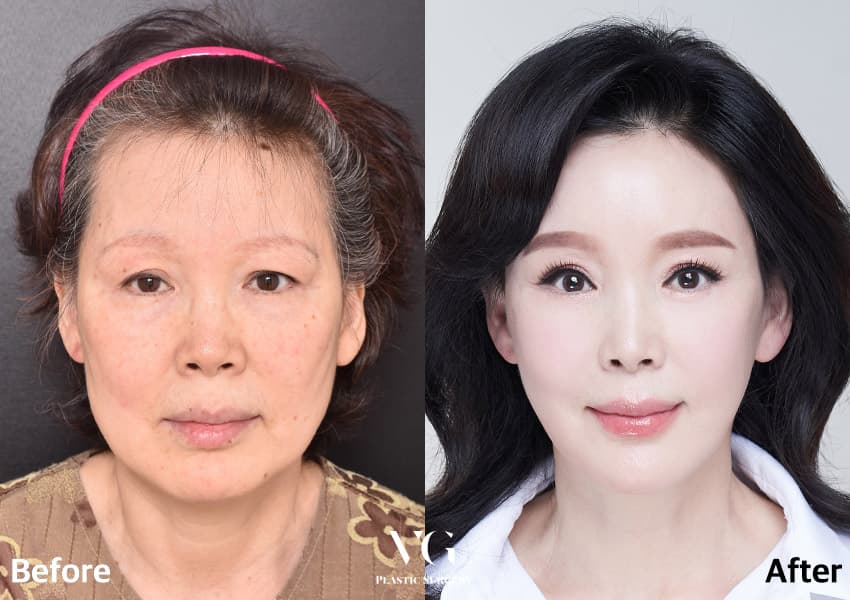
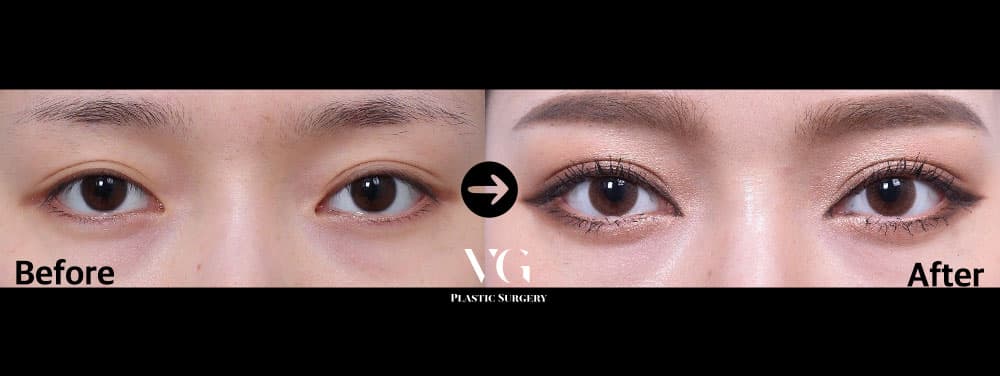
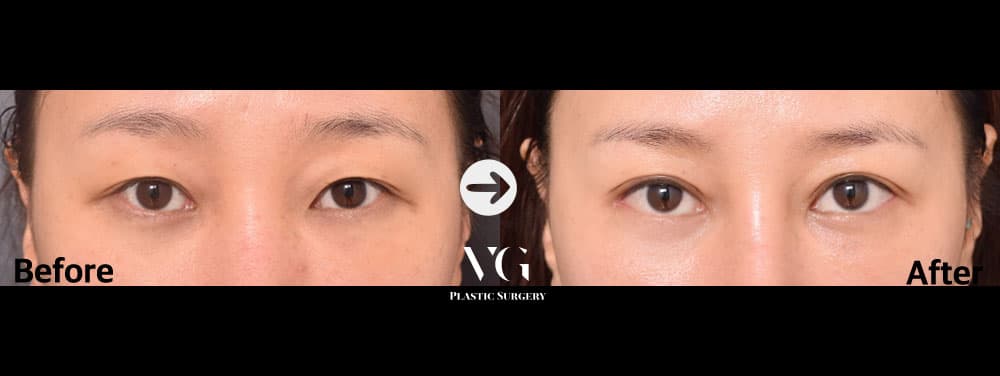
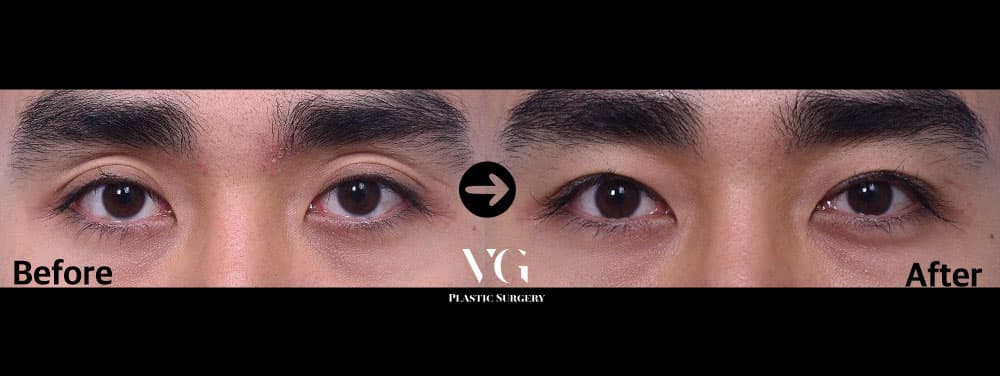
Real patients from our archive, all photographed 3 months after surgery. Tap a case to compare it full size.
Incisional Double Eyelid3 months after surgery
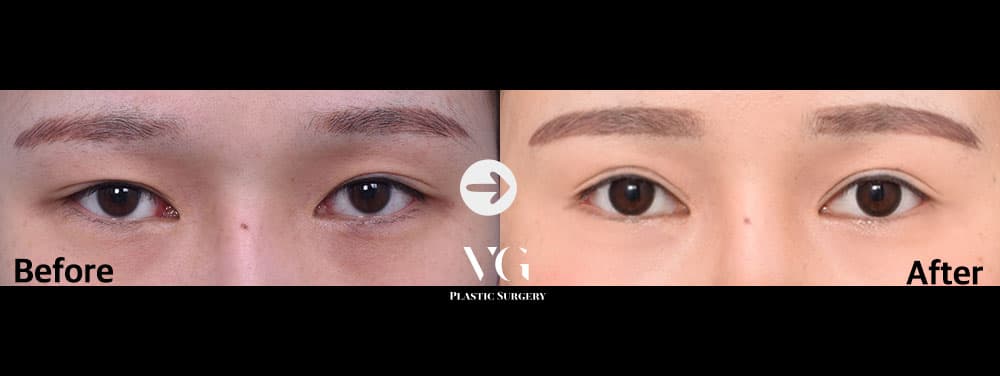
Incisional Double Eyelid3 months after surgery
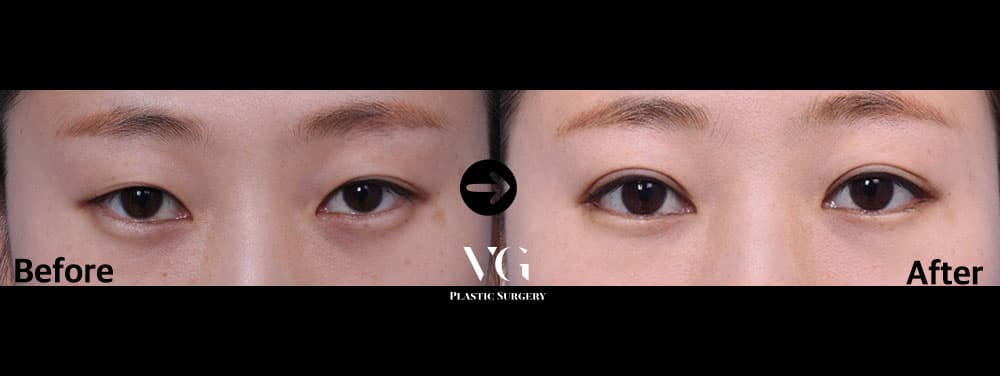
Incisional Double Eyelid3 months after surgery
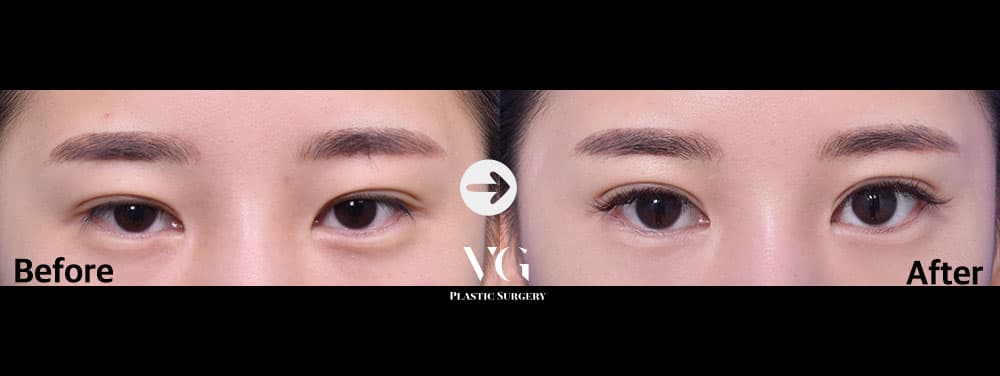
Natural-Adhesion Double Eyelid3 months after surgery
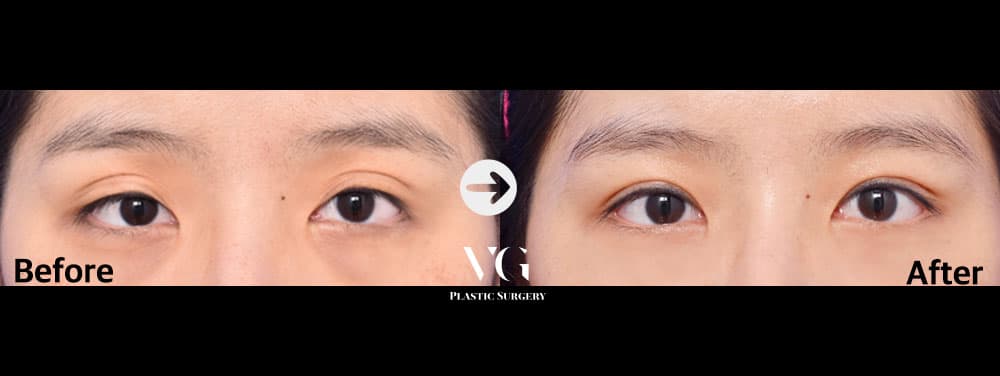
Incisional Double Eyelid3 months after surgery
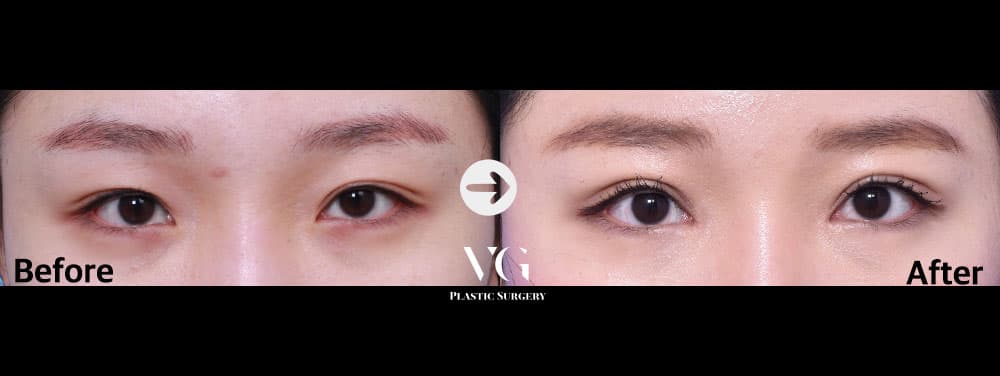
Natural-Adhesion Double Eyelid3 months after surgery
FAQ
Questions patients ask
Are double eyelids rare in Korean faces?
No. Many people in Korea are born with a visible crease, and many have a monolid or a low crease that shows only at the outer half. All of these are normal anatomy; surgery changes how the skin attaches, not whether a lid is healthy.
Monolid vs double eyelid: does a true monolid always need an incision?
Not always. A thin monolid with little fat and good lifting strength can sometimes take the stitch method. A thick monolid with full fat usually needs an incision, because the stitches would have too much weight to hold.
Can a stitch-made crease come undone?
It can loosen or fade over time, more often on thick or heavy lids. If that happens, the crease can usually be redone, sometimes with an incision the second time.
Can inner-corner surgery be done at the same time?
It's a separate decision. It changes the inner corner fold rather than the crease, and it's only worth adding if that fold is what bothers you. It also changes the cost, so mention it when you ask for your estimate.
Will people at home be able to tell I had it done?
In the first weeks, swelling makes the crease look higher and heavier than it will end up. Once it settles, how noticeable it is depends mostly on how high the crease was set for your lid, which is why height is chosen around your lid thickness.
Sources
This article explains general medical information. Whether surgery suits you, and which method, is decided only after a consultation with the surgeon.
Written by
Im Young Min
Chief Director · Plastic Surgery
- Ph.D. in Medicine
- Internship and residency, Seoul St. Mary's Hospital
- Board-certified plastic surgeon, Seoul St. Mary's Hospital
- Adjunct professor of plastic surgery, Seoul St. Mary's Hospital
- Former director, Topface Plastic Surgery
Next step
Send two photos. Get a surgeon’s answer.
Front and side, natural light, no filter. Dr. Im Young Min reviews them and tells you which method fits and how many days to stay in Seoul.
International patients pay the same surgical fee as Korean patients. Pricing policy
Keep reading
Eyes
Why Is Double Eyelid Surgery Popular in Korea? Plan Around the Stitch Day
About half of East Asian upper lids have no natural crease, and in Korea adding one is seen as self-care. If you plan yours in Seoul, stitch removal, generally 5 to 7 days after surgery, shapes the trip.
Im Young Min ·
Eyes
Canthoplasty Recovery Time by Corner: Stitches, Scar, Flight Home and What Sets the Cost
Stitches usually come out around day 5 to 7, most bruising settles over two to four weeks, and the scar keeps softening for six months or more. Plan your flight home around the stitch day.
Im Young Min ·
Eyes
Most Common Plastic Surgery in Korea: What 426 of Our Cases Show
A Seoul plastic surgeon counts the 426 cases in his clinic's before-and-after archive by surgery type, explains what foreign patients ask about most, and says who each operation does not suit.
Im Young Min ·