Eyes
Single vs Double Eyelid: What Differs Under the Skin, and How Each Method Creates a Fold
A double eyelid has a crease because fibers of the lid-lifting muscle reach the skin; a single lid lacks that attachment and carries fat lower. Surgery rebuilds it by stitches or incision, with skin removal when skin has loosened.
Send your concern and a front and side photo. Replies in English, no obligation.
In this article
- 01What is a double eyelid, and why do some lids have none?
- 02Korean single eyelid vs double eyelid: the shapes in between
- 03Three ways to make a fold, compared
- 04Do single lids change after 40?
- 05Will a double eyelid change who I look like?
- 06Asymmetry, a fading fold and dry eyes: the risks
- 07Your next step on WhatsApp
The short answer
If your lids have always been single and now look heavier than they used to, is a double eyelid worth a flight to Seoul, and would your face still look like yours? The single vs double eyelid difference comes down mostly to one connection under the skin. In a double lid, fibers from the muscle that lifts the lid reach the skin and fold it inward when the eye opens; in a single lid they stop short, and a little more fat sits low.
- A double eyelid has a crease because fibers of the lid-lifting muscle attach to the skin; a single lid lacks that attachment.
- Stitched folds suit thin lids with little fat and a strong lift; thicker lids usually need an incision.
- After 40, loose skin or a weak lift often matters more than the crease itself.
- A low crease that follows your natural lid line changes how open the eye looks more than it changes your face.
- Keeping single lids is a reasonable choice when they open well.
Surgery rebuilds that connection with stitches or through an incision, and adds skin removal when loose skin is the real problem, so the right method depends on your lid thickness, fat, lifting strength and spare skin.

Profile
Im Young Min
Chief Director · Board-certified in Plastic Surgery
Hello, I'm Dr. Im Young Min, Chief Director and a board-certified plastic surgeon at VERYGOOD Plastic Surgery in Gangnam, Seoul.
Eyelids are one of the areas I operate on, along with the nose, facial contouring, breast and body. Three plastic surgeons share our eye center, and revision cases are reviewed together before anyone operates. A board-certified anesthesiologist who does not operate is dedicated to each surgery, and a medical interpreter for your language is provided at no extra charge, so talking through your lids doesn't depend on your Korean.
If you can't tell which kind of lid you have, two photos are enough to start on WhatsApp: one with your eyes open looking straight at the camera, one with them gently closed, and a line on how long the heaviness has bothered you. That way your first question is about your own lids, not lids in general.
Send two eyelid photos on WhatsApp
What is a double eyelid, and why do some lids have none?
A double eyelid is an upper lid with a visible crease, a line where the skin folds in when you look straight ahead. Above the line sits a small band of skin; below it, the part of the lid that carries the lashes. A single eyelid, often called a monolid, has no crease, or one so low it hides behind the skin.
What makes the line sits underneath. The levator, the muscle that raises the upper lid, ends in a thin sheet of tissue. In lids with a crease, some of its fibers attach to the skin, so when the muscle pulls, the skin above that point folds in. In single lids the attachment is missing or very low, and the fat that pads the lid tends to sit further down, toward the lashes.
People often ask whether double eyelids are rare. In East Asian faces, lids with no crease or a low crease are common, and plenty of people have one of each, or a crease that only shows on tired days. A single lid is a normal lid, not a defect to correct.
Korean single eyelid vs double eyelid: the shapes in between
Most lids don't sit neatly at either end, and the useful questions are more specific than single or double:
- Hidden crease. A crease exists but disappears under the skin above it. This is often the easiest kind to bring out.
- Tapered or parallel. A tapered crease starts close to the inner corner and widens toward the outer corner; a parallel crease runs at the same height all the way across. Tapered is the shape most often seen in East Asian lids that have a natural crease.
- Thick or thin lid. More fat and thicker skin put more weight on whatever holds the fold.
- A lid that opens weakly. Here the heaviness comes from the lifting muscle, not the skin.
The last one is the easiest to miss. If your lid edge covers part of the pupil, or your forehead lifts every time you look up, a fold alone may not open the eye. The American Academy of Ophthalmology notes that people with a drooping lid often raise their eyebrows to see, which is why a tired-looking forehead can be a lid problem in disguise.
Three ways to make a fold, compared
Our eye center covers double eyelid surgery, ptosis correction, blepharoplasty and revision. The table compares the general approaches; which one your lids need is what the exam is for.
| Approach | How the fold is made | Lids it tends to suit |
|---|---|---|
| Non-incisional (natural adhesion) | Small punctures; stitches link the skin to the lifting tissue underneath | Thin lids, little fat, no loose skin, a strong lift |
| Incisional | A cut along the planned crease; fat or tissue may be trimmed and the skin fixed to the lifting tissue | Thicker lids, more fat, or a stitched fold that has faded |
| Incision with skin removal (upper blepharoplasty) | The same crease, plus a strip of excess skin taken out | Skin that hangs over the lashes, often after 40 |
| Fold plus ptosis correction | The lifting muscle is tightened as the fold is made | Lids that open weakly, at any thickness |
A stitched fold leaves less swelling at the start and disturbs less tissue. The trade-off is hold: in a thick, fatty lid the stitches carry more strain, and a stitched fold can loosen and fade. If your lids fit that first row, fitting non-incisional double eyelid surgery into one week of leave goes through the days.
An incision means more swelling at first and a scar line that sits inside the crease, where for most people it fades into the fold. In exchange, fat and thick tissue can be dealt with directly, and the fixation usually holds longer. How the two compare on recovery and time in Seoul is set out in double eyelid surgery in Korea: incision or not.
Foreign patients pay the same surgery fee as Korean patients, with a written estimate.
Do single lids change after 40?
Yes, and often not the way people expect. Skin loosens, the brow drops a little, and the tissue holding the lifting muscle to the lid can stretch. A single lid that was smooth at 25 can rest on the lashes at 50. At that age, single vs double eyelid is rarely the real question; what people want is to see the outer edge of their view without lifting their brows, and to stop looking tired in photos.
That changes the comparison. On a lid with loose skin, a fold made by stitches alone tends to push the extra skin into a deeper overhang. Taking some of it out through the crease incision is usually what lets the fold show at all. If the heaviness sits at the outer third and the brow has dropped, part of the problem may be above the lid, which is why our facelift center also lists upper blepharoplasty and brow lift.
Say you're 52 and your single lids now touch your lashes
Say your lids have been single all your life, your family keeps saying you look tired, and you catch yourself raising your eyebrows to read the departures board. Your goal is probably not a high crease. It's an open eye that still looks like yours. With that picture I'd want to know first how far the lid edge rises, then how much skin hangs over, and only then talk about fold height.
A low, tapered crease with modest skin removal, plus ptosis correction if the lift is weak, would usually be the conversation.
Will a double eyelid change who I look like?
The crease height decides most of that. A low crease that follows the tapered line many East Asian lids already have changes how open the eye looks more than it changes the face. A high, parallel crease is a bigger change, and on a lid with a strong inner-corner fold it can look added rather than grown.
One practical tip: many surgeons can preview a crease by pressing a thin instrument into the lid while you watch in a mirror. Ask for that preview, and ask for the planned height in millimeters from the lash line, before you agree to anything. If you use eyelid tape or glue, take photos without it, because the tape hides what your lid does at rest.
Cases tell you more than words here. VERYGOOD's English site links to the case archive grouped by procedure, where natural-adhesion and incisional folds are listed separately.
Keeping your single lids is also a reasonable choice. I see plastic surgery as one way people look after themselves, in service of a happier life, not as fixing something wrong. If your lids open well and you like them, you don't need anything here, and I'll tell you if surgery doesn't suit your lids.
Asymmetry, a fading fold and dry eyes: the risks
Swelling and bruising are expected and are heaviest in the first days. The American Society of Plastic Surgeons notes that they usually settle over the following weeks, and that eyes can feel dry, watery or sensitive to light early on. A new fold often looks higher and stiffer at first and comes down as the swelling goes. How fast a lid settles differs between people, so judge the fold after the swelling is gone, not in the first week.
Less common problems include one side settling differently from the other (many lids differ before surgery too), a stitched fold that fades, an extra line above the crease, trouble closing the eye fully for a while, a visible scar, infection or bleeding. Serious problems with vision are rare but possible, and any change in vision needs prompt attention.
These are general reasons to wait or talk it through first:
- an active eye infection or stye
- dry eye that isn't under control, or recent laser eye surgery
- thyroid eye disease that hasn't been stable for some time
- blood thinners or supplements that raise bleeding risk
- pregnancy or breastfeeding
Before you fly, line up an eye doctor or GP at home who will see you if something worries you, and carry your operation record. Pain that increases, swelling that gets worse instead of better, discharge or any change in vision means being seen at home the same day. Ask on WhatsApp, along with your dates, what follow-up looks like once you're back; it's one of the seven questions worth putting to any double eyelid clinic in Korea.
If one of these risks is what's holding you back, put it in your message: a current photo of your lids and a note on any eye conditions, drops you use, or past eyelid procedures. Then your question starts from your own history.
Send two eyelid photos on WhatsApp
Your next step on WhatsApp
Send the two photos (eyes open, eyes gently closed, no tape or makeup), your age, anything done to your lids before, and the dates you could be in Seoul. Ask one thing: is the heaviness in my lids skin, fat or a weak lift? This is also the moment to ask how the deposit and payment work, since both are settled after the consultation.
In Seoul we check lid thickness, fat and lifting strength before deciding whether to cut at all, and you'll hear which of the approaches above fits your lids, including when the answer is none.
Related pages:
Eyes before & after — more cases
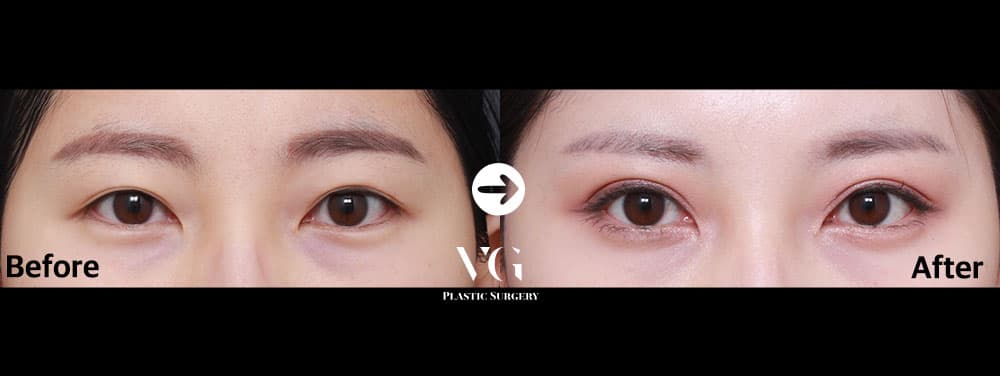
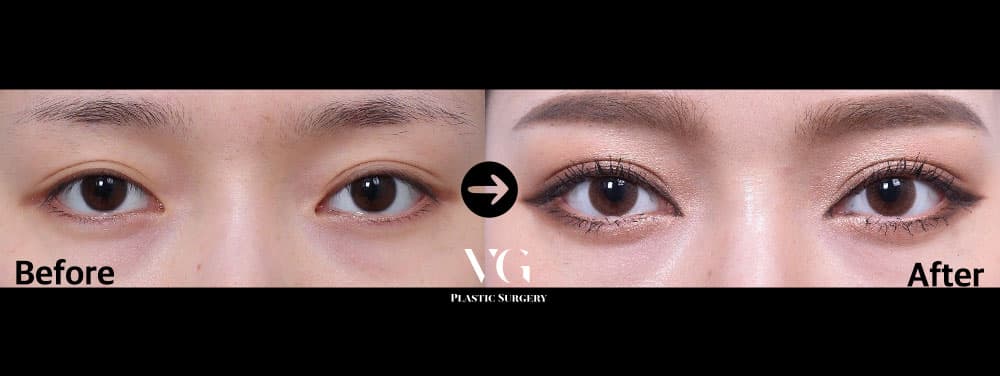
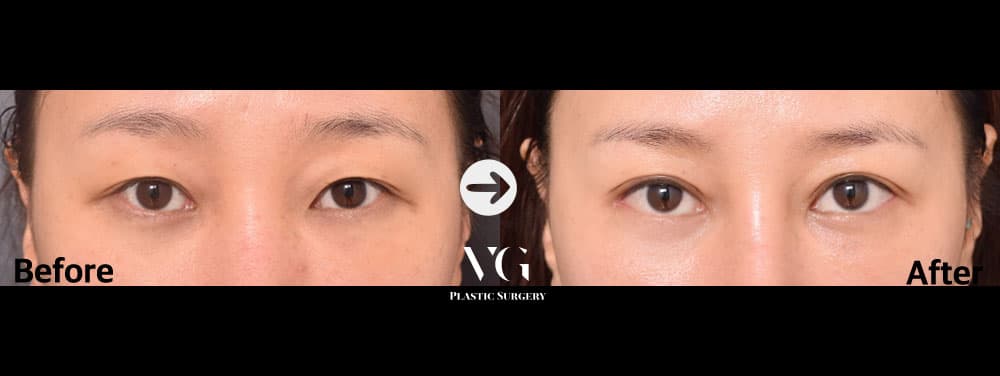
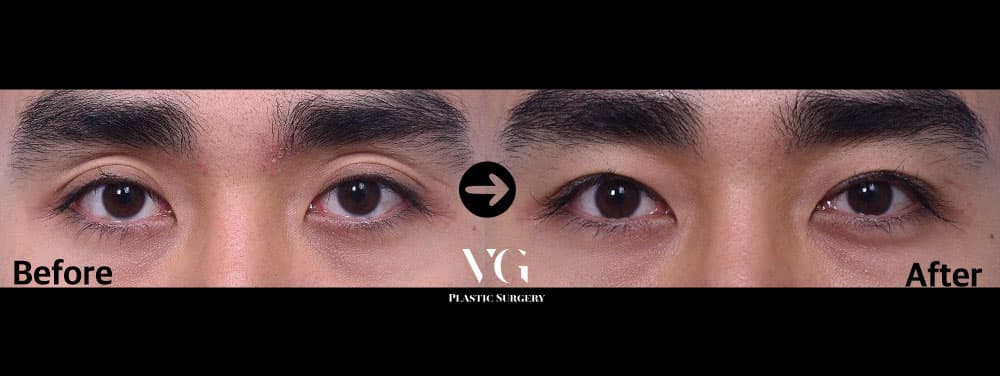
Real patients from our archive, all photographed 3 months after surgery. Tap a case to compare it full size.
Incisional Double Eyelid3 months after surgery
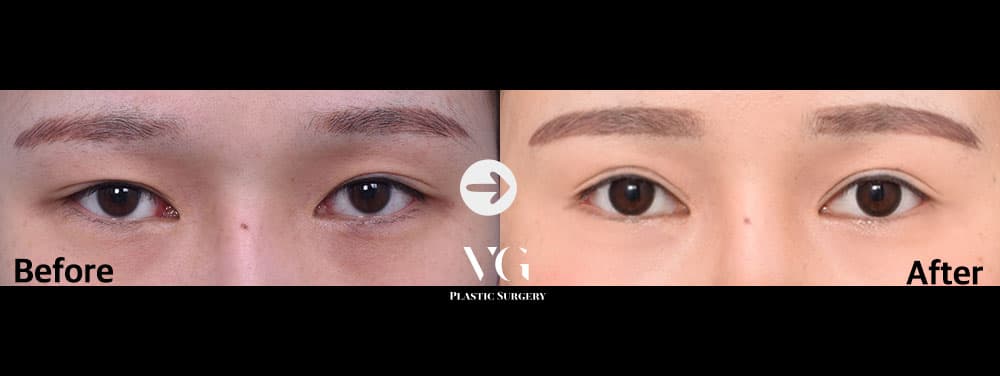
Incisional Double Eyelid3 months after surgery
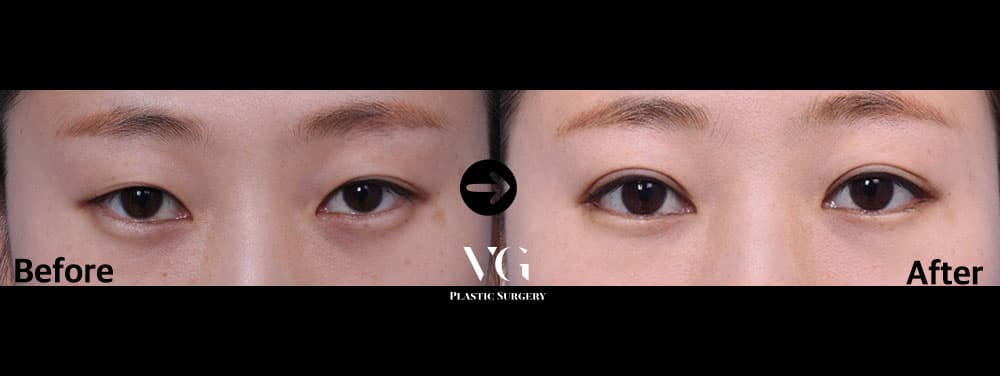
Incisional Double Eyelid3 months after surgery
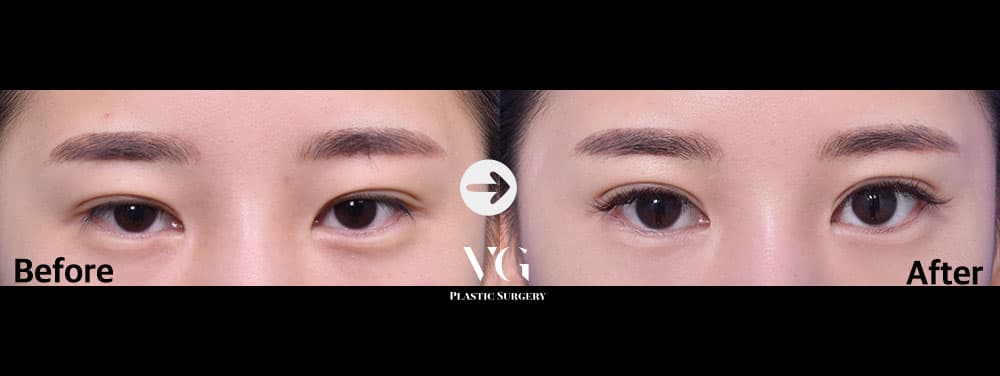
Natural-Adhesion Double Eyelid3 months after surgery
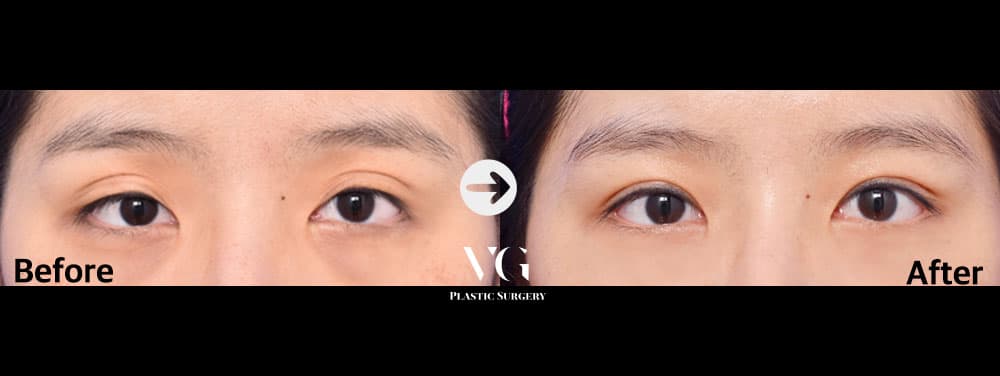
Incisional Double Eyelid3 months after surgery
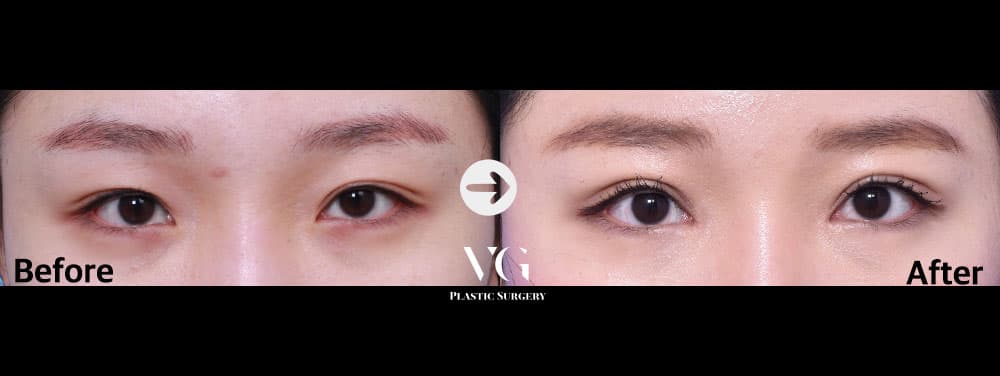
Natural-Adhesion Double Eyelid3 months after surgery
FAQ
Questions patients ask
Can a double eyelid go back to a single eyelid?
A stitched fold can loosen over the years and partly fade, which some people treat as a way back. If you're unsure, start with the lowest crease you would be happy with.
Is a single eyelid the same as a monolid?
In everyday use, yes. Surgeons sometimes separate a true single lid with no crease from a lid with a hidden crease that sits behind the skin above it. The second type often needs less work to show a fold.
Does eyelid tape create a lasting crease?
Tape and glue hold the skin in place but don't create the attachment under the skin, so the fold disappears when you stop. If you've taped for years, mention it at consultation, and send photos without tape so your lid can be judged at rest.
How do I know if I need ptosis correction as well?
Warning signs are a lid edge that covers part of the pupil, a forehead that lifts whenever you look up, or one eye that looks smaller in every photo. A fold on a lid that opens weakly can make the eye look heavier, so the lifting strength is measured before the crease is planned.
I already have one double and one single lid. Can only one side be done?
Yes, matching one side to the other is a common request. The new crease is planned against the height and shape of the natural one, and swelling makes the operated side look higher at first, so judge the match once the swelling is gone.
Sources
This article explains general medical information. Whether surgery suits you, and which method, is decided only after a consultation with the surgeon.
Written by
Im Young Min
Chief Director · Plastic Surgery
- Ph.D. in Medicine
- Internship and residency, Seoul St. Mary's Hospital
- Board-certified plastic surgeon, Seoul St. Mary's Hospital
- Adjunct professor of plastic surgery, Seoul St. Mary's Hospital
- Former director, Topface Plastic Surgery
Next step
Send two photos. Get a surgeon’s answer.
Front and side, natural light, no filter. Dr. Im Young Min reviews them and tells you which method fits and how many days to stay in Seoul.
International patients pay the same surgical fee as Korean patients. Pricing policy
Keep reading
Eyes
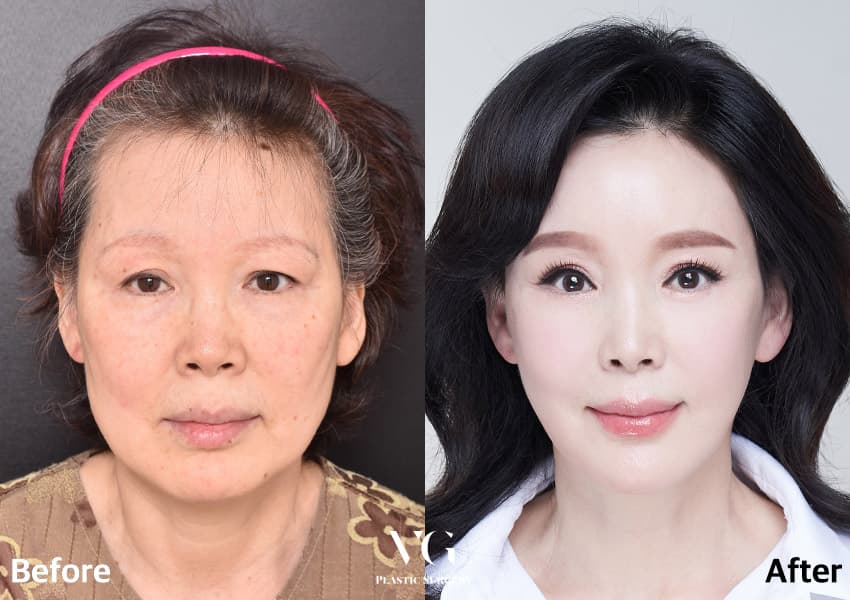
Canthoplasty Recovery Time by Corner: Stitches, Scar, Flight Home and What Sets the Cost
Stitches usually come out around day 5 to 7, most bruising settles over two to four weeks, and the scar keeps softening for six months or more. Plan your flight home around the stitch day.
Im Young Min ·
Eyes
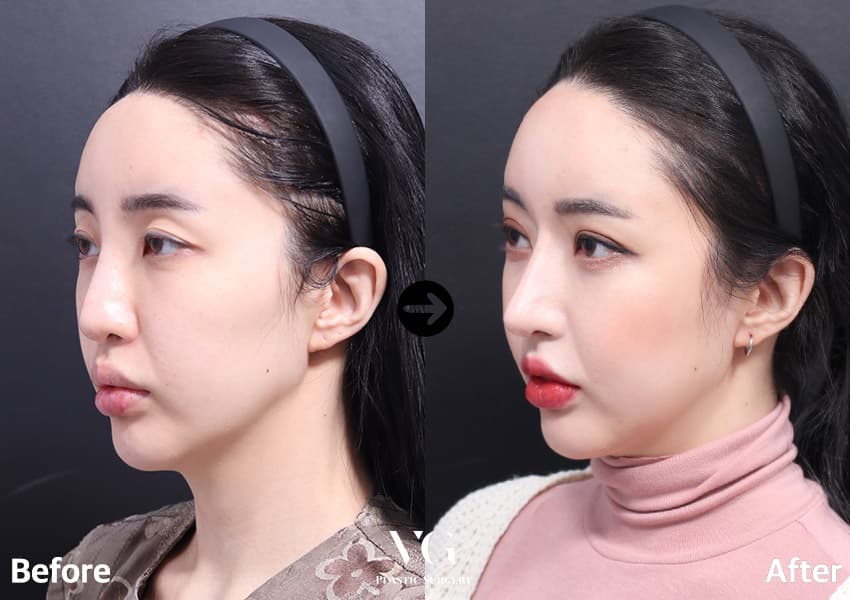
Most Common Plastic Surgery in Korea: What 426 of Our Cases Show
A Seoul plastic surgeon counts the 426 cases in his clinic's before-and-after archive by surgery type, explains what foreign patients ask about most, and says who each operation does not suit.
Im Young Min ·
Eyes
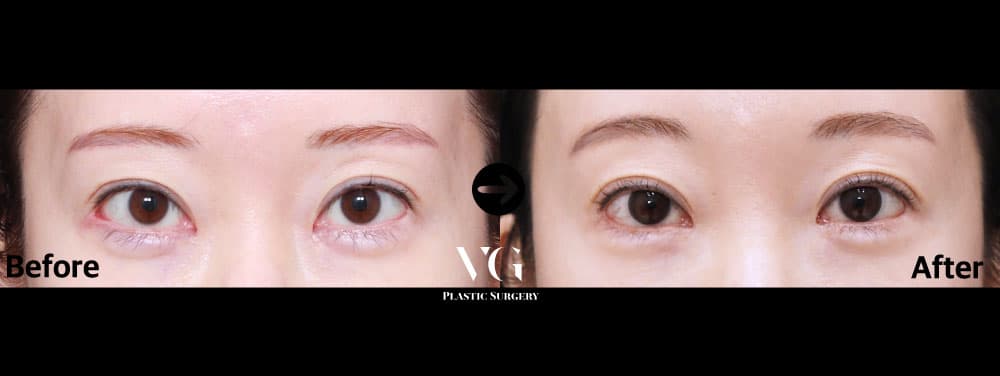
Your Plastic Surgery Interpreter in Seoul: Six Moments Where Words Matter
An eye surgeon in Seoul walks through the six points where interpretation shapes your result — photo quote, consultation, what you agree to, surgery morning, stitch removal and the messages after you fly home — and what to check in any interpreter.
Im Young Min ·