Nose
Considering rib cartilage rhinoplasty Korea? Results, Cost and Risks of Using Your Own Rib
Rib cartilage rhinoplasty uses a piece of your own rib to support or lengthen the nose when septum or ear cartilage can't. Who it suits, what the chest scar involves, and the risks to weigh before travelling.

· 7 min read · Last updated
Edited by Im Young Min
In this article
- 01Why would a nose need cartilage from a rib?
- 02Septum, ear or rib: what each source is good for
- 03What does the chest scar look like, and how sore is it?
- 04Who rib cartilage suits, and who it doesn't
- 05What decides the cost of rib cartilage rhinoplasty in Korea?
- 06Risks and side effects to weigh before you fly
- 07How should a long trip change the plan?
The short answer
Is rib cartilage rhinoplasty Korea surgery worth a second wound on your chest, when you will be healing far from home?
- Rib cartilage is used when the septum or ear can't supply enough strong cartilage.
- It suits short noses, revisions and noses that have lost support more than small refinements.
- The trade-off is a short chest incision, chest soreness and a risk of graft warping.
- Ear cartilage is soft and curved, so it rarely holds a long, straight bridge alone.
- Ask how long to stay near Gangnam and arrange follow-up at home before you book.
Please read on before you book or decide anything.
Profile
Im Young Min
Chief Director · Board-certified in Plastic Surgery
After this you will know why rib is used, what the chest scar and soreness are like, what drives the cost, and which risks to weigh, so you can decide whether to ask about rib at all.
Hello, I'm Dr. Im Young Min, Chief Director and a board-certified plastic surgeon.
I trained and became board-certified at Seoul St. Mary's Hospital, and I am a full member of the Korean Society for Aesthetic Plastic Surgery and the American Society for Aesthetic Plastic Surgery. Rib is a bigger operation than most nose surgery, so I recommend it only when a nose needs it.
I wrote this because many people are told they need rib and assume it means a major, risky operation, or the reverse, that it is just another graft.
In short, it uses your own rib cartilage, taken through a short chest incision, to build or support the nose when septum or ear cartilage is not enough.
Send a side-profile photo and your surgery history on WhatsApp
Why would a nose need cartilage from a rib?
Cartilage grafts in rhinoplasty do two jobs: they hold things up, and they fill things out. A tip that has to project further, a short nose that needs lengthening, or a bridge that has lost support all ask a graft to carry load for years against skin that wants to settle back.
The septum is usually the first choice. It's straight and firm, and it comes from inside the nose with no outside scar. The limit is quantity. A 2014 review of Asian rhinoplasty in Plastic and Reconstructive Surgery Global Open describes septal cartilage in many East Asian noses as limited in size. Ear and rib cartilage come up so often partly for that reason, and a previous operation may also have used the septum already.
Rib gives far more cartilage than the septum or the ear, and it's strong enough to carve into long, straight struts. That's why it appears most in three situations: a short or contracted nose, a revision after an implant or earlier grafts caused problems, and a bridge that needs real height without an implant. For how height along the bridge is planned, see where the bridge starts and what raises it; for second operations, revision planning that starts from what the first surgery left.
Septum, ear or rib: what each source is good for
The three sources of your own cartilage aren't interchangeable. Each has a shape and a strength that suits some jobs and not others.
| Source | What it does well | What it asks of you |
|---|---|---|
| Septum | Straight, firm struts for tip support and small bridge grafts | Taken from inside the nose; the supply is small and may be used up by earlier surgery |
| Ear (concha) | Soft, curved pieces for shaping the tip and small fills | A small incision at the ear; too curved and soft to hold a long, straight bridge by itself |
| Rib | Large, strong pieces for struts, lengthening and bridge height | A short chest incision, soreness while it heals, and a chance the graft bends over time |
People often ask whether ear cartilage can raise the bridge instead. In small amounts it sometimes can, for example to soften an irregularity, or when cut into tiny pieces and wrapped in tissue, as some surgeons do. Its natural curve makes it a poor choice for a long, straight bridge on its own.
Implants such as silicone are a separate path: no donor site, but foreign material under the skin, which matters more when the skin is thin or has been operated on before. And for a bulbous tip, the limit is usually your skin, not the cartilage source; why skin thickness sets the limit on the tip explains why rib isn't a shortcut there.
What does the chest scar look like, and how sore is it?
The cartilage is usually taken through an incision a few centimetres long over the lower ribs. In women it is often placed in or near the crease under the breast, where clothing and a bra line tend to cover it; in men it usually sits over the rib being used. Like any scar it starts pink and firm and fades over many months. How pale and flat it ends up depends on your skin, and people who form thick or raised scars elsewhere are more likely to form one here.
For many people the chest is the part they notice most in the first days: sore when coughing, laughing or getting out of bed, more than the nose itself. Plan for that if you'll be carrying luggage or sitting through a long flight. Taking rib cartilage is usually done under general anaesthesia. At our clinic, one of three full-time anesthesiologists is dedicated to each operation and watches blood pressure, pulse and breathing from the first injection until you wake.
Who rib cartilage suits, and who it doesn't
Rib tends to make sense for a revision where the septum has been used or damaged, a short nose that has to be lengthened against tight skin, a nose that has lost support after injury or infection, or someone who wants clear height without an implant.
It's usually the wrong tool when the change you want is small, such as a slight hump or a tip that only needs refining. It doesn't help when the issue is nostril width, which is a soft-tissue question covered in when nostril reduction helps a wide nose. Rib cartilage also tends to harden (calcify) with age, in some people more than others, and heavily calcified cartilage is harder to carve. Smokers, and anyone with a chest or lung condition, need that conversation before anything is decided.
Say you are 30, you had a silicone implant years ago, and the tip has started to look thin and pushed forward. You ask whether rib is one answer. I would first want to know what has already been used: if an earlier operation took your septal cartilage, there may be little left, and ear cartilage may be too soft to support a long, strong nose. Rib is the source that gives enough firm material in that situation. If the problem is only a slightly low bridge, I would likely not suggest it, because a smaller graft can do the job without a chest incision. The photo and your surgery history decide which of these applies.
What decides the cost of rib cartilage rhinoplasty in Korea?
The main factor is how much structure your nose needs rebuilt, because that sets how much rib cartilage is taken and how it is shaped. A first operation differs from a revision, where scar tissue and earlier grafts change the work. Anaesthesia and the length of the operation also count, since two surgical sites are involved. The days you stay in Korea matter too, because the chest and the nose both need checking before you travel home. Follow-up is the last factor, especially if you will be far away afterwards. To get the figure for your case, send a side-profile photo on WhatsApp and ask for it there.
Risks and side effects to weigh before you fly
A rib graft adds donor-site risks to the usual rhinoplasty list. On the chest: the scar, pain while it heals, and rarely an air leak into the space around the lung (pneumothorax) if the thin lining beneath the rib is breached, which surgeons check for during the operation. In the nose, the complication rib is known for is warping, where a carved graft slowly bends in the months after surgery. Careful carving reduces that risk; it doesn't remove it.
On the nose side, the American Society of Plastic Surgeons' list applies as it does to any rhinoplasty: bleeding, infection, trouble breathing, a perforated septum, numbness, a shape you're unhappy with, and sometimes a second operation. A rib-grafted nose also usually feels firmer than it did before, especially at the tip.
The CDC advises medical travellers to arrange follow-up care at home before leaving and to be careful about flying soon after surgery, because of the risk of blood clots. With rib, ask as well how the chest wound will be checked before you go, so a doctor at home isn't seeing it for the first time with no notes. How each person heals differs, and whether rib belongs in your plan at all is decided once a surgeon has examined your nose in person.
If you have records from an earlier nose operation, a photo of the operation note or discharge summary says more than a long description. Send it on WhatsApp with your travel dates, and ask how long the surgeon would want you near Gangnam after a rib graft.
Send a side-profile photo and your surgery history on WhatsApp
How should a long trip change the plan?
Most recovery stories online describe the nose alone. With rib you're healing in two places, and the chest has to be comfortable enough for the seat, the seatbelt and the luggage. Ask about both before you fix a return date, and don't borrow a timeline from someone else's operation.
The nose keeps changing long after the trip. The American Society of Plastic Surgeons notes that the contour can take up to a year to refine fully, and a graft-supported tip often looks stiffer and fuller early on; how swelling changes a natural result over time covers which parts settle last.
Check who will operate before anything else. Every surgeon here operates under their own name, with their training published, and checking a rhinoplasty surgeon from abroad lists what to look up. The clinic is at 635 Nonhyeon-ro in Gangnam, and the site lists interpreter support for the visit. Pack front-opening tops, because lifting your arms over your head can pull on a fresh chest wound, and keep your Seoul records in your carry-on.
If you are still unsure about rib cartilage rhinoplasty Korea surgery, send one side-profile photo taken in daylight on WhatsApp, with a line on any nose surgery you have had and the year. Ask one question: is rib likely to be needed for my nose, or could septum or ear cartilage be enough? One photo is enough, and you can ask before booking anything. When you come to Seoul, I examine you and recommend what fits your nose, whether that is rib or something smaller.
Related pages:
Nose before & after — more cases
Real patients from our archive, all photographed 3 months after surgery. Tap a case to compare it full size.
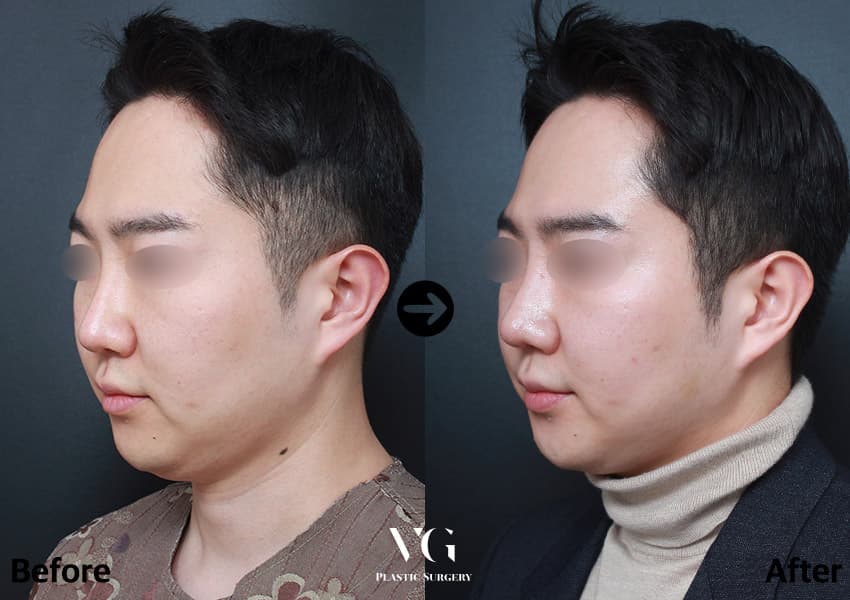
Male Rhinoplasty3 months after surgery
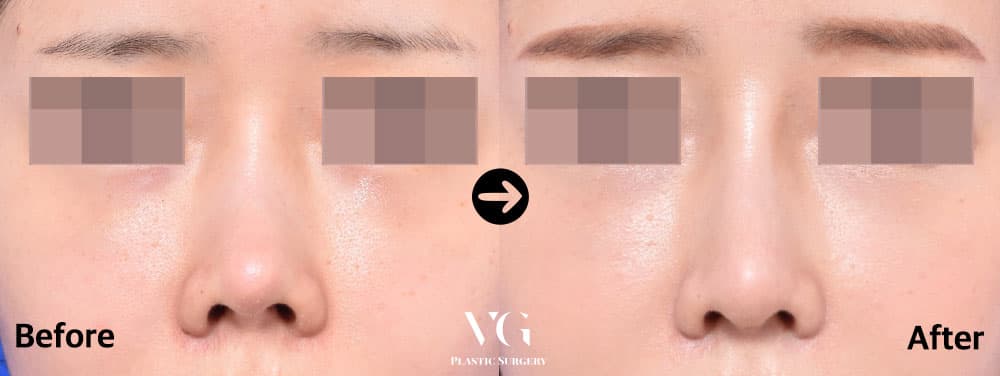
Revision Rhinoplasty3 months after surgery
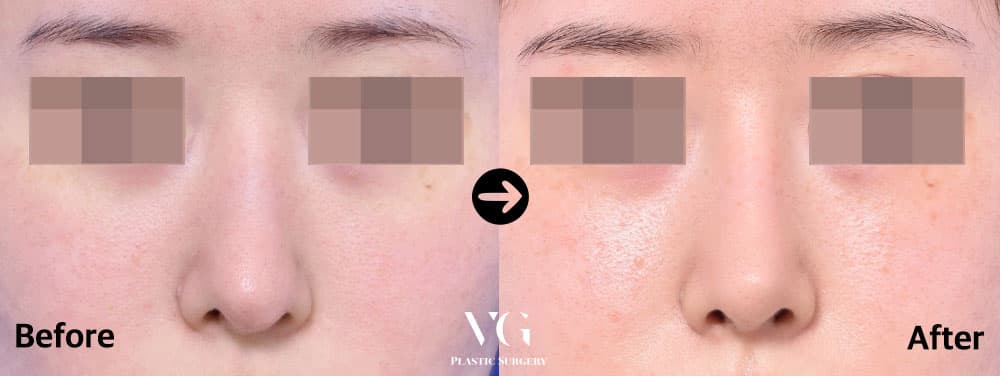
Revision Rhinoplasty3 months after surgery
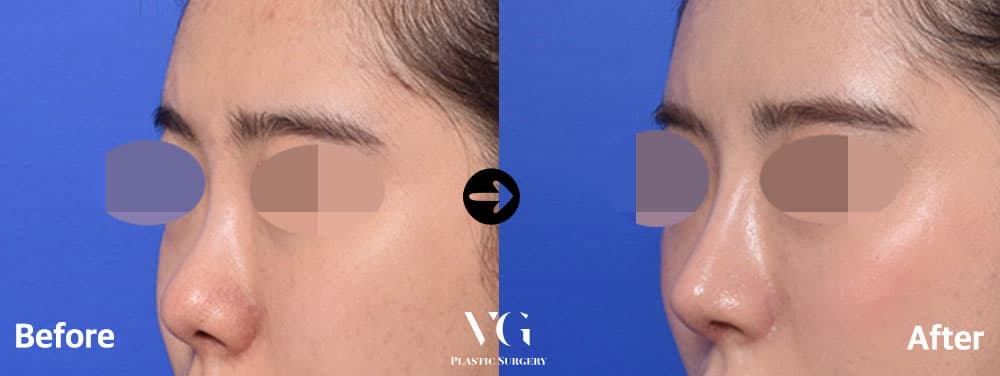
Rhinoplasty3 months after surgery
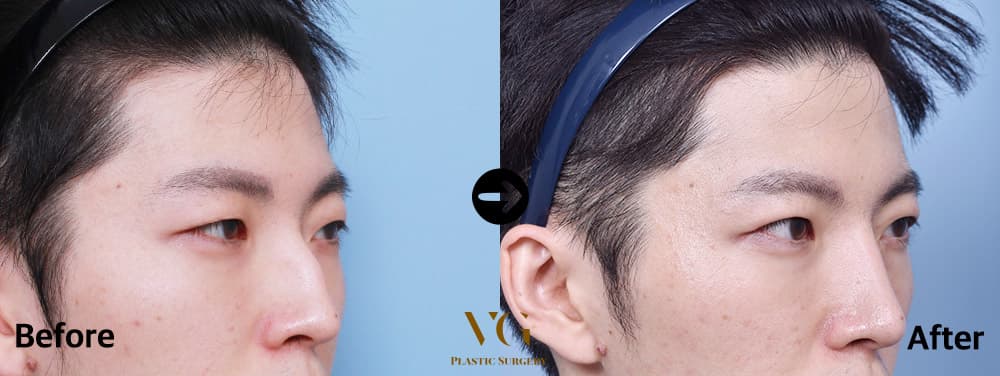
Male Rhinoplasty3 months after surgery
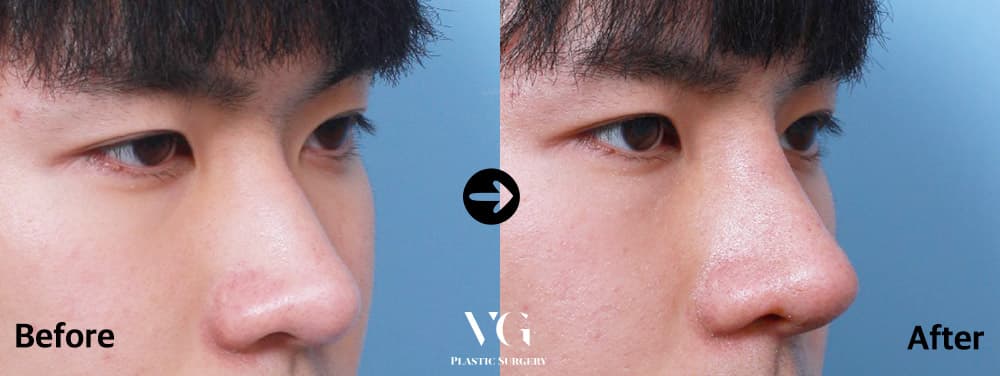
Male Rhinoplasty3 months after surgery
FAQ
Questions patients ask
Can donor rib cartilage be used instead of my own?
Some surgeons use processed donor rib cartilage, which avoids a chest incision. It has its own trade-offs, including questions about how much of it is absorbed or bends over time, and it isn't suitable for every nose. Ask directly whether it applies to your case and why, rather than assuming either option.
Is rib cartilage rhinoplasty Korea surgery done under general anaesthesia?
Usually, yes, because cartilage is taken from the chest as well as shaped into the nose.
Will my nose feel hard afterwards?
Usually firmer than before, especially at the tip, because a stiffer graft is now supporting it. Many people get used to the feel as swelling goes down, but a rib-supported tip rarely moves as freely as an unoperated one.
I already have a silicone implant. Can rib replace it?
Replacing an implant with your own cartilage is one of the common reasons rib comes up, especially when the skin over the implant has thinned or the implant has shifted. What's possible is set by the skin and scar tissue left, so bring any records you have from the first operation.
Is there a minimum or maximum age?
Surgeons generally wait until the face has finished growing. At the other end, rib cartilage tends to calcify with age, which can make it harder to use, but age alone doesn't decide it.
Sources
This article explains general medical information. Whether surgery suits you, and which method, is decided only after a consultation with the surgeon.
Written by
Im Young Min
Chief Director · Plastic Surgery
- Ph.D. in Medicine
- Internship and residency, Seoul St. Mary's Hospital
- Board-certified plastic surgeon, Seoul St. Mary's Hospital
- Adjunct professor of plastic surgery, Seoul St. Mary's Hospital
- Former director, Topface Plastic Surgery
Next step
Send two photos. Get a surgeon’s answer.
Front and side, natural light, no filter. Dr. Im Young Min reviews them and tells you which method fits and how many days to stay in Seoul.
International patients pay the same surgical fee as Korean patients. Pricing policy
Keep reading
Nose
Rhinoplasty Cost in South Korea in Rupees: What Changes It for a Flat Nose or Crooked Septum? Reviews, Methods and Recovery
There's no honest rupee figure for a nose nobody has examined. The cost follows the method, septum work, revision, anesthesia time and days in Seoul; send photos on WhatsApp to ask about yours.
Im Young Min ·
Nose
What Decides the Cost of Rhinoplasty in South Korea? Reviews, Methods and Recovery
There is no single price for a nose job in Korea: the method, the cartilage source, septum work, revision status and anesthesia set the figure for your nose.
Im Young Min ·
Nose
How Much Does a Nose Job Cost in Korea? Four Cost Drivers, Reviews, Methods and Recovery
A nose job in Korea is priced from four parts: the scope of the change, the building material, any breathing work and the anesthesia. Foreigners pay the same surgical fee as Korean patients, with a written estimate.
Im Young Min ·