Nose
Considering Male Rhinoplasty Korea? Cost, Methods and When to Wait
Male rhinoplasty Korea carries the usual rhinoplasty risks plus limits set by thick tip skin, bridge height and tip angle. Wait if your breathing is unexamined, your nose was recently broken or the trip is shorter than the splint week.
· 8 min read · Last updated
Edited by Im Young Min
In this article
- 01What decides the cost of male rhinoplasty in Korea?
- 02The risks of any rhinoplasty apply in Seoul too
- 03Why does a man's nose set tighter limits?
- 04Implant or your own cartilage, and where each one can fail
- 05When should a man wait, or skip it?
- 06Breathing belongs in the same surgical plan
- 07What if something goes wrong after you fly home?
- 08What to put in your first message
The short answer
Wondering whether male rhinoplasty Korea is worth the trip, and what happens if something goes wrong after you fly home? Read on before you book anything.
- Every rhinoplasty risk on the ASPS list applies in Seoul too, and the final contour can take up to a year to refine.
- Thick tip skin, tip rotation and bridge height set tighter limits on a man's nose.
- Silicone and your own cartilage fail in different ways, and rib cartilage tends to calcify with age.
- Wait if your breathing hasn't been examined, your nose was recently broken, or the trip is shorter than the splint week.
- At VG Plastic Surgery an on-site ENT specialist assesses the septum and airway alongside the shape.
After this you will know what shapes the cost, which methods suit a man's nose, when it is wiser to wait, and how to plan the flight home.
Profile
Im Young Min
Chief Director · Board-certified in Plastic Surgery
Hello, I'm Dr. Im Young Min, Chief Director and board-certified plastic surgeon at VG Plastic Surgery.
At our clinic in Gangnam, an ENT specialist works alongside the plastic surgeons on the rhinoplasty team, so breathing and internal structure are assessed together with the shape of the nose.
I am writing this because many men assume a nose job is a quick, simple fix that fits into a short trip, when thick skin, the septum and swelling often set the pace.
The short answer: male rhinoplasty Korea can give a straighter, stronger bridge and a better-sitting tip, but the plan has to fit your skin, your breathing and your travel dates.
Send a side-profile photo on WhatsApp
What decides the cost of male rhinoplasty in Korea?
The cost depends on what your nose needs, not on a fixed package. The main factors are the method (an implant, your own cartilage, or both), how much of the bridge and tip is being reworked, and whether the septum is corrected in the same operation. The type of anaesthesia, the number of days you can stay in Seoul, and the follow-up checks before you fly home also change the plan. Thick skin or a previous nose surgery can make the work longer and more involved.
To get the figure for your case, send a side-profile photo on WhatsApp and ask what applies to your nose.
The risks of any rhinoplasty apply in Seoul too
Every rhinoplasty carries the same core list wherever it's done. The American Society of Plastic Surgeons names anesthesia risks, bleeding, infection, poor wound healing or scarring, numbness, difficulty breathing, skin discoloration and swelling, a hole in the septum, an appearance you're unhappy with, and the possibility of revision surgery.
Travel changes how two of those land. The first is swelling. ASPS notes that swelling goes down within a few weeks but the new contour can take up to a year to refine, so the nose you photograph at the airport is an early draft. Men with thicker skin often see the tip settle last. The second is breathing: a change in airflow can be hard to judge while the splint and internal dressings are in, and it may only become clear once you're home.
None of this makes a male rhinoplasty Korea trip reckless. It means the plan has to account for the months after you leave, and that's where most of the sections below end up.
Why does a man's nose set tighter limits?
Skin, bridge line and tip angle do most of the limiting. Men's nasal skin is often thicker and oilier, which hides fine tip work. A masculine profile usually wants a straight, fairly strong bridge and a tip that isn't turned up, and small misjudgements in either direction tend to read as feminine.
Many East Asian men start from exactly this combination, and the skin is usually the part surgery changes least. There's more on that in why skin thickness sets the limit on the tip.
| Limit | Why it matters more on a male face | What lowers the risk |
|---|---|---|
| Thick, oily tip skin | A sharp, narrow tip from a photo may not show through | Choosing a tip shape the skin can carry |
| Upturned (over-rotated) tip | More nostril show reads as softer and younger | Keeping rotation modest and judging the side profile |
| Tall, narrow implanted bridge | Height out of proportion looks placed | Matching height to brow, forehead and chin |
| Deviated septum or narrow valve | A higher bridge doesn't open a blocked airway | Assessing the airway together with the shape |
Reference photos are where many plans start to drift. Men often bring pictures of Korean actors or models, and those noses tend to be narrow and high with a defined tip, set on faces with a particular brow and jaw. A nose has to match the face it sits on: the same bridge looks different above a wide, square jaw than above a slim chin. If the jawline is what actually bothers you, that's a facial contouring question, separate from the nose.
Bridge height has its own logic too, covered in where the bridge should start and what raises it.
Implant or your own cartilage, and where each one can fail
Both materials have failure modes. A silicone implant is quicker to place and leaves no donor site, but it's a foreign body that can shift, show through thin skin, become infected or, rarely, push through the skin. Your own cartilage, from the septum, ear or rib, avoids a foreign body but can warp, partly resorb, or leave a scar where it was taken.
For men the choice often comes down to how much height is wanted and how much tip support is needed. A strong bridge built from an implant that reaches into the tip puts pressure on the skin there, which is one reason surgeons commonly support the tip with the patient's own cartilage. Thick skin also tends to call for firmer tip support, and heavier tip work in thick skin is often done through the open approach, which leaves a small scar across the column between the nostrils.
The trade-offs are laid out in inside-the-nose incisions versus the open approach.
Age adds its own limit, and it matters if you're in your 40s or 50s. Rib cartilage tends to calcify with age, which can make it harder to carve and less predictable as a graft. The septum may have less usable cartilage if it was broken or operated on before. Older skin over the tip is often heavier, and the tip itself may have drooped. Each of these narrows what is realistic; none of them rules surgery out on its own.
If silicone is on the table, the first week after Korean silicone rhinoplasty, from splint to boarding gate shows how the splint week fits around a flight.
When should a man wait, or skip it?
Wait when the cause, the timing or the expectation doesn't fit. A male rhinoplasty Korea plan should usually pause in any of these situations.
- Breathing trouble nobody has examined. If one side blocks at night or you breathe through your mouth, the septum and nasal valve need assessing first, because shaping alone can make a tight airway feel tighter.
- A reference nose your skin can't carry. A sharply defined tip from a thin-skinned photo is likely to disappoint on thick, oily skin, and pushing for it raises the risk of skin problems over the tip.
- Contact sport or heavy training in the coming weeks. A knock to a healing nose can shift bone or an implant, so the off-season is the better slot.
- A wish that keeps moving. If you've changed your nose before and still can't stop checking it, a conversation about that comes before another operation.
If you've already had surgery and want a correction, the logic shifts again; what a revision has to start from covers it.
Say you are 38, your skin is thick and oily, and you want a straighter bridge and a tip that looks less rounded. You also mention that one side of your nose is often blocked. I would not start with the tip. With thick skin, a very sharp tip often will not show through, so I would first ask whether the blocked side comes from a crooked septum, because that changes which cartilage is available and how the bridge is built. Then I would look at your travel dates.
If you can only stay a few days, we would talk about whether the plan fits that time or whether it is better to wait. Your skin, your breathing and your calendar decide the plan together.
Breathing belongs in the same surgical plan
A deviated septum or a narrow nasal valve should be assessed before the shape is chosen, because raising or narrowing the nose can make an already tight airway feel worse. Here, an ENT specialist practises alongside the plastic surgeons, so a septum that doesn't breathe well is examined and treated as part of the operation instead of being left to someone else.
That specialist is Kim Han Gyeol, whose listed background includes an otolaryngology residency at Samsung Medical Center, Sungkyunkwan University, and who joins the rhinoplasty centre to look after the septum and the airway.
Anesthesia is the other risk the trip doesn't change. They don't perform cosmetic surgery, so the surgeon does nothing but operate. In all, eight specialists are on staff across plastic surgery, ENT and anesthesiology.
What if something goes wrong after you fly home?
Plan for it before you book. The US CDC's medical tourism guidance advises arranging follow-up care at home before you travel, keeping copies of your medical records, and allowing for the higher risk of blood clots when you fly soon after surgery.
Before you leave Seoul, have a written record of what was done: which material was used, where any cartilage was taken from, whether the septum was treated, and which medicines you're taking. A local ENT or plastic surgeon can act on that; a vague description leaves them guessing.
Know which signs need same-day care at home: swelling that suddenly increases on one side, bleeding that won't stop with gentle pressure, fever, redness or discharge spreading from an incision, or an implant edge you can suddenly see or feel. Those go to a local doctor or emergency department that day. The surgeon in Seoul should hear about them too, but distance is no reason to delay.
This is the male rhinoplasty Korea question many people skip when comparing clinics. It belongs on the list in how to check who will actually operate on your nose, right next to the surgeon's name.
If the weeks after the flight are what worry you most, send that question on WhatsApp together with a side-profile photo of your nose.
Send a side-profile photo on WhatsApp
What to put in your first message
Two things make a first message useful: a side-profile photo taken in daylight with your face relaxed, and the dates you could stay in Seoul. If you have had nose surgery or a broken nose before, add the year and what was done, because it changes which graft material is realistic. Then ask one question: does my nose need anything beyond the bridge and tip, such as the septum? Send it all on WhatsApp. One photo is enough, and you can ask before booking anything.
When you come to Seoul, I examine your nose and recommend what fits you.
Related pages:
Nose before & after — more cases
Real patients from our archive, all photographed 3 months after surgery. Tap a case to compare it full size.
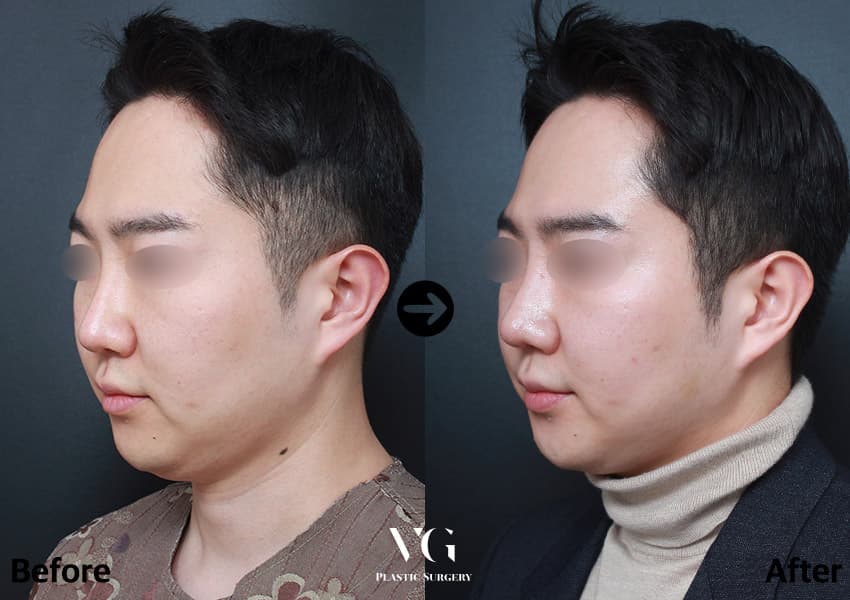
Male Rhinoplasty3 months after surgery
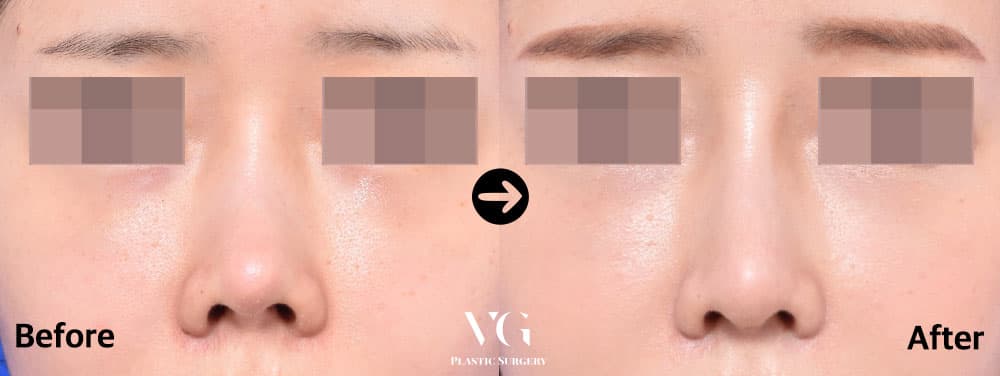
Revision Rhinoplasty3 months after surgery
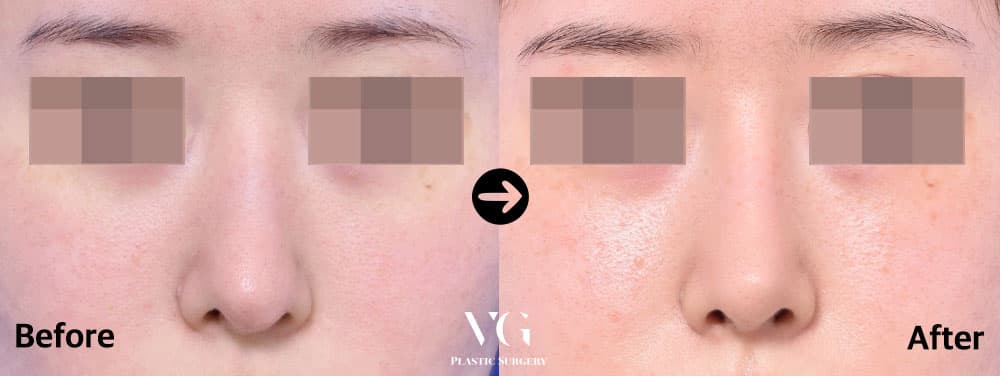
Revision Rhinoplasty3 months after surgery
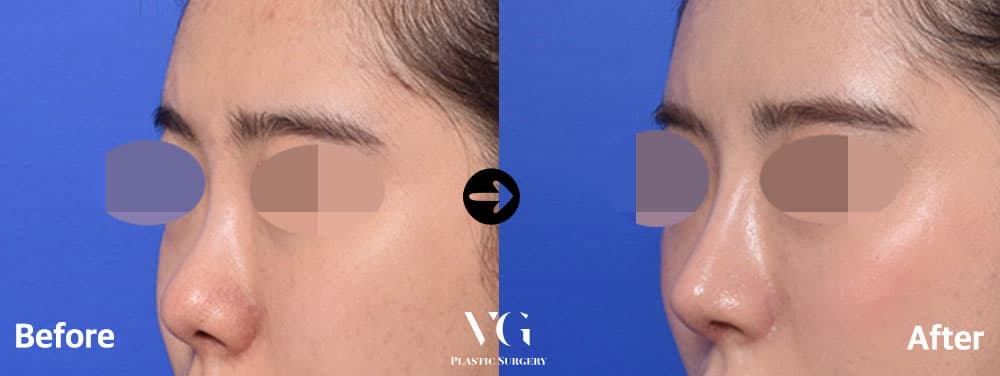
Rhinoplasty3 months after surgery
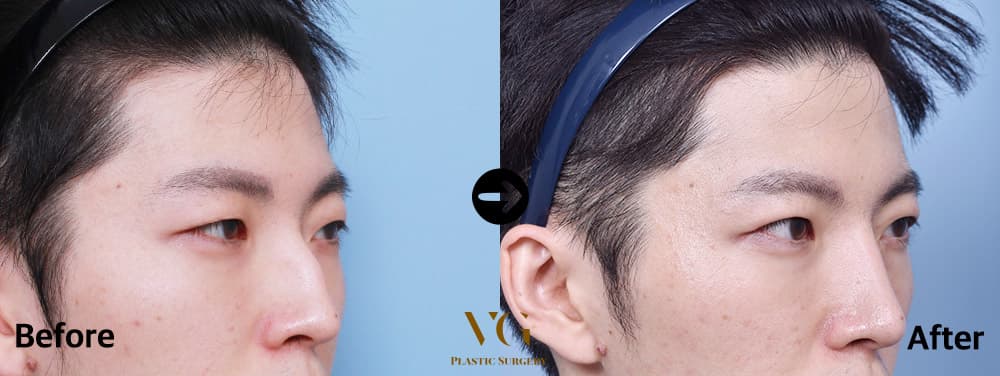
Male Rhinoplasty3 months after surgery
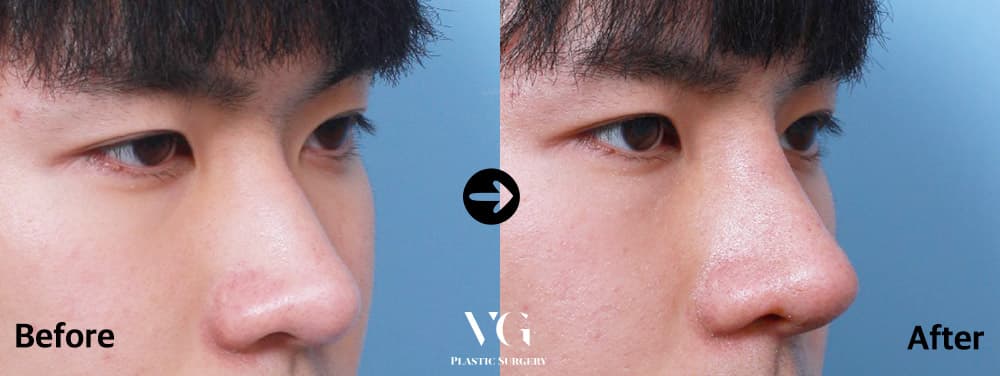
Male Rhinoplasty3 months after surgery
FAQ
Questions patients ask
Will Korean rhinoplasty make a man's nose look feminine?
It can if the tip is turned up too far or the bridge is made too narrow or scooped. A masculine result usually keeps a straight, fairly strong bridge and modest tip rotation. Bring side-profile reference photos and say plainly which features you don't want.
Is silicone or rib cartilage the right choice for a man's bridge?
Neither suits everyone. Silicone is widely used for augmentation in East Asia and needs no donor site, but it is a foreign body that can shift, show or become infected. Rib cartilage avoids that but can warp and, in older men, may be calcified. Skin thickness, previous surgery and how much height you want usually decide it.
Can a deviated septum be fixed in the same male rhinoplasty Korea operation?
Often, yes. At VG Plastic Surgery an ENT specialist works with the rhinoplasty team, so a deviated septum or narrow nasal valve is examined and treated as part of the operation. Whether your septum needs it is confirmed at the consultation in Seoul.
How soon can I fly home after a nose job in Seoul?
The CDC notes that flying soon after surgery raises the risk of blood clots. Confirm your follow-up dates before booking the return flight.
Am I too old for male rhinoplasty in my 50s?
Age alone rarely rules it out. What changes is the material and the tip: rib cartilage tends to calcify with age, and heavier tip skin limits refinement. Your general health and the anesthesia assessment matter more than the number.
Can I fit rhinoplasty into a long weekend in Korea?
A long weekend leaves no room for the splint week and the check before flying. Plan the trip around the splint period and the follow-up visit. The silicone rhinoplasty recovery post linked above walks through that first week day by day.
Sources
This article explains general medical information. Whether surgery suits you, and which method, is decided only after a consultation with the surgeon.
Written by
Im Young Min
Chief Director · Plastic Surgery
- Ph.D. in Medicine
- Internship and residency, Seoul St. Mary's Hospital
- Board-certified plastic surgeon, Seoul St. Mary's Hospital
- Adjunct professor of plastic surgery, Seoul St. Mary's Hospital
- Former director, Topface Plastic Surgery
Next step
Send two photos. Get a surgeon’s answer.
Front and side, natural light, no filter. Dr. Im Young Min reviews them and tells you which method fits and how many days to stay in Seoul.
International patients pay the same surgical fee as Korean patients. Pricing policy
Keep reading
Nose
Rhinoplasty Cost in South Korea in Rupees: What Changes It for a Flat Nose or Crooked Septum? Reviews, Methods and Recovery
There's no honest rupee figure for a nose nobody has examined. The cost follows the method, septum work, revision, anesthesia time and days in Seoul; send photos on WhatsApp to ask about yours.
Im Young Min ·
Nose
What Decides the Cost of Rhinoplasty in South Korea? Reviews, Methods and Recovery
There is no single price for a nose job in Korea: the method, the cartilage source, septum work, revision status and anesthesia set the figure for your nose.
Im Young Min ·
Nose
How Much Does a Nose Job Cost in Korea? Four Cost Drivers, Reviews, Methods and Recovery
A nose job in Korea is priced from four parts: the scope of the change, the building material, any breathing work and the anesthesia. Foreigners pay the same surgical fee as Korean patients, with a written estimate.
Im Young Min ·