Nose
Natural Korean Nose Job: What Decides the Cost, Which Methods, and How Many Days in Seoul?
A natural korean nose job keeps the bridge and tip in proportion to your own skin and face. Plan the trip around a splint that usually stays on for about seven days, and expect swelling to settle for months after you fly home.
· 7 min read · Last updated
Edited by Im Young Min
In this article
- 01What makes a Korean nose job look natural?
- 02Seven days with a splint sets the shortest stay
- 03How many days off does a natural korean nose job really take?
- 04Swelling is why week two can look unnatural
- 05Why does breathing matter for a natural result?
- 06What decides the cost of a natural korean nose job?
- 07Risks to weigh before you book flights
- 08Who follows up once you're home?
- 09What to send before you choose dates
The short answer
Worried that a natural korean nose job will still look like surgery once you are back home?
- A natural result comes from proportion: bridge, tip and nostrils that match your face and the skin covering them.
- The splint usually stays on for about seven days, so a long weekend is too short for the trip.
- Bruising often fades by around three weeks, but swelling can take six months to a year to settle.
- Breathing is assessed with an ENT specialist as part of the same rhinoplasty plan here.
- Before you leave Seoul, take copies of your records and agree who sees you for follow-up at home.
It is worth reading on before you book flights or pick dates.
Profile
Im Young Min
Chief Director · Board-certified in Plastic Surgery
After this you will know what decides the cost, which methods are used, how many days to plan in Seoul, and what to send first.
Hello, I'm Dr. Im Young Min, Chief Director, board-certified plastic surgeon.
At our clinic, rhinoplasty is reviewed with an ENT specialist who practises alongside the plastic surgeons, so breathing and internal structure are assessed in the same plan as shape. I trained and board-certified at Seoul St. Mary's Hospital and am a full member of ASAPS.
Many people assume natural just means a smaller or lower nose, when it is really about how the bridge and tip fit your own skin and face.
A natural korean nose job keeps the new bridge and tip in proportion to you, so people notice you look well before they notice your nose.
Send your dates and a side photo on WhatsApp
What makes a Korean nose job look natural?
Proportion and skin. A nose reads as natural when bridge height, tip projection and nostril width suit the face around them and the skin that has to cover them.
A review of Asian rhinoplasty in Plastic and Reconstructive Surgery Global Open (Ishii, 2014) describes a common pattern in East Asian noses: a lower bridge, thicker skin and soft tissue, and tip cartilage that offers less support. That is why many Korean nose operations add height and tip support instead of taking structure away.
Thick skin is the number people forget to ask about. It softens whatever sits underneath, which helps a result look gentle. It also means a sharp, pinched tip seen on a thin-skinned nose may simply not show through, and pushing more height than the skin can comfortably stretch over puts tension on the tip.
The same review discusses two broad ways to build height: synthetic implants and the patient's own cartilage (from the septum, ear or rib). Each has trade-offs, and which one suits your nose is a consultation question, since it hangs on skin thickness, how much cartilage you have, and how much change you want.
"Natural" also shifts with the face. For many men it means a straighter, stronger bridge, which the guide to nose surgery for Korean men covers. If your nose looks wide mainly at the nostrils, nostril reduction (alarplasty) may matter more than the bridge. And if you're not yet sure your nose needs surgery at all, start with whether to go ahead now or wait.
Seven days with a splint sets the shortest stay
About one week is the floor. The NHS describes a dressing after the operation and a splint taped over the nose for 7 days, and the American Society of Plastic Surgeons (ASPS) notes that a splint, internal packing or both may be used.
For trip planning, that turns into a simple sequence: room for the in-person consultation before surgery, the operation, the splint week, and the visit where the splint comes off. A three-day weekend doesn't fit that sequence. The exact number of nights for your plan is set at consultation, because a tip-only change and a bridge-plus-tip operation don't always follow the same schedule.
| Point in recovery | What the sources describe | What it means for the trip |
|---|---|---|
| Days 0–7 | Splint taped over the nose (NHS) | Stay in Seoul; plan quiet days near your hotel |
| Around 3 weeks | Bruising, swelling and redness may have faded (NHS) | Most people feel ready for face-to-face work |
| 4–6 weeks | Strenuous exercise and contact sports can resume (NHS) | Hold gym, surfing or football plans until here |
| Up to 6 months | Swelling may take this long to go completely (NHS) | Don't judge the final shape yet |
| Up to 1 year | Contour keeps refining (ASPS) | The version to judge |
How many days off does a natural korean nose job really take?
Up to two weeks of leave, by the NHS estimate, and for a traveller those two weeks split in two. The first week belongs to Seoul and the splint. The second is travel and rest at home, often with some bruising around the eyes, which the NHS says can last about three weeks.
If you teach, work in hospitality or face customers, that second week matters more than the first. Two weeks of leave plus a weekend gives you a buffer; ten working days with a flight squeezed into each end leaves none.
Flying deserves its own question at consultation. The NHS page doesn't set a rule for flights after rhinoplasty, and it lists a blood clot in a vein among the general risks of any operation, which is worth weighing before a long-haul seat. Ask your surgeon directly which day after splint removal suits your flight and what to do on board.
Say you are flying in from abroad with a low bridge, a soft tip and fairly thick skin, and you want people to say you look rested rather than ask what you had done. I would look first at how much your skin can show, because thick skin hides fine changes and a large jump in height can look pushed forward. I would also check whether your breathing is comfortable, since that affects the internal structure I plan around. Then we would count back from your flight: the splint stays on for seven days, so the dates you can spend in Seoul decide how the plan fits your calendar.
Swelling is why week two can look unnatural
Many people judge the shape too early. ASPS describes initial swelling that eases within a few weeks, swelling that can come and go and be worse in the morning during the first year, and up to a year for the nasal contour to fully refine.
The tip is usually the slowest part, and thicker skin tends to hold swelling longer. So a nose that looks a little full or a little high in the airport mirror is often a nose that hasn't finished settling. Photos posted online at one or two weeks tell you little about month twelve, which is also why reading angles and timing in other people's photos is worth a few minutes before you compare yourself to anyone.
Why does breathing matter for a natural result?
A nose that looks right and breathes badly is a poor result. Here, an ear, nose and throat specialist practises alongside the plastic surgeons, so a deviated septum or a narrow airway is examined and treated as part of the operation.
That matters for travellers in a practical way: a breathing problem found after you've flown home is much harder to sort out than one found at the planning stage. If you already snore, breathe through your mouth at night or feel one side block easily, the questions to ask when your nose also breathes badly are a good list to bring.
The team around the operation is part of the same picture. The clinic has eight full-time specialists across plastic surgery, ENT and anaesthesiology, and three anesthesiologists on staff, one dedicated to every operation; they don't perform cosmetic surgery. Every surgeon here is board-certified and operates under their own name, and you can check who will actually operate on you before you commit to dates.
What decides the cost of a natural korean nose job?
The cost depends on what your nose needs, not on a standard package. The method matters first: whether the work is on the bridge, the tip, or both, and whether your own cartilage or an implant is used. The amount of change and the thickness of your skin affect how much work is involved. Anaesthesia and the number of days you spend in Seoul for the splint week and checks also play a part. To get the figure for your case, send a daylight front photo and side photo of your nose on WhatsApp and ask.
Risks to weigh before you book flights
Rhinoplasty is surgery, and a natural look doesn't lower its risks. The NHS lists occasional lasting breathing difficulty, damage to the cartilage wall between the nostrils, an altered sense of smell and heavy nosebleeds, plus the small risks of any operation: excessive bleeding, a blood clot in a vein, infection and an allergic reaction to the anaesthetic.
Material adds its own trade-offs. Implants avoid a second donor site but are foreign material under thin tip skin; the patient's own cartilage avoids that but means harvesting it, and rib cartilage adds a separate scar and recovery. Some noses need a second, smaller operation later, which is one more reason to keep the first one in proportion.
Healing differs from person to person, and whether surgery suits your nose, and which method, is decided at the in-person examination in Seoul.
If one of these risks is the thing keeping you up at night, send that single question on WhatsApp together with a side photo of your nose.
Send your dates and a side photo on WhatsApp
Who follows up once you're home?
The U.S. Centers for Disease Control and Prevention (CDC) advises people travelling for medical care to plan follow-up at home and to take copies of their medical records. For a nose, that means telling your own GP or a local ENT before you go, and asking in Seoul for copies of your operation notes and medication list.
ASPS suggests asking your surgeon when you should return for follow-up care. For a traveller the useful version is more specific: which check happens before you fly, what you should do at home in the weeks after, and which symptoms mean you should see a doctor locally straight away.
Some people try to fit a second operation into the same trip. If yours is eyelids, ptosis correction has its own recovery and stay, and two recoveries running together change how many days you need and how you look at the gate.
What to send before you choose dates
Start with the calendar. Send your possible travel dates, one front photo and one daylight side photo of your nose on WhatsApp, plus the one change you'd want a natural korean nose job to make. One photo is enough to begin, and you can ask before booking anything. When you come to Seoul, I examine your nose and recommend what fits you.
Related pages:
Nose before & after — more cases
Real patients from our archive, all photographed 3 months after surgery. Tap a case to compare it full size.
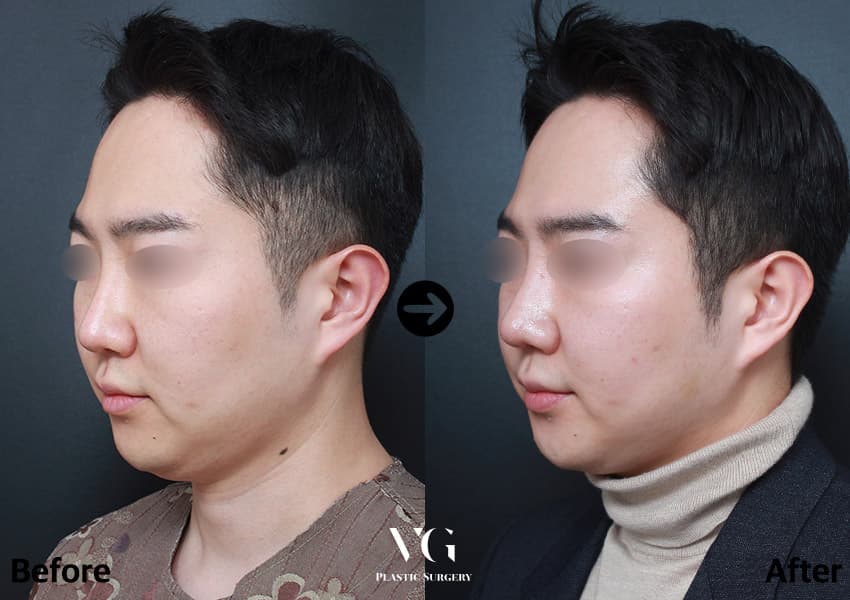
Male Rhinoplasty3 months after surgery
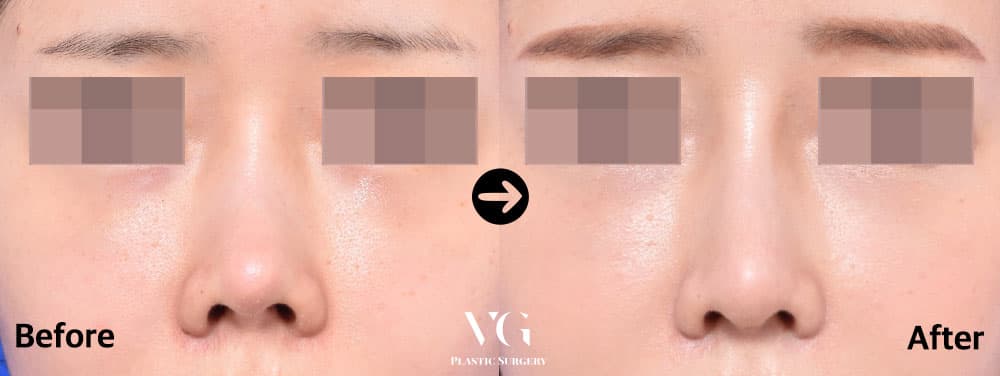
Revision Rhinoplasty3 months after surgery
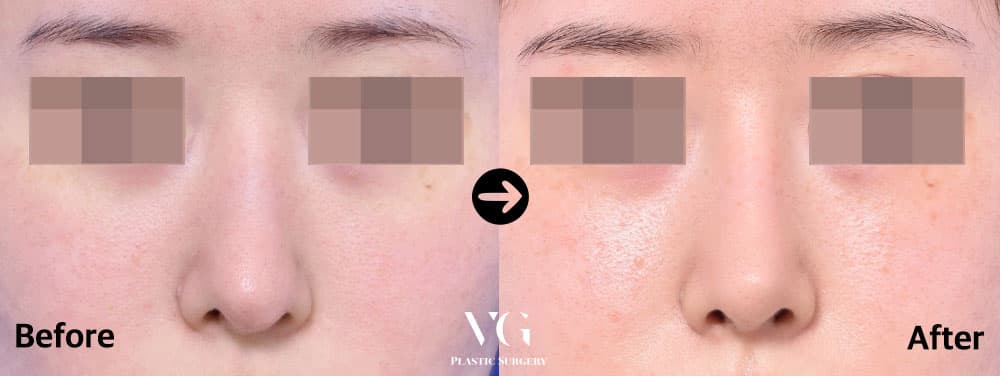
Revision Rhinoplasty3 months after surgery
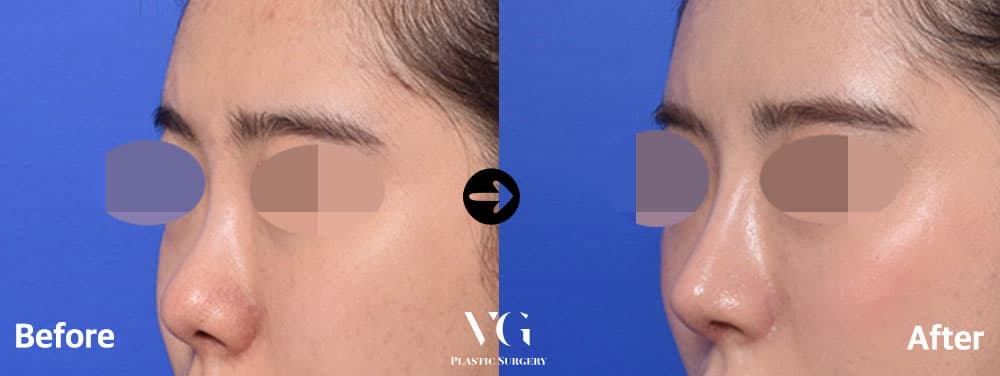
Rhinoplasty3 months after surgery
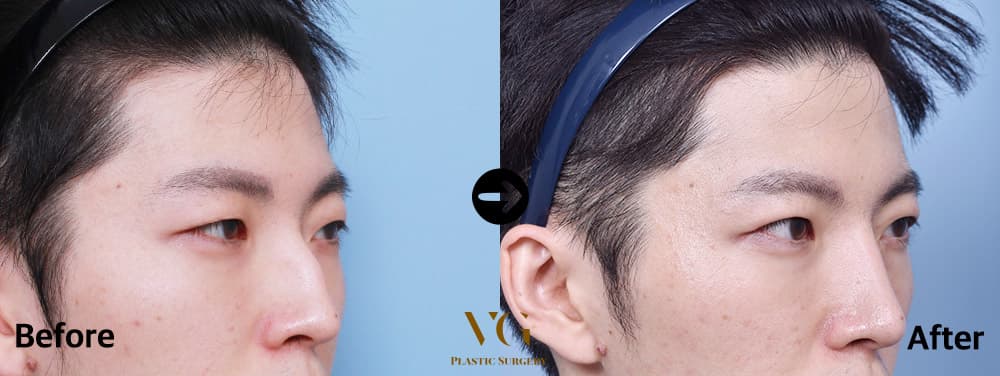
Male Rhinoplasty3 months after surgery
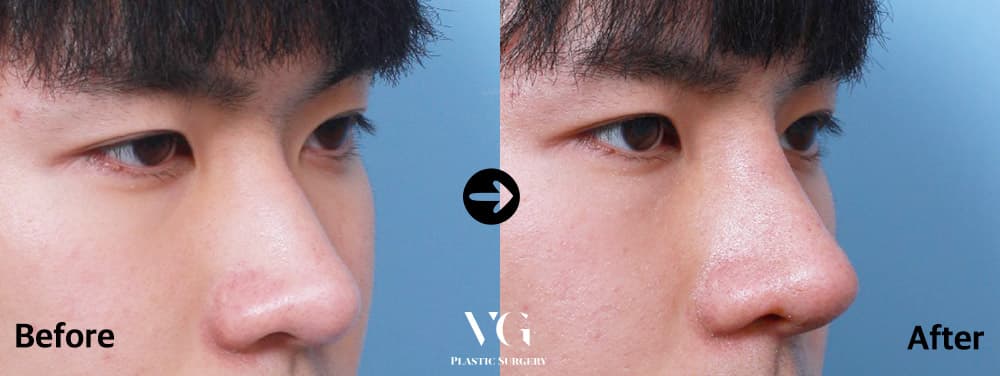
Male Rhinoplasty3 months after surgery
FAQ
Questions patients ask
Can I get a natural korean nose job on a long weekend in Seoul?
A long weekend is too short. Add the consultation before surgery and plan for well over a week.
Will people at home be able to tell I had surgery?
In the first weeks, often yes, because of bruising and swelling rather than shape. The NHS says bruising, swelling and redness may have faded by around three weeks. A nose built in proportion to your face tends to draw less attention once that settles.
Is cartilage or an implant better for a natural look?
Both are used in Asian rhinoplasty, and each has trade-offs. Your own cartilage avoids foreign material but needs a donor site; an implant avoids harvesting but sits under skin that has to cover it. Skin thickness, available cartilage and how much height you want decide which suits you.
Can I fly home with the splint still on?
Ask your surgeon before booking. Most travellers plan the return flight after the splint has been removed in Seoul, so the check happens before the trip home. Long flights also deserve a conversation about blood clot risk.
What should I bring to my doctor at home afterwards?
The CDC advises taking copies of your medical records home. Bring your operation notes, your medication list and the date of splint removal, and tell your GP or a local ENT about the surgery before you travel.
Sources
This article explains general medical information. Whether surgery suits you, and which method, is decided only after a consultation with the surgeon.
Written by
Im Young Min
Chief Director · Plastic Surgery
- Ph.D. in Medicine
- Internship and residency, Seoul St. Mary's Hospital
- Board-certified plastic surgeon, Seoul St. Mary's Hospital
- Adjunct professor of plastic surgery, Seoul St. Mary's Hospital
- Former director, Topface Plastic Surgery
Next step
Send two photos. Get a surgeon’s answer.
Front and side, natural light, no filter. Dr. Im Young Min reviews them and tells you which method fits and how many days to stay in Seoul.
International patients pay the same surgical fee as Korean patients. Pricing policy
Keep reading
Nose
Rhinoplasty Cost in South Korea in Rupees: What Changes It for a Flat Nose or Crooked Septum? Reviews, Methods and Recovery
There's no honest rupee figure for a nose nobody has examined. The cost follows the method, septum work, revision, anesthesia time and days in Seoul; send photos on WhatsApp to ask about yours.
Im Young Min ·
Nose
What Decides the Cost of Rhinoplasty in South Korea? Reviews, Methods and Recovery
There is no single price for a nose job in Korea: the method, the cartilage source, septum work, revision status and anesthesia set the figure for your nose.
Im Young Min ·
Nose
How Much Does a Nose Job Cost in Korea? Four Cost Drivers, Reviews, Methods and Recovery
A nose job in Korea is priced from four parts: the scope of the change, the building material, any breathing work and the anesthesia. Foreigners pay the same surgical fee as Korean patients, with a written estimate.
Im Young Min ·